The 2021 "New Development and New Order" Macroeconomic Forum and Innovation Summit ended successfully.
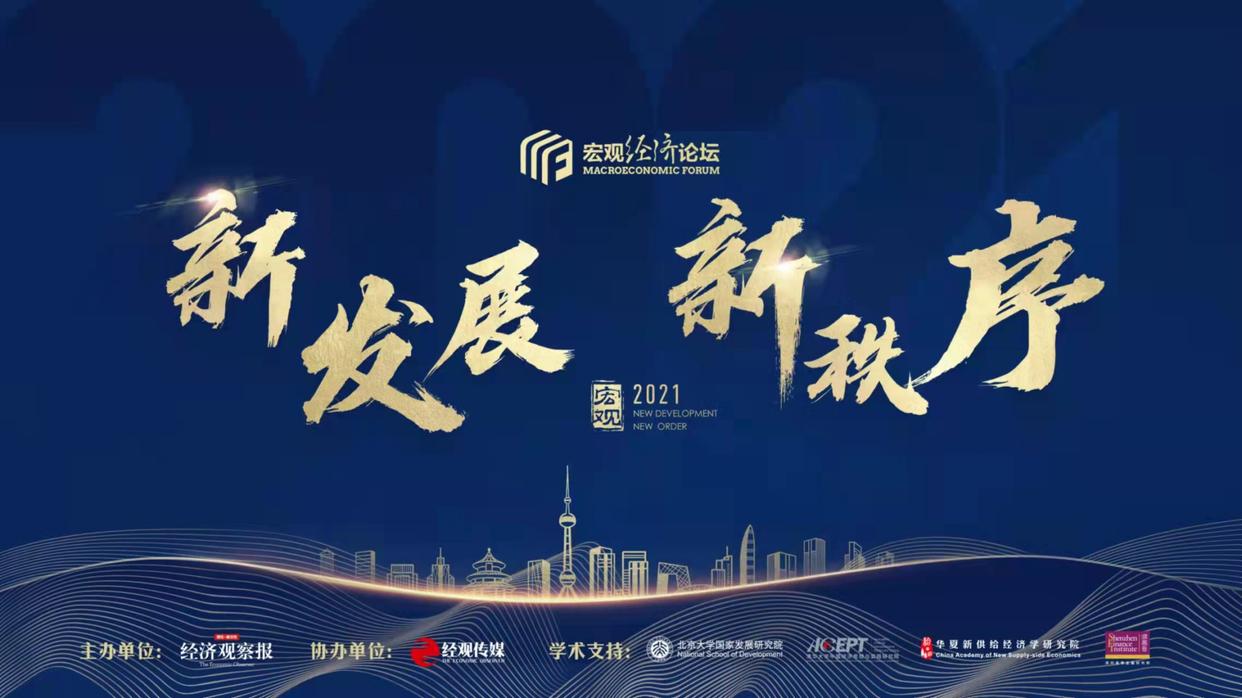
On November 25th, the 2021 Macroeconomic Forum and Innovation Summit jointly organized by Economic Observer and Jingguan Media was launched in the cloud.
Focusing on the theme of "New Development, New Order", the forum invited policy researchers, economists and entrepreneurs to discuss and share, and jointly take the pulse of China’s economic trend and explore a new development path. On the same day, guests attending the 2021 Macroeconomic and Innovation Summit included: Gao Peiyong, vice president of China Academy of Social Sciences and member of the faculty; Chou Baoxing, academician of the International Eurasian Academy of Sciences, former vice minister of the Ministry of Housing and Urban-Rural Development and chairman of the China Urban Science Research Association; Chen Daofu, deputy director of the Financial Research Institute of the State Council Development Research Center; Bi Jiyao, vice president of China Macroeconomic Research Institute; and Yao Yang, president of the National Development Research Institute of Peking University.
This year is the first year of the 14 th Five-Year Plan, and it is facing the goal of the second century. In this context, China’s economy is moving forward steadily, and the road to high-quality development is more solid, which fully reflects the resilience of China’s economy and China’s enterprises. At the same time, the epidemic has not been effectively controlled worldwide, and the world economic recovery still faces many uncertainties.
Under such circumstances, China’s economy is under pressure. How to stabilize China’s economic recovery, keep the economy running in a reasonable range in the face of the future, and continue to promote green and low-carbon in the recovery to achieve high-quality development, which is an important issue that all sectors of society are most concerned about when we are about to bid farewell to 2021.
At the 2021 Macroeconomic Forum and Innovation Summit, experts and scholars gave the answer that innovation is driven by reform and development is driven by innovation, and thought that innovation and reform are the only way to solve the above problems. What people expect is that, while maintaining the necessary growth rate of China’s economy, monetary and fiscal policies will be more effectively coordinated, macro-policies will be more closely integrated with industrial development, and regional development and industrial layout will provide more open development space for enterprises, and finance will truly serve the entity and stimulate the vitality of generate, the main body of innovation.
Sharing five macroeconomic themes
Wen Zhao, executive editor-in-chief of Economic Observer, said in his speech at the forum: "China has set the’ double carbon target’ of carbon neutrality in peak carbon dioxide emissions by 2030 and by 2060, which means the reconstruction of the energy system and a major change in production and lifestyle; For enterprises, this is a clear signal that opportunities are everywhere, and the key lies in whether enterprises have the ability to grasp them. "
As a professional financial media, Economic Observer chooses to hold a macroeconomic forum at the end of each year, hoping to build a platform for communication and exchange, and invite authoritative experts and scholars in the fields of economy, finance and industry to discuss the macro trend together with rationality and constructiveness.
Subsequently, the guests delivered keynote speeches one after another.
Gao Peiyong, vice president of China Academy of Social Sciences and member of the academic department, said in his keynote speech that if macroeconomic policies are to be extended to, integrated with and configured around micro-subjects, they should focus on and be based on market subjects. To promote economic and social development, we must base ourselves on the growth of market players and their development. Only by keeping the main players in the market can we keep jobs, jobs and people’s livelihood, thus keeping the basic disk of China’s economic development. At present, there are more than 150 million market players in China, and the role and position of market players have changed greatly. It is under such a background that macro-policy allocation has the driving force of deep integration with micro-foundation.
Chou Baoxing, an academician of the International Eurasian Academy of Sciences, former deputy minister of the Ministry of Housing and Urban-Rural Development and chairman of the China Urban Science Research Association, believes that the dual-carbon strategy actually needs to be promoted by double innovation, because more than 70% of the technologies and policies used in the future are waiting for all our entrepreneurs to create and innovate, and this is also an opportunity for countless large enterprises, new enterprises and high-efficiency enterprises to emerge; To achieve carbon neutrality in China, new investment will be increased, which will exceed 150 trillion yuan in any case, so 150 trillion yuan is much larger than GDP, which means that it is a second opportunity for wealth distribution. Most of these new wealth will be distributed between cities and new enterprises, because wealth is created and investment is invested by enterprises, which is a very good opportunity for wealth creation and distribution for the second time.
Chen Daofu, deputy director of the Financial Research Institute of the State Council Development Research Center, said that when China is talking about building the country through science and technology and how finance can better promote the development of science and technology, it should first promote the development of science and technology itself, so that the achievements of science and technology can be more quality, more pioneering and have potential production potential. Only on this basis can this part of the results be gradually recognized by the industry and presented in this realistic industry. At this time, finance can build a bridge between technology and industry, so that technology and industry can achieve good connectivity.
Bi Jiyao, vice president of China Macroeconomic Research Institute, gave a keynote speech on "The New Environment Faced by China’s Development during the 14th Five-Year Plan". During the 14th Five-Year Plan, China will enter a new stage of development, and its continued development has many advantages and conditions. The fundamentals of long-term economic improvement have not changed. However, at the same time, the problems of unbalanced development and insufficient development are still outstanding. It still needs hard work to maintain stable economic operation and promote high-quality development. First, pay more attention to expanding domestic demand; The second is to deepen the structural reform of the supply side; The third is to accelerate the improvement of independent innovation ability; The fourth is to develop and expand strategic emerging industries; The fifth is to deepen the structural reform of the financial supply side; The sixth is to expand high-level opening up.
Yao Yang, president of the National Development Research Institute of Peking University, predicted that in the next 10 to 30 years, the best investment destination in the world will still be China, not other countries. We should not be swayed by these short-term economic downturns, but should see the potential of China’s economic growth in the future. The potential growth of China’s economy itself is probably between 5.5% and 6%. If it can grow by 8.5% this year, it should be a very high growth rate. On average for two years, the growth rate is also around 5.5%.
Four thematic round-table dialogues
On the afternoon of November 25th, Guo Hongchao, deputy editor-in-chief of Economic Observer, said in his speech at the summit that 2021 is the first year of the 14th Five-Year Plan, and the impact of the COVID-19 epidemic on the macro-economy is gradually weakening. China is accelerating the construction of a new development pattern, and opportunities and challenges coexist. With the official opening of the Beijing Stock Exchange, it shows the decision-makers’ determination to further improve the multi-level capital market and promote innovation-driven development and economic transformation and upgrading. Listed companies are the cornerstone of the development of the capital market and the pillar force of China’s economy.
The summit set up four forums, namely, round-table dialogues, with four themes, namely, "Finance helps the real economy", "The road to high-quality development of listed companies", "Sustainable development and upgrading" and "Innovation promotes urban upgrading", respectively, to discuss how finance can help the development of the real economy, increase support for the real economy and prevent risks in the financial system. Hot economic topics such as the development of listed companies, promoting the realization of "double carbon" goals, and urban innovation and development.
In the section of "Finance Helps the Real Economy", Professor Wang Jian, vice president of Shenzhen Institute of Advanced Finance and former senior economist of the Federal Reserve, delivered a keynote speech entitled "Financial Opening and Financial Technology Opportunities".
In the subsequent round-table dialogue session on "Finance Helps the Real Economy", chaired by Chen Jingwei, deputy director of the Investment and Financing Research Center of the Institute of Finance of the Academy of Social Sciences of China and executive researcher of the Institute of Finance of China Academy of Social Sciences, Zhang Fei, head of Standard Chartered Venture Capital in Greater China and North Asia, John Zhang, Party Secretary and Vice President of Changan International Trust Co., Ltd., He Beina, President of Shanghai Chunxin Private Equity Fund Management Co., Ltd., Yuan Yuming, CEO of Huolian Technology Co., Ltd., and Li Dazhi, Executive Vice President of Beijing Fuguo Datong Fund Sales Co., Ltd. were invited to discuss how finance can help the development of the real economy, increase support for entities and prevent financial system risks.
At the same time, the parallel forum focused on the topic of "the road to high-quality development of capital market", which was presided over by yu zhang, assistant director and chief macro analyst of Huachuang Securities Research Institute. Join hands with Chen Zhi, deputy general manager and executive director of Yuanchen Technology, Zhou Hongjun, deputy general manager and secretary of the board of directors of Zhendong Pharmaceutical, Li Jia, chief financial officer of Rongchang Bio, Chairman of China-Israel Hyde, Chairman of Dongfang Gaosheng, Chairman of Dongfang Lue, economist, venture capital expert, founder of incremental origin, president of incremental research institute and founder of incremental capital. In-depth discussions were carried out on exploring the road of innovation-driven high-quality development, how listed companies can play a good role in the overall strategy of economic and industrial upgrading, and how environmentally-friendly listed companies can seize development opportunities under the dual-carbon goal. Companies with outstanding performance in the capital market in the past year were honored from two main aspects: scientific and technological innovation and investment value.
Subsequently, the round-table forum with the two themes of "sustainable development and upgrading" and "innovation promoting urban upgrading" was opened at the same time.
Among them, the "Sustainable Development and Upgrading" roundtable forum was hosted by Ge Xing ‘an, vice chairman of the Social Value Investment Alliance and former president of Shenzhen Stock Exchange, the chief consulting officer of Menglang Technology Company. Zhao Junhua, Director of Energy Market and Energy Finance Laboratory of Shenzhen Institute of Advanced Finance, Zhao Yonggang, General Manager of Research and Development Department of CSI Index Co., Ltd., General Manager of ESG Business Department, Zhang Hui, Managing Director of Huaxing Capital, Li Zhenxing, Executive Director of southern fund Equity Investment Department, and Ma Linqing, Managing Partner of Wuniu Holdings, participated in the discussion to discuss issues such as promoting the realization of the goal of "double carbon", promoting green development, seizing the opportunity of carbon neutrality, and sustainable development promoted by ESG investment. In addition, the round-table dialogue on "Innovation Promotes Urban Upgrading" was hosted by Hao Ju, President of Ruixin Consulting and Dean of Ruiguan Research Institute; Liang Ma, a researcher at the National Institute of Development and Strategy of Renmin University of China and a professor at the School of Public Administration; Peng Kong, director of the Research Center for Sustainable Settlements of the School of Architecture of Tsinghua University; and Zhang Qiqi, general manager of 51WORLD Urban and Transportation BG, participated in the round-table discussion, and discussed in depth the driving force of urban future upgrading and development, the boosting force of science and technology and innovation to cities, the content and direction of urban industrial upgrading.
Successfully held the ten-year ceremony of outstanding financial enterprises
After the guests’ wonderful speeches, the 2020-2021 Ten-year Festival of Outstanding Financial Enterprises and the awarding ceremony officially landed.
China’s economy is moving forward steadily, and the road to high-quality development is more solid. As an important part of China’s economy, the financial industry will face brand-new changes and challenges. Financial institutions need to improve their governance structure system to achieve all-round improvement in business scale, operating efficiency and service quality.
The Financial Enterprise Excellence Festival was initiated and hosted by Economic Observer. Since its establishment in 2012, it has been successfully held for the tenth time, and it has become a large-scale financial industry-wide selection activity in China with authority, professionalism, public welfare, innovation and sustainability.
Through the evaluation and investigation of professional institutions, industry experts and data statistics institutions, the evaluation criteria are taken from enterprise services, profitability, innovation ability, risk control ability and social responsibility, so as to excavate more outstanding enterprises and potential financial institutions for China’s financial field and commend institutions and brands that made outstanding contributions to the promotion and development of the industry in that year.
After several months’ evaluation and investigation, this year’s Excellent Financial Enterprise Festival selected institutions and brands that made positive contributions to the development of the financial industry in the fields of banking, insurance, funds, trusts, securities, wealth management, futures, third-party financial institutions, financial leasing and so on in 2020-2021. Through the integrated communication of Economic Observer, the participating enterprises can get more accurate market positioning in the financial market, enhance their corporate image and brand awareness, and promote the steady development of the financial industry.
The 7th Annual Financial Conference in 2021 was announced.
Grasping the new development stage, implementing the new development concept, building a new development pattern and promoting high-quality development-looking forward to a large number of market players in the future in 2021 is one of the unique advantages of China’s economic development, and "activating the vitality of market players" will become the key to China’s economic "14 th Five-Year Plan". At the same time, in the era of scientific and technological change, hard core technology will become an important strategic support to promote the high-quality development of China’s economy and ensure national security. We also expect that, while maintaining the necessary growth rate, all walks of life will also have a broader space for development, and finance will truly serve the entity and stimulate the vitality of generate, the main body of innovation.
At present, China is just like a huge ship sailing in the vast sea of the new era, and the magnificent journey needs the power of navigation.
In this context, the Seventh Annual Financial Conference in 2021 was grandly opened, and the honor of "Pilot Enterprise of the Year" was announced. In the future, these financial institutions in various fields will promote financial development in a healthy and orderly manner and drive economic development.
Pang Lijing/Wen