Where does RDN go to treat hypertension? Professor Guo Yifang: The future can be expected.
Renal artery denervation (RDN) is a hot topic in the field of hypertension in recent years. Although it has not been widely used in clinic, with the release of various clinical data, more and more industries focus on RDN.
RDN targets the sympathetic nervous system, which does play a role in raising blood pressure. Therefore, RDN selectively reverses a mechanism of hypertension. But hypertension is a multifactorial disease. Is it really enough to target a single pathogenic mechanism to produce effective and sustained blood pressure reduction in a large number of hypertensive patients? Yixin specially interviewed the vice president of Hebei Provincial People’s Hospital.Professor Guo Yifang, shared his views on the future prospects of RDN.
One more proof of RDN’s long-term effect
Recently, the three-year research results of RADIANCE-HTN SOLO test were published, which confirmed that the safety and effectiveness of ultrasonic RDN lasted for 36 months.
Patients with ambulatory blood pressure ≥135/85 mmHg and < 170/105 mmHg after 4 weeks of stopping antihypertensive drugs were randomly divided into ultrasound RDN group or sham operation group. The results of 36-month follow-up showed that the systolic blood pressure and diastolic blood pressure in RDN group decreased by 17.7 mmHg and 11.3 mmHg respectively compared with baseline. In terms of safety, there were no adverse events related to equipment or operation during the follow-up period.
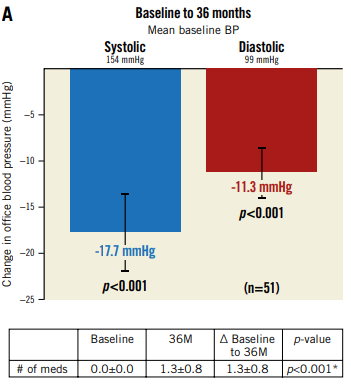
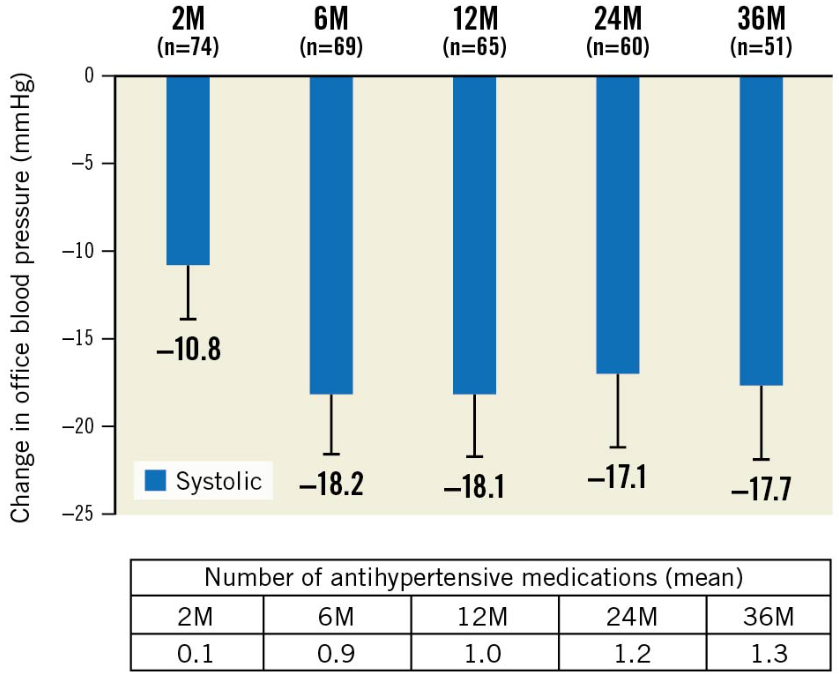
In response to this research result, Professor Guo Yifang pointed out that in recent years, the effectiveness and safety of RDN has been an important topic in the field of hypertension treatment, which has attracted extensive attention from scholars at home and abroad.Radiation-HTN solo research provides valuable new evidence for the instrument treatment of hypertension. However, Professor Guo is cautiously optimistic about the results of this study, considering the differences in the conclusions of several RDN studies published in recent years and the limitations of this study itself..
The evidence-based road of RDN
The basic principle of RDN is to block the afferent and efferent activities of sympathetic nerve around renal artery by radio frequency energy, ultrasonic energy or injecting heat into perivascular space, and reduce the influence of sympathetic nervous system on renal vascular resistance, renin release and sodium reabsorption. RDN blocks the signal conduction between the brain and sympathetic nerve to a certain extent, thus reducing the sympathetic nerve excitability of patients with hypertension. Theoretically, it can achieve long-term antihypertensive effect through a minimally invasive operation.
As early as 2009 and 2010, RDN completed two early clinical trials in Europe and Australia, namely Symplicity HTN-1 and HTN-2. The results of 3-year follow-up showed that the average systolic blood pressure and diastolic blood pressure of refractory hypertensive patients receiving RDN decreased by about 30 mmHg and 14 mmHg respectively, and there were no obvious adverse reactions and complications. More importantly, after three years of follow-up, these patients found no obvious signs of blood pressure rebound.
Because this is the first minimally invasive surgical technique that has been proved in history and can definitely lower patients’ blood pressure, RDN shines brilliantly after the above exploratory experiment, but the well-known sham-operated control experiment-Symplicity HTN-3 did not get positive results, which weakened people’s enthusiasm for RDN: although the research proved its safety, it did not significantly lower blood pressure compared with the control group.
On the basis of summarizing the research experience and lessons of SYMPLICITY HTN-3, the researchers subsequently carried out a new generation of randomized controlled trials, such as SPYRAL HTN-OFF MED, SPYRAL HTN-ON MED, SPYRAL HTN-OFF, etc. These studies used different techniques and methods to ablate the renal artery sympathetic nerve. The results showed that the ambulatory blood pressure and clinic blood pressure in RDN group decreased clinically regardless of whether antihypertensive drugs were used or not.
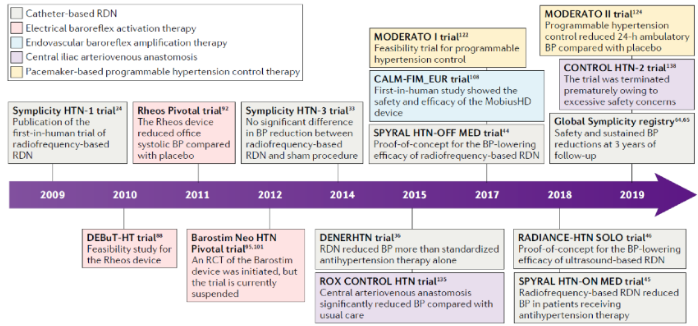
Clinical research course of RDN
(Source: Nat Rev Cardiol. 2020 Oct; 17(10):614-628. )
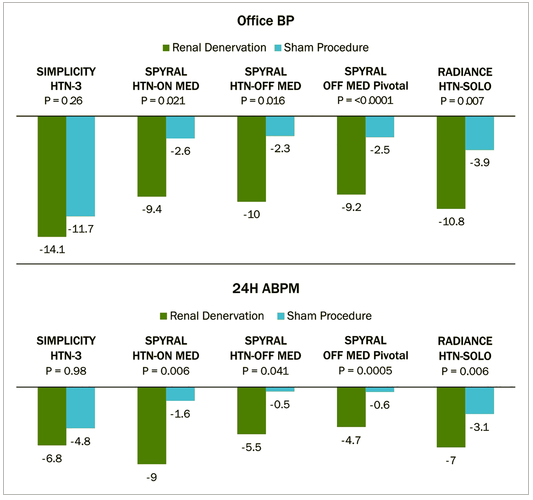
In different studies, compared with sham operation group, systolic blood pressure in RDN group decreased.
The REQUIRE study aims to evaluate the effectiveness and safety of ultrasound renal artery ablation system in controlling blood pressure in patients with refractory hypertension. 143 patients with refractory hypertension (office blood pressure ≥150/90 mmHg and 24-hour SBP≥140 mmHg) were randomly assigned to RDN or sham operation group. Three months after operation, there was no significant difference in the 24-hour ambulatory systolic blood pressure between the RDN group (-6.6 mmHg) and the sham operation group (-6.5 mmHg) (P=0.971). The difference of SBP between family self-measured blood pressure and clinic blood pressure was -1.8 mmHg(P=0.488) and -2.0 mmHg(P=0.511) respectively, and there was no difference. There was no significant difference in drug load between the two groups. No major adverse events related to the operation were found.
At the EuroPCR annual meeting in 2022, a number of research data of RDN were published: Global Symplicity Registry, SPYRAL HTN-ON MED, Radiation HTN Solo & Trio, which further confirmed the potential of RDN as an adjuvant therapy for hypertension, supplemented the existing first-line therapy, and thus changed the lifestyle and drug treatment.
Professor Guo Yifang: RDN can be expected in the future
The occurrence of hypertension is a complex process, involving many mechanisms, and it is not expected to solve all patients’ problems through one drug or technology. RDN only blocks renal sympathetic innervation, and may have no therapeutic effect on other mechanisms that cause and maintain hypertension. Moreover, the antihypertensive effect of RDN is moderate, which is only equivalent to taking an antihypertensive drug.
Professor Guo Yifang talked about the future prospect of RDN. He pointed out that RDN is still in the stage of research and exploration, and it can not be used as a mature treatment technology in clinical practice. From the pathophysiological mechanism, the sympathetic nervous system plays an important role in the occurrence and maintenance of hypertension, so in theory, RDN will definitely have an ideal effect on some hypertensive patients. butThe pathophysiological mechanism of hypertension in different patients is inconsistent, the renal artery structure in different patients is obviously inconsistent, the principle of different types of RDN technology and equipment is inconsistent, and the experience and technical level of different operators are inconsistent. These four "inconsistencies" will inevitably affect the effectiveness and safety of RDN treatment and its application value and clinical status in antihypertensive treatment..
On the whole,For patients whose blood pressure can’t be satisfactorily controlled after lifestyle intervention and adequate treatment with various antihypertensive drugs, patients with obvious sympathetic hyperactivity, or patients who can’t tolerate antihypertensive drugs, it is reasonable to carry out RDN treatment in mature medical centers.. It is believed that RDN will play a more important role in the field of hypertension treatment in the future with the progress of related technologies and the continuous improvement of treatment equipment.
Expert introduction

Guo yifang
People’s Hospital of Hebei Province
Chief physician/professor, doctoral tutor, currently vice president of Hebei Provincial People’s Hospital. He is also the vice chairman of the Hypertension Committee of Chinese Medical Doctor Association, the vice chairman of China Society Hypertension Branch, the executive director of China Hypertension Alliance, the chairman of the Geriatrics Branch of Hebei Medical Association, the chairman of the Hypertension Professional Physician Branch of Hebei Medical Association, and the chairman of the Medical Engineering Branch of Hebei Medical Association. And the editorial boards of Chinese Journal of Internal Medicine, Chinese Journal of Geriatrics, chinese journal of cardiology and Chinese Journal of General Practitioners, and the standing editorial boards of Chinese Journal of Hypertension and chinese journal of cardiovascular medicine. Enjoy the special allowance of the State Council.
references
1. David E. Kandzari, Raymond R. Townsend, George Bakris, et al. Renal denervation in hypertension patients: Proceedings from an expert consensus roundtable cosponsored by SCAI and NKF. Catheter Cardiovasc Interv. 03 August 2021.
2 "China cardiovascular medical device industry innovation white paper 2021"
3. Nat Rev Cardiol. 2020 Oct; 17(10):614-628.
4. C. Venkata S. Ram. Renal Denervation Therapy for Hypertension: All That Glitters Is Not Gold. Medscape. https://www.medscape.com/viewarticle/976670_1
5. Ultrasound renal denervation meets primary efficacy endpoint in RADIANCE II study. Cardiovascularnews. 26th July 2022.
6. Florian Rader, Ajay J. Kirtane, Yale Wang, et al. Durability of blood pressure reduction after ultrasound renal denervation: three-year follow-up of the treatment arm of the randomised RADIANCE-HTN SOLO trial. DOI: 10.4244/EIJ-D-22-00305
Typesetting: Yixin Editorial Department