[Circumferential depth] "De-Americanization era", the Middle East ushered in "reconciliation season"
[Global Times correspondent in Syria and Egypt Xue Dan Huang Peizhao] After Saudi Arabia and Iran signed a joint statement in Beijing on March 10, agreeing to resume diplomatic relations, good news came from the reconciliation between the two countries — — According to a report by the Saudi National News Agency on March 27th, Foreign Minister Shai agreed to hold a bilateral meeting during Ramadan to speed up the resumption of diplomatic work between the two countries. The warming of relations between Saudi Arabia and Iran is only part of the "reconciliation season" in the Middle East. Recently, high-level visits have entered a frequent period between Arab countries or between Iran, Turkey and Arab countries, and relations between countries have improved significantly. For more than a century, the Middle East has been one of the most turbulent regions in the world, with constant conflicts among countries and within countries. What has laid the foundation for the turmoil in the Middle East? What makes the parties to the long-term conflict now extend an olive branch to each other? How will this affect the world?
"breaking ice" and "thawing" become key words
"Breaking the ice" and "thawing" have become the key words of recent diplomatic activities in Middle East countries. On March 19th, nine days after Saudi Arabia and Iran announced that they had agreed to resume diplomatic relations, the Iranian President’s Office said that President Leahy had received and accepted the invitation of Saudi King Salman to visit. The warming of relations between Iran and Saudi Arabia has also led to the thawing of relations between Tehran and other Arab countries. According to AFP and other media reports, on March 16th, Shamkhani, secretary of the Supreme National Security Council of Iran, held talks with UAE President Mohammad in Abu Dhabi. On March 13th, Iran expressed its hope to resume relations with Bahrain, so as to end the seven-year relationship breakdown. Tehran also hopes that the "thawing tide" can be extended to Egypt, Jordan and other countries. According to the American Grid News Network, Saudi Arabia and Iran are considered to be a pair of old enemies in the Middle East, and the religious and political contradictions between the two countries are very complicated. In 2016, Saudi Arabia executed a Shiite cleric, and in Tehran, the Iranian capital dominated by Shiite Muslims, protesters attacked the Saudi embassy, and then the two countries broke off diplomatic relations. Arab countries such as the United Arab Emirates, Bahrain and Kuwait immediately cut off or downgraded their diplomatic relations with Iran.
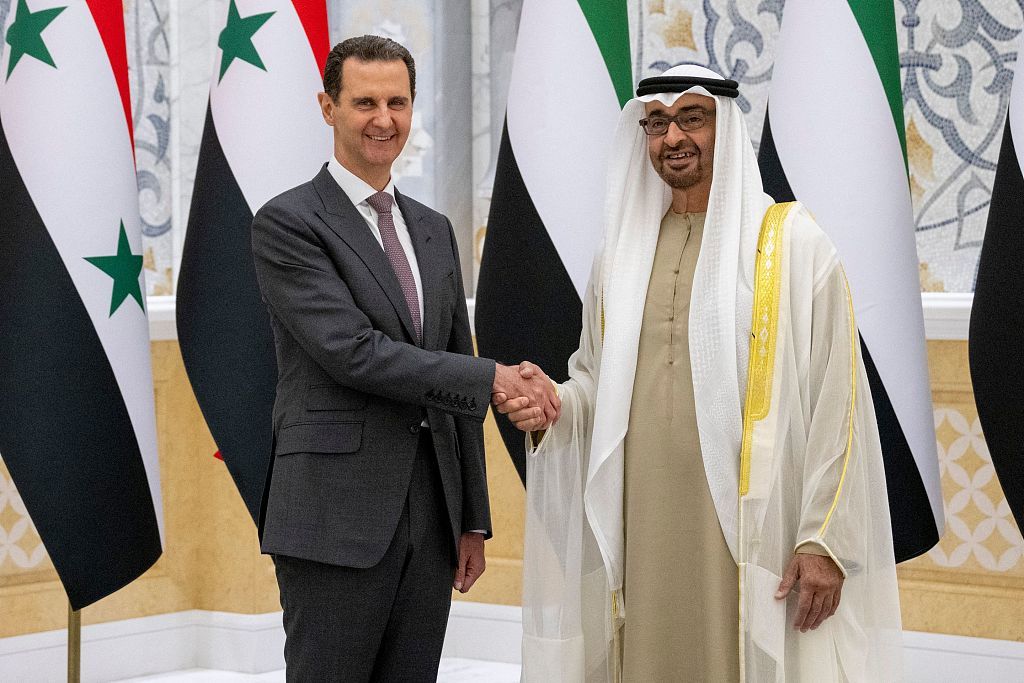
With the breaking of the relationship between Saudi Arabia and Iraq, the reconciliation between Arab countries is also accelerating. Also on March 19th, Syrian President Bashar al-Assad visited the United Arab Emirates, and the Afghan military sent fighter jets to escort him. President Muhammad personally greeted Bashar at the airport, and then the two men discussed issues such as "brotherhood" and "strengthening cooperation" between Syria and Syria. After the outbreak of the Syrian civil war in 2011, the League of Arab States suspended Syria’s membership and publicly supported Syrian opposition forces. Regarding Bashar’s visit, Mohammed said that Syria has been away from the Arab family for a long time, and "it is time to go home now". In addition to the UAE, Saudi Arabia is also holding talks with Syria to explore the restoration of consular relations. Reuters previously said that Saudi Arabia and Syria may reopen their embassies in late April. Jordan’s Deputy Prime Minister and Minister of Foreign Affairs and Overseas Chinese Affairs Assafadi and UN Secretary-General’s Special Envoy for Syria Peterson also discussed the initiative to solve the Syrian crisis through direct intergovernmental dialogue.
The relationship between Israel and Arab countries is also constantly breaking the ice. According to the US "Wall Street Journal" report, Oman abolished a decades-long ban in February this year, clearing the way for Israeli planes to fly over Afghanistan’s airspace. This move shows that the relationship between Israel and the Arab countries that have long refused to openly accept this Jewish state has been further thawed. Earlier, Israel had normalized relations with several Arab countries, including Bahrain, the United Arab Emirates and Morocco.
"Reconciliation season is coming in the Middle East". According to the Gulf Times of the United Arab Emirates, there have been many encouraging reconciliation phenomena in the Middle East recently, including cavusoglu’s visit to Egypt on March 18th, becoming the first Turkish foreign minister to visit Egypt in 10 years. Even Palestine and Israel are negotiating to curb violence at least during Ramadan. The two sides recently held a meeting in Sharm el-Sheikh, Egypt, and agreed on a plan to stop the escalation of violence. The atmosphere of reconciliation between countries also has an impact on both sides of the conflict in some countries. After 10 days of negotiations in Geneva, Switzerland, the Yemeni government and Houthi armed forces recently reached an agreement on prisoner exchange, agreeing to release 887 detainees. The parties to the conflict in Sudan also realized the value of reconciliation and agreed to promote peace through the political process.
In fact, this round of "reconciliation tide" in the Middle East can be traced back to the second half of 2020 at the earliest. The British "Middle East Eye" news network said that at that time, the UAE and Iran began to contact, and Saudi Arabia contacted Qatar in early 2021. Subsequently, intensive diplomatic contacts were launched between Egypt and Qatar and other Arab countries, and between Turkey, Israel and Iran and Arab countries. For example, the Israeli president visited Turkey in March 2022, which was the first time that an Israeli president visited Ankara in 15 years.
Divide and rule in western countries is the source of unrest.
For a long time, the Middle East has been one of the most turbulent regions in the world. According to Qatar Al Jazeera, in the past half century, there have been more wars in this region than in any other region. After the end of the cold war, violent conflicts in many parts of the world have subsided, but the Middle East is the opposite. Since the 21st century, the armed conflicts in this region have accounted for one third of the total armed conflicts in the world. However, the "Middle East Forum", an American think tank, has previously issued a document pointing out that in the four centuries before the First World War, the Middle East was relatively stable. Wang Guang, a professor at Shanghai International Studies University and executive director of the China-Arab Reform and Development Research Center, said in an interview with the Global Times reporter that in history, Arabs have lived in the same country for a long time. Although their relationship is complicated, they have many integrations and close contacts.
So, what makes the Middle East so "flammable and explosive"? Wang Guangda said that the long-term turmoil in the region has both internal and external causes, and the politicization of religious issues is one of them. From the religious point of view, there are two pairs of contradictions in the Middle East countries. First, the contradiction between Islamic countries and Israel is the main contradiction in the Middle East countries, which has continued since the founding of Israel. Secondly, the contradiction between Islamic countries is mainly reflected in the struggle between Sunni countries represented by Saudi Arabia and Shiite camps represented by Iran for the leadership of the Islamic world. This contradiction has been continuously fermented since the Islamic Revolution in Iran in 1979 and intensified in the 21st century. An important reason for the long-term disharmony between Middle East countries is that religious issues have been used by extraterritorial forces and become a tool for the West to provoke relations between Middle East countries.
"The Sykes-Pico Agreement of 1916 opened a century of Middle East history." According to the UAE newspaper El Pais, the traditional view is that this secret agreement between Britain and France to carve up the Asian part of the Ottoman Empire is the source of chaos in the Middle East. Professor Logan of Oxford University said that Britain, France and other western countries forcibly demarcated national borders in the Middle East and used them to divide and rule these countries, laying a hidden danger for future conflicts. If the Balfour Declaration written by the British Foreign Secretary in 1917 led to the continuous Arab-Israeli conflict, then France’s attempt to establish a Christian nation-state in Lebanon not only led to the partial disintegration of the country, but also led to the conflict between Lebanon and Syria. The root cause of the border conflict between Iraq and Kuwait is also territorial dispute.
After the Suez Canal crisis in 1956, the United States replaced Britain and France as the main "player" in the Middle East, and Washington’s Middle East policy also had a long-term impact on the pattern of the region. Wang said that the Middle East is one of the cradles of the Cold War, and it is also a place where the United States and the Soviet Union compete for hegemony. Countries in the region choose to take sides and join different camps. After the end of the Cold War, the United States dominated the Middle East, forcibly promoted regime change and the so-called "democratic" export, and plunged the Middle East into perennial war by waging war and instigating the "Arab Spring", bringing deep suffering to the local people.
With the change of security concept, countries are more pragmatic and open.
"(Middle East ‘ Reconciliation tide ’ ) is determined by the changes in the broader international situation. "Al Jazeera and other media all mentioned the United States when analyzing the accelerated reconciliation of Middle East countries. The United States continues to shift its strategic focus to the Asia-Pacific region, gradually changing its strategic focus in the Middle East and giving up its traditional commitment to Arab allies. This has led American Middle Eastern allies to gradually realize that Washington cannot be trusted, so they began to make efforts to diversify their security and military partners and implement more hedging strategies. Both Saudi Arabia and Iran want to join the BRICS cooperation mechanism, and Iran is already an observer of the SCO. Gary Peng, a scholar at American Wesleyan College, believes that, to a large extent, the Middle East has entered the "de-Americanization era", which is characterized by more pragmatic and open governments and mixed alliances among countries, and they do this in order to win more room for manoeuvre for themselves.
Wang Guangda said that the United States, which is keen on camp confrontation, has gradually implemented strategic contraction in the Middle East, while China, which upholds the concept of peaceful development and win-win cooperation, has increasingly close ties with countries in the Middle East, and the "One Belt, One Road" initiative is also well received by these countries. In the "tide of reconciliation" in the Middle East, China played a role of boosting and mediating.
Ezzat, executive director of the Egyptian Foreign Affairs Committee, said in an interview with the Global Times that the people in the Middle East have suffered from war for a long time and have long longed for peace. With the changes in the international situation and the promotion of all parties, Middle Eastern countries have begun to realize that peace is the best choice, which provides important conditions and impetus for reconciliation. Li Xueyan, from the Middle East Institute of Shanghai International Studies University, said that from the perspective of the region, "seeking peace and development" has become the mainstream aspiration of countries in the Middle East in recent years, and it has also enhanced the willingness of countries to resolve conflicts. In addition, regional countries also hope to expand their influence in the construction of a new Middle East order, which needs to be shaped by soft power rather than war. In particular, it should be pointed out that the urgent task for most countries in the Middle East, represented by Saudi Arabia, is to speed up development and change the single economic development model that relies on oil. Therefore, their focus is no longer on geopolitical games, but on creating a better surrounding environment, improving regional relations and creating conditions for domestic development.
The British "Middle East Eye" news network and other media said that the outbreak of the COVID-19 epidemic and the losses caused by it also made Middle East countries more pragmatic and began to give priority to interest-based agendas such as trade rather than ideological agendas. This is particularly evident in the reconciliation process between Egypt and Qatar, the United Arab Emirates and Turkey. The conflict between Russia and Ukraine makes the location advantage and the importance of oil and gas resources in the eastern Mediterranean more prominent, thus creating a positive atmosphere for Turkey, Israel and Egypt to reach a consensus. In addition, the earthquakes in Turkey and Syria on February 6th created space for the "disaster relief diplomacy" of Middle East countries. Some analysts said that the Trump administration played an important role in promoting reconciliation between Israel and Arab countries.
The United States and the West will not let go easily.
What impact will this "reconciliation tide" in the Middle East countries have on the region and the world? First of all, Saudi Arabia and Iran have played an important role in shaping the political structure in the Middle East, and the improvement of relations between the two countries may further ease the internal conflicts in other Middle East countries. According to media analysis such as CNN, Yemen’s civil war broke out in 2014, and Shay supported the opposing factions in Yemen’s civil war. Reconciliation between the two countries will promote a ceasefire between the two sides of the Yemen conflict and form an inclusive national government. A similar situation may also be staged in Lebanon and Syria. Analysts say that it is also in Iraq’s interest for Shai to achieve reconciliation, because since the fall of Saddam Hussein’s regime in 2003, Iraq has become an arena for confrontation between Tehran and Riyadh.
Wang Guang said that the acceleration of reconciliation among Middle Eastern countries will enhance their influence in international organizations and increase their weight in the multipolar world structure. If the countries in the Middle East put more energy into seeking reform and development, the people in the Middle East will actually benefit. If the countries in the Middle East break the barriers and become one, they will create a strategic economic zone with rich resources and important geostrategic value, and an integrated Middle East market may appear in the future. The long-term turmoil in the Middle East has seriously affected world peace and development. If the region stabilizes, it will be an important contribution to promoting world peace. All countries will benefit from the stability of the Middle East, a region of great geopolitical and geo-economic significance.
However, The New York Times, Britain’s "Middle East Eye" news network and other media believe that the sustainability of reconciliation among countries in the Middle East and the resilience of the process of normalization of relations remain to be seen. The international and regional situations that promote the accelerated reconciliation of countries in the region are prone to change, and there are also uncertainties within countries, so how far reconciliation can go is still unknown. Wang Guangda reminded that it will take time for Middle East countries to form consensus and join forces. For the Middle East, a region with special geostrategic value, the United States and the West will not let go easily, but will probably try to undermine the process of regional reconciliation.
While countries in the Middle East were carrying out shuttle diplomacy, the US military said that it had carried out air strikes against Iranian-backed militants in eastern Syria on the evening of March 23rd. In the afternoon, a drone suspected to be launched by pro-Iranian militants attacked a local US military facility, causing casualties among US contractors and soldiers. Jalillund, a professor of international relations at Tehran University, said that some regional and international forces do not want security and peace in the Middle East. They are trying their best to create problems between Iran and Arab countries and prevent Syria from returning to the embrace of the Arab world.