The public online shopping for 6 pure camellia oils found that they were all "adulterated"
Straight News
Deep and fierce investigation
Text/photo reporter Song Wangqun
Camellia oil, also known as camellia seed oil, is commonly called "Yuezi oil" by citizens. With the implementation of the "two-child" policy, camellia oil is becoming more and more popular. However, the reporter’s investigation found that the quality of camellia oil currently on sale in the market is mixed, and even some brands still have "adulteration" behavior. A citizen of Shenzhen recently bought six pure camellia oils and sent them to Shenzhen Institute of Metrology and Quality Inspection for inspection. The inspection results showed that none of the six pure camellia oils met the national standards. The person in charge of Shenzhen Consumers Association said that related products are suspected of false propaganda, and consumers can ask for ten times compensation.
Customer complaint: online shopping for camellia oil actually detected "adulteration"
Mr. Zheng is in charge of purchasing in a company in Shenzhen. "The Spring Festival is approaching. According to the company’s arrangement, he bought a batch of camellia oil through the Tmall flagship store of six brands of camellia oil and gave it to the company’s customers." Mr. Zheng said, "The six brands of camellia oil are all 5L specifications, and the price ranges from more than 200 yuan to more than 600 yuan per bottle. The sellers all claim that their products are pure camellia oil, and the quality grade is the first grade. You can buy them without adding any other edible oil ingredients."
"But some familiar customers told me that the camellia oil received was not pure enough and had no natural fragrance of camellia oil." Mr. Zheng said, "The camellia oil I purchased is purchased through Tmall flagship store, unless there is something wrong with the product itself." In order to find out, Mr. Zheng sent one of the camellia oils to a testing institution for testing.
"The test results surprised us. Other vegetable oils were detected, which did not meet the national standards. It was not pure camellia oil. Isn’t this adulteration?" Mr. Zheng said.
Recently, the reporter checked the Taobao Tmall purchase records and invoices of Mr. Zheng’s purchase of camellia oil, as well as the unopened camellia oil products. In the column of quality grade, all six products are marked as "first class", "international first class" or "squeezing first class", the product standard number is "GB11765", and the ingredients are "camellia seed oil".
According to the national standard GB11765 issued by the General Administration of Quality Supervision, Inspection and Quarantine, all products marked with "Camellia oleifera seed oil" should meet the standard, which requires that "Camellia oleifera seed oil should not be mixed with other edible oils and non-edible oils, and should not be added with any flavors and fragrances".
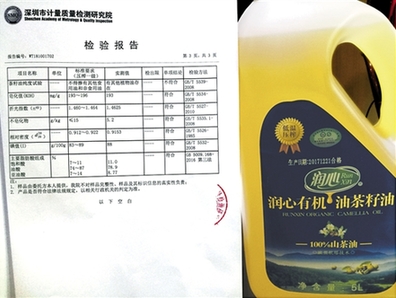
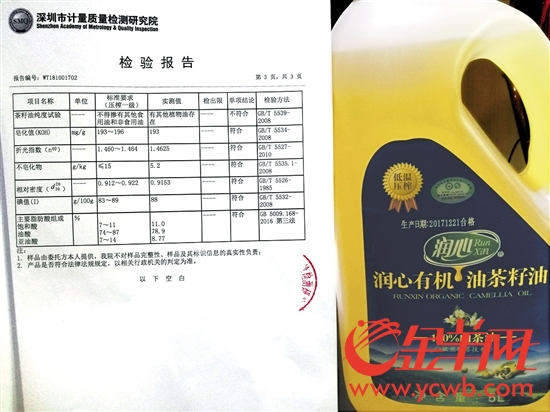
On the afternoon of January 8, the reporter accompanied Mr. Zheng to send six kinds of camellia oil to Longhua experimental base of Shenzhen Institute of Metrology and Quality Inspection for inspection. On January 17th, the inspection report was released. The inspection report showed that none of the "Rapeseed Oil Purity Test" of six brands of camellia oil met the requirements of the first-class standard for crushing, and other vegetable oils existed in the measured values (see the above figure). In addition, two of the camellia oils are not up to standard in terms of refractive index, iodine value, oleic acid and linoleic acid.
Insiders: The cost per catty is about 80 yuan.
On January 22 nd and 23 rd, the reporter called six camellia oil manufacturers to verify the situation. Among them, the service calls of three manufacturers were not answered. The manufacturer of Jinx responded that all the products submitted by the company were up to standard, and said that the same batch of products submitted by Mr. Zheng had been sampled for inspection. A person in charge of X township factory who claimed to be Vice President Zhou said that the report submitted by consumers for inspection has no legal effect. The manufacturer of Green X responded to the reporter that the company sent tea oil for inspection many times, all of which met the national standards.
Zhang Gong, who has been engaged in the camellia oil industry for more than ten years, said that at present, the price of purchasing a kilo of camellia oil by the people is generally around 80 yuan, and the weight of a 5L bottle of camellia oil is 9-10 kilos. The most expensive camellia oil purchased by Mr. Zheng is more than 600 yuan, and the average price is only more than 60 yuan a kilo, which is far lower than the private purchase price.
Zhang Gong said that if the mixed ingredients are controlled within 10%, it is basically difficult to detect. If even the indexes such as refractive index, iodine value, oleic acid and linoleic acid are not up to standard, it can only show that more other edible oil ingredients are mixed.
Shenzhen Consumers Association: Related manufacturers are suspected of false propaganda.
On January 23rd, the reporter reported the situation to Shenzhen Municipal Market Supervision Administration and Shenzhen Consumers Association. According to the Shenzhen Municipal Market Supervision Administration, since it is an online shopping product, consumers should report it to the industrial and commercial administration department where the product trademark is located.
The Shenzhen Consumers Association said, "The product is advertised as 100% pure tea oil, but the result of the consumer’s inspection is that it is mixed with other edible oil, which is suspected of false propaganda. According to the rule of’ one fake and ten penalties’, consumers can ask for 10 times compensation, and the market supervision department will investigate it." The staff of Shenzhen Consumers Association said that the laws and regulations on online shopping supervision are still not perfect, and it is difficult for consumers to protect their rights. At present, Mr. Zheng can only complain to the industrial and commercial departments where the trademarks of the purchased products are located.