Improve the unified, standardized and fair judicial expertise system.

  [Introduction to the author]Professor of China University of Political Science and Law, doctoral supervisor, mainly engaged in criminal procedure law research; Associate Professor, Doctor of Law, China University of Political Science and Law.

  [article source]China Judicial Appraisal, No.3, 2015

  [executive summary]Deepening the reform of judicial expertise system is an important content of comprehensively promoting the rule of law and deepening the reform of judicial system. However, at present, the management of the judicial expertise system still restricts the further development of the unified management system of judicial expertise, such as the business scope of the appraisal institutions in the investigation organs and the roster management of the judicial organs. In terms of the implementation procedure of judicial expertise, the problems related to the entrustment and acceptance of judicial expertise, the technical standards and specifications adopted, and the expert responsibility system are still outstanding; In the aspect of litigation procedure, the problems related to the initiation, cross-examination and re-appraisal of judicial expertise have not been well solved. This means that there is still a big obstacle to the development of the unified, standardized and fair judicial expertise system in China, and it is necessary to further improve the unified judicial expertise management system, the standardized judicial expertise implementation procedures and the fair judicial expertise litigation procedures.

  [Keywords:]Judicial expertise, expertise management, expertise implementation procedures, expertise litigation procedures

  Judicial expertise is not only an important part of the judicial system, but also a judicial guarantee system. Judicial expertise serves litigation activities and provides scientific and technical guarantee for fair justice. Its perfection is directly related to the realization of judicial justice, so it has always been the focus of judicial reform. The Decision of the Central Committee of the Communist Party of China on Comprehensively Deepening the Reform and the Decision of the Central Committee of the Communist Party of China on Comprehensively Promoting the Rule of Law adopted by the Third Plenary Session and the Fourth Plenary Session of the 18th CPC Central Committee require deepening the reform of the judicial system, improving the unified judicial expertise management system, speeding up the construction of a fair, efficient and authoritative socialist judicial system, and making the people feel fair and just in every judicial case. Based on the main problems encountered in the reform of judicial expertise system in recent years, this paper puts forward some ideas to improve the judicial expertise system under the background of comprehensively promoting the rule of law. In view of the fact that the reform of judicial expertise system needs the overall promotion and coordination of litigation system, evidence system and administrative management system, this paper discusses it from three aspects: unified management of judicial expertise, implementation procedure of judicial expertise and litigation procedure of judicial expertise.

  A sound and unified management system of judicial expertise

  There have been two major drawbacks in the management of judicial expertise in China: first, the establishment of judicial expertise institutions is chaotic; Second, the practice management of judicial authentication institutions is decentralized, which leads to repeated authentication and multiple authentication. Faced with many appraisal opinions with different conclusions, the public security and judicial organs generally tend to trust and adopt the appraisal opinions issued by the appraisal institutions within their own organs, which leads to the problems of "self-investigation and self-examination, self-inspection and self-examination", and the neutrality of the appraisal institutions or appraisers is questioned. In order to solve these problems, the Ministry of Justice has successively issued a series of ministerial regulations or normative documents, including the Measures for the Administration of Registration of Judicial Appraisal Institutions, the Measures for the Administration of Judicial Appraisers, the Provisions on the Classification of Judicial Appraisal Practices (Provisional) and the Provisions on the Administration of Judicial Appraisal Licenses. In 2002, the Supreme People’s Court also issued the Interim Measures for Judicial Expertise of People’s Courts and the Administrative Measures for Entrusting and Organizing Judicial Expertise of People’s Courts, which made corresponding provisions on the management of judicial expertise institutions and personnel of people’s courts. Although these reform measures have improved the management order of judicial expertise, on the whole, they have little effect.

  In order to solve the outstanding problems in the practice of judicial expertise, such as unified management, socialization of appraisal institutions and neutrality of appraisers, on February 28th, 2005, the National People’s Congress Standing Committee (NPCSC) adopted the Decision on the Management of Judicial Expertise (hereinafter referred to as the Decision), which became an important legal basis for the management of judicial expertise. The "Decision" first focuses on solving the problem of the independence of the appraisal institutions, excluding the situation that the investigation organs are entrusted by the society to engage in appraisal services and the people’s courts and judicial administrative departments set up appraisal institutions themselves, and puts the appraisal institutions in a more neutral position that is not attached to any judicial organs or administrative organs. More importantly, the "Decision" establishes a unified management system of judicial expertise: the judicial administrative department has the right to conduct examination and registration management of social expertise institutions applied for by legal persons or other organizations, and to conduct filing and registration management of appraisal institutions of investigation organs. It can be said that the "Decision" is mainly devoted to the unified management of judicial expertise, that is, the judicial administrative organs should achieve the unification of registration, qualification, training, appraisal standards, fees and penalties for violations, and so on. However, in practice, the unified judicial expertise management system is far from being formed, and the judicial expertise management order is still chaotic.

  1.1 The rejection and breakthrough of the unified management of judicial expertise by the investigation organs and appraisal institutions.

  According to the provisions of Article 7 of the Decision, the establishment of an authentication institution by the investigation organ is not only restricted by the needs of investigation, but also the authentication institution "may not accept the entrustment of the society to engage in judicial authentication business". However, the the National People’s Congress Standing Committee (NPCSC) Law Commission affirmed whether the investigation organs can entrust each other and whether the investigation organs can accept the entrustment of the judicial organs to engage in the judicial expertise business, which opened the door for the expansion of the service scope of the authentication institutions of the investigation organs. In view of this reality, the Central Political and Legal Committee turned to require the management mode of combining the direct management of the subordinate departments with the filing and registration of the judicial administrative department for the appraisal institutions and appraisers belonging to the investigation organs [2]. In judicial practice, some investigation organs authorize their appraisal institutions to conduct appraisal business "externally" to the society, thus breaking through the restriction of "not accepting entrustment to engage in judicial appraisal business for the society" in the Decision, so that the reality has not changed much before the reform, and the reform goal of neutrality of appraisal institutions has basically failed.

  1.2 The judicial organs’ erosion and division of the management right of judicial expertise

  The biggest progress of the Decision lies in the abolition of the appraisal institutions of judicial organs, and the complete realization of the "separation of trial and appraisal" necessary for judicial justice. By cutting off the connection between the judicial organs and the appraisal institutions, the Decision aims to ensure the neutrality of the court and reduce the inevitable doubts of the parties about the appraisal opinions because of the court’s "self-examination and self-examination". However, due to the traditional concept that the appraisal institution has long been an internal institution of the court and the appraiser has long regarded himself as a judge’s assistant, the interest relationship between the judicial organ, the appraisal institution and the appraiser is still broken and even alienated under the influence of the original power inertia. In practice, some local courts are not willing to lose the right to administer judicial expertise. On the basis of the register management of judicial administrative departments, they register and manage the appraisal matters within the "three categories" stipulated in the Decision, and register and manage the appraisal matters beyond the "three categories" that require the Ministry of Justice to consult the Supreme People’s Court and the Supreme People’s Procuratorate. This practice of selecting and compiling from the roster compiled by the judicial administrative department or outside the roster leads to the mixed management of the roster registration of authentication institutions by the judicial organs and the judicial administrative department, and the judicial organs actually divide the judicial authentication management power of the judicial administrative departments. Some local courts even went beyond the judicial administrative department to register some authentication institutions, resulting in confusion in the management order of judicial authentication, disorderly operation of judicial authentication institutions and unfair competition in the field of judicial authentication.

  1.3 Social judicial authentication institutions "non-litigation authentication" and "authentication consultation" disorderly operation.

  Before the promulgation of "Decision", the multi-head identification and repeated identification caused by the confusion of judicial expertise system was one of the difficult problems in the reform of judicial expertise. After the reform of the judicial expertise system, although the legislative progress has not been fully realized, compared with before the reform, the judicial expertise management has gradually entered the track of rule of law, science and standardization, which is mainly reflected in the unified management of social judicial expertise institutions by the judicial administrative department and the improvement of the appraisal management order. However, in addition to providing judicial expertise services, social judicial expertise institutions also engage in a large number of "non-litigation expertise" or "expertise consultation". "Non-litigation appraisal" refers to law enforcement appraisal that does not directly aim at litigation, such as arbitration appraisal, technical appraisal of traffic accidents, technical appraisal of disputes between doctors and patients, and technical appraisal involving violations of party discipline and political discipline. The scope of "appraisal consultation" is wide, and there are three main situations: "pre-litigation appraisal", "out-of-litigation appraisal" and "appraisal entity consultation". According to the investigation and analysis of some scholars, "the proportion of improper control of litigation appraisal affects the appraisal order is small, while the proportion of repeated appraisal, multi-head appraisal and disputes over appraisal opinions caused by non-litigation appraisal and appraisal consultation is large." {2} "This shows that the" non-litigation appraisal "or" appraisal consultation "of social judicial appraisal institutions is the main source of the current disorder of appraisal. Therefore, in order to improve the management of social judicial authentication institutions, the judicial authentication management department should focus on standardizing its non-judicial authentication activities of "serving the society". "Non-litigation appraisal" must be accepted according to law,The procedures and results of issuing expert opinions should be distinguished from judicial expertise. "Appraisal consultation" should be cautious, not "ask for advice". "Pre-litigation appraisal" should be strictly implemented in accordance with local regulations or the relevant provisions of the General Rules of Judicial Appraisal Procedure of the Ministry of Justice, and the entrustment of appraisal for unknown purposes and violation of social morality should be rejected; Consultation on appraisal entities should be handled with caution, and irresponsible or controversial advice should not be provided. Legislation on expert consultation should also be followed up, so that judicial expertise management can be based on laws.

  To sum up, the biggest problem facing the current judicial expertise management is that the unified judicial expertise management system established by the Decision has not really formed. At the same time, new problems in the management of judicial expertise, such as how to manage non-judicial expertise in social judicial expertise institutions, lack corresponding legislative norms. Under the background of comprehensively promoting the rule of law and deepening the reform of judicial administration, judicial administrative organs should seize the opportunity to further implement and improve the unified judicial expertise management system, so as to truly improve the judicial expertise order. In addition to further implementing the unified management system of judicial expertise, the following reforms must be carried out.

  1.3.1 Improve the access and management of appraisers.

  Judicial appraiser is the main body to carry out appraisal, and is a natural person who uses specialized knowledge and technical methods to solve specialized problems in litigation activities. Judicial appraisers have the dual attributes of scientific and technical workers and legal workers, and they should have the necessary legal knowledge in addition to the corresponding professional knowledge. In addition, judicial appraisers must have good legal professional ethics and the scientific spirit of seeking truth from facts, which is the premise to ensure the objectivity and fairness of expert opinions. In some appraisals with many subjective factors (such as forensic psychiatric appraisal), the appraiser should also have considerable years of practice experience.

  For a long time in China, there is a lack of uniform professional standards and qualifications for judicial appraisers, and there is a lack of necessary practice assessment methods. The author thinks that we can learn from the appraiser roster system in civil law countries, establish a unified professional qualification system for judicial appraisers, and strive to improve the professionalism and specialization level of judicial appraisers: (1) establish a unified professional qualification system for judicial appraisers that combines professional qualification examination and qualification identification; (2) Organize unified special training for judicial appraisers before taking up their posts and transferring their posts; (3) Establish a unified management system for the practice of judicial appraisers; (4) Improve the supervision system of qualification evaluation; (5) Implementing a unified and lifelong continuing education system; (6) Implement a unified practice inspection and registration system {3}.

  1.3.2 Give full play to the positive role of trade associations.

  Because judicial expertise involves many industries, it is not enough to rely solely on the administrative management of judicial administrative organs, but also to play the role of self-discipline management of trade associations. Judicial expertise industry associations can organize experts to formulate judicial expertise operating rules, technical specifications and standards, judicial expertise institutions’ qualification evaluation standards, and judicial expertise quality and integrity assessment methods, and can also assist judicial administrative organs in supervision and management; Safeguard the legitimate rights and interests of judicial authenticators and judicial authentication institutions; To supervise and inspect the professional ethics and practice discipline of judicial authentication institutions and judicial authenticators, and reward and punish them; Organize members to carry out continuing education and training, and form a mode of combining unified management of judicial administrative organs with self-discipline management of trade associations.

  1.3.3 Improve the practice responsibility system of judicial expertise.

  While improving the practice environment, maintaining the appraisal order and providing the practice guarantee, we should further improve the practice responsibility system. The Decision stipulates two kinds of legal responsibilities: administrative responsibility and criminal responsibility. Some scholars suggest that the provisions on civil liability should be added. When an appraiser makes a wrong appraisal due to intentional or gross negligence, the client may apply for damages, and the appraisal institution and appraiser shall be jointly and severally liable for this.

  2. Improve and standardize the implementation procedures of judicial expertise.

  The Central Political and Legal Work Conference held in January, 2014 put forward the requirement of "improving the unified and authoritative judicial expertise system", indicating that besides the unified judicial expertise management system, it is also necessary to ensure that the results of judicial expertise are authoritative and can effectively guarantee judicial justice. The authority of judicial expertise results depends on the standardization and fairness of the expertise procedure. In view of the fact that judicial expertise is a highly unified activity of science and law, it should be carried out in strict accordance with scientific laws and the relevant provisions of the law, and its procedures can also be divided into two aspects: the implementation procedure of judicial expertise and the litigation procedure of judicial expertise. Therefore, in order to establish an authoritative judicial expertise system, it is necessary to take a two-pronged approach, not only to standardize the implementation procedures of expertise, but also to improve the fair judicial expertise litigation procedures. The author will discuss these two issues in turn in the following.

  In order to further realize the standardization, institutionalization and scientificization of judicial expertise activities, the Ministry of Justice promulgated the newly formulated General Principles of Judicial Expertise Procedure (hereinafter referred to as the General Principles) on August 7, 2007 to replace the General Principles of Judicial Expertise Procedure (for Trial Implementation) issued by the Ministry of Justice on August 31, 2001, which is another important achievement in the reform of judicial expertise system. First of all, the biggest deficiency of the National People’s Congress Standing Committee (NPCSC) Decision in 2005 is the lack of provisions related to the implementation procedures of judicial expertise. The promulgation of the General Principles just makes up for the lack of norms in this field. Secondly, the "General Principles" follow the inherent laws of judicial expertise activities, and clearly stipulate the entrustment and acceptance of judicial expertise, the implementation of judicial expertise, the technical standards and specifications that judicial expertise should follow, and the special provisions of judicial expertise procedures in accordance with the workflow of judicial expertise activities {4}. Thirdly, based on the Decision, the General Principles further implemented the responsibility system of judicial appraisers, strengthened the supervision responsibility of judicial appraisal institutions, and standardized the acceptance conditions of re-appraisal, which not only implemented the principles of the Decision, but also partially solved the problems left over by the Decision, and complemented and promoted each other with the Decision, becoming an important legal document for adjusting judicial appraisal activities.

  (1) The General Principles clearly stipulates the obligations of judicial appraisers, thus further implementing the responsibility system of judicial appraisers. Judicial appraisers use science and technology and expertise to independently identify and judge the specialized issues involved in litigation, and are responsible for their own expert opinions, which is the core content of the judicial appraiser responsibility system established in the Decision [3]. The General Principles put this principle into practice through a series of obligations and system designs. For example, it is stipulated that judicial appraisers should abide by the obligations of confidentiality, avoidance, testifying in court and independently issue expert opinions; Consulting relevant experts on complex, difficult and special technical issues, the final expert opinion shall still be issued by the judicial appraiser of this institution; If there are different opinions on the appraisal opinions in the judicial appraisal attended by many people, it shall be indicated, etc.

  (2) The "General Principles" provide a guarantee for improving the quality of identification by strengthening the supervision responsibility of judicial authentication institutions to the judicial appraisers of their own institutions. According to the provisions of the General Principles, judicial authentication institutions have the right to examine and accept the entrustment of authentication according to law; Assign judicial appraisers, and supervise judicial appraisers to abide by legal obligations, professional ethics and practice discipline, technical specifications and appraisal time limit; Supervise the use and storage of judicial authentication materials; Unified collection of judicial expertise fees; To urge judicial appraisers to testify in court according to law and implement the system of withdrawal of appraisers; Organize expert consultation and multi-agency appraisal; Organize review and correct violations. The above provisions enable judicial authentication institutions to play a subjective role in organizing, managing and supervising the authentication activities of judicial authenticators. These regulations further urge judicial appraisers to become the real subject of appraisal, while appraisal institutions gradually retreat to the position of supervision and management. Unlike the Decision, which emphasizes the unified (macro) management of the appraisers by the judicial administrative organs, the General Principles emphasizes the supervision of the appraisers at the micro level, which is not only inconsistent with the Decision, but also a supplement and development to the Decision.

  (3) The General Principles embody the principle of combining administrative management with industry management. In addition to emphasizing the legitimacy of the subject of judicial expertise, the General Principles also require it to abide by professional ethics and practice discipline, which reflects the obvious intention of the General Principles to introduce industry management into the field of judicial expertise [4]. In addition, by affirming the role of industry organizations in formulating industry technical standards and specifications, and giving industry organizations the power to give industry sanctions for violations of industry norms.

  (4) The General Principles have improved the procedural system and related rules of judicial expertise. Taking the entrustment and acceptance of appraisal as an example, the General Rules for Trial Implementation stipulates that when the parties entrust judicial appraisal, it is generally carried out through a law firm, while the General Rules stipulates that the entrustment shall be uniformly accepted by the judicial appraisal institution without the assistance of other intermediaries. Moreover, the General Principles also stipulates the formal requirements and specific procedures for the judicial authentication institutions to accept the entrustment of authentication, lists the cases in which the authentication institutions refuse to accept it, and clarifies the rights and obligations of both the client and the entrusted judicial authentication institutions. In addition, in order to ensure the justice and rationality of the judicial expertise procedure, the General Principles not only makes general provisions on the implementation process of judicial expertise, but also makes special provisions on special circumstances such as physical examination of women or minors, forensic psychiatric expertise or autopsy, and on-site extraction of samples in accordance with relevant laws and regulations. This not only reflects the fairness of the appraisal procedure, but also strengthens the supervision of the client on the appraisal process.

  To sum up, the "General Principles" and the "Decision" echo and complement each other in content, which is not only the concretization of the requirements of the "Decision", but also the expansion on the basis of the "Decision", which is conducive to standardizing the implementation procedures of China’s appraisal and pushing China’s judicial appraisal reform to a new stage. However, it is worth noting that when the General Principles were adopted, the three major procedural laws had not been revised. Now, the General Principles have been implemented for nearly eight years, and the three major procedural laws have been significantly revised and changed. Therefore, the implementation procedure of judicial expertise should also keep pace with the times, and more targeted industry norms and appraisal standards should be issued according to the revised contents of the three major procedural laws.

  3. Improve the just judicial authentication procedure

  In essence, judicial expertise is a scientific cognitive activity to help judicial organs solve some specialized problems in litigation, aiming at supplementing the lack of knowledge of judicial personnel in specialized fields. It has both scientific content and legal requirements, which embodies the high unity of science and law. On the one hand, judicial expertise not only serves litigation activities, but also is an important part of litigation; On the other hand, the expert opinions produced by judicial expertise will be used as evidence in litigation. Therefore, not only the implementation of judicial expertise should comply with scientific laws and legal requirements (such as legal period, etc.), but also the use of expert opinions should be adjusted by procedural rules and evidence rules. Clear and complete procedural provisions are an important guarantee for the formation and application of scientific appraisal opinions, so perfecting fair judicial appraisal litigation procedures is also an important content of judicial appraisal system reform.

  《中共中央关于全面推进依法治国若干重大问题的决定》中明确指出,要“推进以审判为中心的诉讼制度改革,确保侦查、审查起诉的案件事实证据经得起法律的检验。全面贯彻证据裁判规则,严格依法收集、固定、保存、审查、运用证据,完善证人、鉴定人出庭制度,保证庭审在查明事实、认定证据、保护诉权、公正裁判中发挥决定性作用。”四中全会决定的上述内容一方面回应了目前证人、鉴定人出庭作证制度实施不理想的现实,另一方面提出“推进以审判为中心的诉讼制度改革”的要求。这说明推进“以审判为中心”是当前诉讼制度改革最迫切的任务,而司法鉴定质证程序的完善是实现这一任务的必然要求。这不仅为司法鉴定诉讼程序的进一步完善提出了更高的要求,而且也是一个难得的机遇。在为实现“以审判为中心”的系统性诉讼制度改革中,司法鉴定质证程序的完善既能够得到助力,也有望为这一体系性改革的成功添砖加瓦。围绕“以审判为中心”这一目标,应从以下几个方面完善司法鉴定的诉讼程序。

  3.1 健全司法鉴定的启动程序

  The initiation of judicial expertise mainly refers to the allocation of entrustment and decision-making power, which is not consistent in various countries. The civil law system adopts the principle of authority, and judges have the final decision on whether judicial expertise is needed or not and the authorization of appraisers. For example, Article 156 of the French Criminal Procedure Law stipulates: "Any pre-trial judge or trial judge may, at the request of the procuratorate, or on his own authority, or at the request of a party, order an appraisal." The requests of both the prosecution and the defense are not necessarily binding on the judge, but "the pre-trial judge shall make a reasoned ruling when he thinks that the requirements for appraisal should not be met". In common law countries, the parties themselves decide whether to choose, when to choose and which experts are beneficial to them to provide expert advice for the jury and judges to consider. Although Article 706 of the United States Federal Rules of Evidence stipulates that the court may appoint any expert witness with the consent of the parties, it may also appoint an expert witness according to its own choice. However, it also stipulates that this rule does not restrict the parties from calling expert witnesses according to their own choices. In judicial practice, expert witnesses, as the main means for the parties to win favorable judgments, are basically summoned according to their own needs. It can be seen that due to the different litigation modes, the two legal system countries have made different provisions on the ownership of judicial expertise. However, in recent years, there has been a trend of mutual absorption and integration in the decision-making power of appraisal in countries all over the world, especially when judges control the initiation of appraisal.The most significant aspect is that both parties enjoy the equal right to request identification [5].

  The initiation of the appraisal is not only related to the protection of the litigant’s litigation rights and the realization of procedural justice, but also determines whether the litigation procedure can achieve the goal of finding the truth with the help of judicial appraisal. In some cases, the initiation of appraisal is directly related to the defendant’s crime and non-crime. It can be said that the allocation of the initiation right of appraisal is the core issue of appraisal procedure in criminal proceedings. At present, the mode of starting the appraisal in China is similar to that in the civil law system, but the main body that plays the role of authority in starting the appraisal procedure includes not only judges, but also investigation organs and procuratorial organs. This mode may lead to the investigation organ and the procuratorial organ initiating the appraisal by themselves, and it is difficult to guarantee the objectivity and neutrality of the appraisal. On the other hand, the initiation of identification by investigation organs and procuratorial organs is also the main reason for "multiple identification" and "repeated identification". In view of this, our country should cancel the power of the investigation organ to initiate the appraisal by itself, and the court should exercise the final decision to initiate the appraisal uniformly. Of course, the realization of this reform depends on the establishment of judicial review mechanism in investigation activities. As mentioned above, the decision of the Fourth Plenary Session to promote the "trial-centered" litigation system reform must include establishing the status of trial neutrality and judicial supremacy in litigation, so the establishment of judicial review mechanism in the whole process of criminal litigation in China is self-evident requirement. The author advocates that we should explore the establishment of judicial review and writ permission system in line with China’s national conditions in the process of promoting the "trial-centered" litigation system reform.At the right time, the decision-making power to examine the appraisal and other investigations involving the restriction or deprivation of citizens’ personal rights, property rights and privacy rights will be uniformly handed over to the judicial organs, and judicial review and writ authorization will be implemented. In the concrete steps, we can learn from Russia’s practice, and gradually transition from restricting the investigation organ’s right to start the appraisal to completely canceling it.

  In addition, in China’s criminal proceedings, the public security organs have the right to initiate the appraisal, while the litigants only have the right to request supplementary appraisal and re-appraisal, which is obviously contrary to the principle of equality between prosecution and defense. At present, China’s trial mode is changing from interrogation to confrontation, and the burden of proof of the parties is increasing, which is in contradiction with the limited start of appraisal. With the increasing burden of proof of the parties, the law should not restrict or deprive the parties of their right to choose their own appraisal, but should allow them to entrust the appraisal because of the need of proof, and allow them to obtain favorable evidence through appraisal activities. This is also an effective way to strengthen the participation ability of both the prosecution and the defense in the appraisal procedure, standardize the judicial appraisal activities and establish the credibility of the judicial appraisal results. As a judicial authentication institution, there is no reason not to provide necessary authentication services in the face of a large number of litigant authentication needs in litigation. Therefore, in order to ensure the participation of the parties and the democracy of the appraisal procedure, both the prosecution and the defense should be given equal rights to apply for entrusted appraisal, and the final decision belongs to the court. At the same time, it is stipulated that as long as the application for appraisal submitted by the parties meets the procedural requirements, the court should approve it, and the prosecution and the defense should not be treated differently or discriminated against.

  3.2 Improve the cross-examination procedure of expert opinions.

  The important contents of "trial-centered" are "trial-centered" and "trial materialization", and the key to realize trial materialization is trial cross-examination. For expert opinions, in order to make the cross-examination procedure substantive, it is necessary to urge the appraisers to testify in court and realize effective cross-examination through expert assistants. Because the expert opinion is the expert’s subjective judgment on specialized issues, on the one hand, the judge lacks sufficient judgment ability for this special evidence, and only by relying on the assistance of the expert can the expert opinion be effectively examined and judged; On the other hand, the expert opinion belongs to verbal evidence, and its inquiry and acceptance can only be effectively carried out when the appraiser appears in court. Therefore, it is a common practice all over the world to ask the appraiser to appear in court to accept questions from both the prosecution and the defense.

  China’s Criminal Procedure Law in 1996 and the National People’s Congress Standing Committee (NPCSC)’s Decision in 2005 both emphasized the obligation of expert witnesses to testify in court, but it failed to be implemented in practice due to the lack of supporting system guarantee. The Criminal Procedure Law, amended in 2012, first clarified the conditions for the appraiser to testify in court. According to the third paragraph of Article 187, if the public prosecutor, the party concerned or the defender or the agent ad litem have objections to the expert opinion, and the people’s court deems it necessary for the expert to appear in court, the expert shall testify in court. This provision actually reduces the requirements of the appraiser to testify in court and narrows the scope of the obligation of the appraiser to testify in court by clarifying the two conditions of "the prosecution and the defense have objections to the appraisal opinions" and "the people’s court deems it necessary", but it is more realistic and feasible for gradually promoting the system of the appraiser to testify in court.

  In addition, the new "Criminal Procedure Law" also stipulates the legal consequences that an expert should appear in court instead of appearing in court, that is, "the expert opinion shall not be used as the basis for finalizing the case", which is equivalent to establishing the hearsay exclusion rule of expert opinion. In order to make the trial cross-examination procedure after the expert appears in court substantive, the new Criminal Procedure Law also introduces the expert assistant system. As both the prosecution and the defense are non-professionals, it is difficult to ask questions to the point about the highly professional expert opinions. Therefore, it is very necessary to attract other experts to assist in the cross-examination of expert opinions. Article 192 of the new Criminal Procedure Law stipulates: "During the court hearing, the public prosecutor, the parties, the defenders and the agents ad litem may apply to the court to notify people with specialized knowledge to appear in court and give their opinions on the expert opinions made by the appraisers. The court shall make a decision on whether to approve the above application. " Giving both the prosecution and the defense the right to apply for expert assistants to assist in cross-examination of expert opinions in court is helpful to the materialization of the cross-examination procedure of expert opinions and can help the court to effectively examine and judge the probative value of relevant expert opinions. Especially in cases with multiple expert opinions, the participation of expert assistants is particularly important to help judges decide which expert opinion to take as the basis for final decision. Not only that, the introduction of expert assistants also helps to exercise the right of defense. Due to the unbalanced distribution of the right to start the appraisal, judicial appraisal is mostly initiated by the public security and judicial organs according to their functions and powers. The defense is often skeptical about the appraisal opinions entrusted by the public authorities, but it is unable to effectively cross-examine the appraisal opinions.The introduction of expert assistants just fills the gap of the defense’s cross-examination ability and enables the defense to better exercise its right of defense. The introduction of expert assistants will also help to eliminate the doubts of the parties about the expert opinions, settle the disputes in time, and avoid unnecessary repeated appraisal and the "expert dispute" caused by it.

  3.3 Improve the re-appraisal procedures.

  From a scientific point of view, there is only one correct appraisal opinion. The emergence of different appraisal opinions in the same case can only show that the subjective and objective aspects of appraisal have deviated. Re-appraisal is undoubtedly the only way to test and correct the wrong appraisal opinions and draw a correct conclusion. Therefore, the appraisal systems in various countries stipulate the right to re-appraisal without exception. One of the main problems in the practice of judicial expertise in China, that is, the unrestricted exercise of the right to apply for re-appraisal, leads to repeated appraisal of the same problem, and the contradiction between expert opinions is not only unavoidable, but also increasingly complicated. This problem of multi-head appraisal and repeated appraisal has seriously affected the objectivity, scientificity and authority of judicial appraisal, affected judicial justice to a certain extent, and wasted considerable judicial resources.

  There are many reasons for multi-head identification and repeated identification, including the reasons of judicial organs, the identification problem itself, the level of appraisers and appraisal institutions, and the disharmony of the interests of the parties. Therefore, the problem of multi-head appraisal and repeated appraisal is not only the adjustment of appraisal management regulations, but also the adjustment object of procedural law.

  Re-appraisal is to doubt the previous appraisal opinions, or several appraisers have differences on the appraisal opinions, and the original appraisal items need to be re-appraised. Therefore, the re-appraisal must generally be undertaken by an appraisal institution with higher level, better testing equipment and stronger technical force. In this regard, Article 14 of the "Interim Provisions on Judicial Appraisal of People’s Courts" issued by the Supreme People’s Court in 2001 stipulates that if one of the following circumstances requires re-appraisal, the people’s court shall entrust the judicial appraisal institution of the higher court to re-appraise [6]: (1) The appraiser does not have the relevant appraisal qualifications; (2) The appraisal procedure does not conform to the law; (3) The appraisal conclusion is in contradiction with other evidence; (four) the identification materials are false, or the original identification method is defective; (five) the appraiser should avoid not avoiding, but has different opinions on his appraisal conclusion; (six) the same case has multiple different expert conclusions; (seven) there is evidence that there are factors that affect the accurate identification of the appraiser.

  However, the Interim Provisions on Judicial Appraisal of People’s Courts only solves the problem of the ownership of re-appraisal, and there will still be problems of the effectiveness of different appraisal opinions in judicial practice. To this end, the General Principles designed a series of solutions to the problems of multi-head appraisal, repeated appraisal and long-term indecision in practice. First of all, the "General Principles" requires appraisal institutions to accept the entrustment of re-appraisal, and at the same time stipulates stricter conditions for re-appraisal, so as to ensure that the start of re-appraisal follows uniform and strict standards and avoid arbitrariness and ease in the start of re-appraisal. Secondly, the "General Principles" stipulates a number of systems to ensure the quality of appraisal, such as appointing or selecting two or more appraisers to jointly appraise, consulting relevant experts outside the institution in case of particularly complicated, difficult and special technical problems, and appointing a special person to supervise and review the appraisal process after the appraisal, and so on. These measures are conducive to increasing the acceptability of appraisal opinions, thus eliminating the root causes of re-appraisal. Thirdly, the "General Principles" revised and reiterated the time limit system for appraisal, which not only made the time limit for appraisal better meet the needs of litigation, but also clarified the conditions for extending the time limit, which was helpful to solve the chronic disease of long-standing appraisal to some extent. Finally, strictly observing and adopting uniform technical standards and specifications is an important guarantee for scientific and accurate appraisal opinions, and it is also one of the important measures to solve the problem of multi-head appraisal and repeated appraisal. Based on the current situation of formulating technical standards and specifications in the field of judicial expertise in China and according to industry practices,It stipulates the hierarchical structure and sequence of technical standards and specifications that judicial appraisers should abide by and adopt when conducting appraisal, which to some extent reduces the inconsistency of appraisal results and the resulting problem of repeated appraisal.

  The author thinks that in order to solve the problem of repeated identification, we must also establish a hierarchical system of judicial identification in the litigation legal system, limit the number of identification and standardize the re-identification procedure. First, establish a hierarchical system of judicial expertise to limit the number of re-appraisals. It can be considered that the level of judicial expertise in China is divided into two levels and the number of appraisals is limited to two. The reason why it is limited to two times is mainly to ensure that both parties to the lawsuit have the right to apply for appraisal once. The first level is the first appraisal procedure, that is, the appraisal conducted by an appraiser with appraisal qualifications. The second level is the review and appraisal procedure. Taking criminal appraisal as an example, the review and appraisal expert committee composed of the chief physician, professor of forensic medicine and senior forensic experts specializing in practice in hospitals above the provincial level can conduct the review and appraisal. Generally speaking, the prosecution exercises the right of first appraisal and decides whether to file a complaint according to the opinion of first appraisal. In order to protect the legitimate rights and interests of the defendant, if the defense objection is established, it may apply for review and appraisal. Secondly, establish the supervision procedure of recheck appraisal, and correct the wrong recheck appraisal when necessary. It should be clear that the re-appraisal opinion does not invalidate the appraisal opinion of the first appraisal, and which appraisal opinion is more scientific and probative should be determined by the judge through examination and judgment. If the judge decides that the reexamination appraisal is inadmissible, one party to the lawsuit may apply to start the supervision procedure of reexamination appraisal. The review and appraisal expert committee that made the original decision shall select experts to form a supervision and appraisal expert committee for re-appraisal. Experts participating in the re-examination and appraisal shall not be used as appraisers again according to the principle of avoidance.However, you can attend the appraisal at the request of the re-appraisers and explain the reasons for the re-examination of the appraisal.

  3.4 Strengthen the protection of the rights of judicial appraisers

  The Criminal Procedure Law, amended in 2012, strengthened the protection of appraisers’ right to participate in litigation, mainly by including appraisers in the scope of personal protection. One of the reasons why appraisers are unwilling to testify in court in judicial practice is that they are afraid of retaliation for testifying in court. In criminal cases, the identification matters are often directly related to the criminal responsibility of criminal suspects and defendants. In reality, the parties have threatened or even retaliated against the appraisers, so the appraisers are often worried about testifying in court. Strengthening the personal protection of appraisers is very important for prompting appraisers to testify in court. According to Article 62 of the Criminal Procedure Law, in cases of crimes endangering national security, terrorist activities, organized crimes of underworld nature, drug crimes, etc., if the personal safety of witnesses, experts and victims or their close relatives is in danger because of testifying in the proceedings, the people’s courts, people’s procuratorates and public security organs shall take one or more of the following protective measures … The second paragraph of the same article also gives the experts the right to request personal protection in other cases, which is the first step. The third paragraph also stipulates the cooperation obligations of the relevant units and individuals in the protection of the personal rights of witnesses and experts, so that the personal protection of witnesses and experts may be implemented.

  However, the Criminal Procedure Law only stipulates the economic compensation for ordinary witnesses to testify in court, but does not include the appraiser in the scope of compensation. As an expert witness, an expert witness should enjoy the same rights as an ordinary witness, so we should refer to the economic compensation system for ordinary witnesses to testify in court and give the expert the right of economic compensation.

  In addition, the Criminal Procedure Law does not clearly stipulate what litigation rights the appraiser enjoys during the pre-trial appraisal. Looking at the legislation and practice of various countries, in order to ensure the successful completion of the appraisal task, the appraiser should also enjoy the following rights in the process of carrying out the appraisal: (1) The right to refuse the appraisal. When the questions raised by the judicial organs are beyond the scope of the appraiser’s knowledge or the materials provided by the judicial organs are insufficient to make an appraisal opinion, the appraiser should have the right to refuse the appraisal. (2) the right to know. The appraiser has the right to know the case materials about the appraisal object and request supplementary materials necessary for the appraisal opinion. (3) the right to conduct investigation and inspection under the guidance of the court. When the relevant information provided by the entrusting organ is incomplete, the appraiser shall have the right to carry out certain investigation activities under the organization of the court, including interrogating the criminal suspect, defendant, victim or witness, in order to obtain the necessary information needed for the appraisal.

  [Notes and References]

  [1] See the provisions of Article 4 of the Opinions of the National People’s Congress Standing Committee (NPCSC) Law Commission to the Ministry of Justice on whether the access management of judicial authentication institutions and appraisers can be implemented before the implementation of the decision on the management of judicial authentication (Letter No.52 [2005] of the Law Commission).

  [2] See the Opinions of the Political and Legal Committee of the CPC Central Committee on Further Improving the Judicial Appraisal Management System and Selecting National Judicial Appraisal Institutions (Political and Legal [2008] No.2).

  [3] See Article 10 of the Decision: "Judicial expertise shall be subject to the appraiser’s responsibility system. The appraiser shall conduct the appraisal independently, be responsible for the appraisal opinions and sign or seal the appraisal book. If many people participate in the appraisal and have different opinions on the appraisal opinions, it shall be indicated. "

  [4] See Article 3 of the General Principles: "Judicial authentication institutions and judicial appraisers shall abide by laws, regulations and rules, abide by professional ethics and discipline, respect science and abide by technical operation norms."

  [5] The major reform of the appraisal system in the new Criminal Procedure Code promulgated by Russia on December 18th, 2001 is a typical example. On the premise of strictly limiting the investigator’s right to start the appraisal and handing it over to the court, it gives the defense an equal right to claim the appraisal.

  [6] After the "Decision" was issued in 2005, there was no so-called "judicial authentication institution of Shanghai court".

  {1} Criminal Law Office of the National People’s Congress Standing Committee (NPCSC) Law Committee. the NPC Standing Committee’s decision on the management of judicial expertise [M]. Beijing: Law Press, 2005:21-22.

  (2) Zou Mingli. Study on the management measures of deepening the "three-oriented" judicial expertise [J]. China Justice, 2012,(4):95-99.

  {3} Huo Xiandan, Thoughts on Further Perfecting the Judicial Appraisal System [J]. Judicial Appraisal in China, 2014,(1):16-20.

  {4} Interpretation of "General Rules of Judicial Appraisal Procedure" by the heads of relevant departments of the Ministry of Justice [n]. Legal Daily, 2007-08-13.
Start of sequential booster immunization of COVID-19 vaccine

  Start of sequential booster immunization of COVID-19 vaccine

  [Authoritative release]

  In the past week, the newly confirmed cases in neighboring countries and regions continued to grow rapidly, and the pressure of "external defense input" in China continued to increase. On February 19th, the press conference of the State Council joint defense and control mechanism was held in Beijing. Relevant experts responded to the situation of epidemic prevention and control and vaccination work.

  "At present, China’s local cluster epidemic still occurs. With the return after the holiday and the resumption of work, the risk of epidemic spread persists." Mi Feng, spokesperson of the National Health and Wellness Commission and deputy director of the Propaganda Department, stressed that it is necessary to always adhere to the general strategy of "external defense input, internal defense rebound" and the general policy of "dynamic clearing", overcome paralyzed thoughts and relaxed mentality, and accurately prevent and control the epidemic.

  While still in Spring Festival travel rush, we should do our best to prevent the spread of the epidemic.

  Wu Liangyou, deputy director of the CDC of the National Health and Wellness Commission, suggested that schools will open one after another during the period of Spring Festival travel rush. The National Health and Wellness Commission will pay close attention to the epidemic prevention and control work in various places, and guide the safe and orderly flow of personnel in conjunction with relevant departments to ensure the overall stability of the epidemic situation during Spring Festival travel rush. At present, the working group sent by the Comprehensive Group of the State Council Joint Prevention and Control Mechanism has been working with local authorities to deal with the cluster epidemic in Liaoning, Inner Mongolia, Guangdong and other provinces and regions to guide the implementation of various measures.

  Guo Yanhong, inspector of the Medical Administration Hospital Authority of the National Health and Wellness Commission, pointed out that after the outbreak in Baise, Guangxi, the joint prevention and control mechanism of the State Council immediately sent a working group to the front line to guide the prevention and treatment of the local epidemic, and a number of national medical treatment experts joined the working group to carry out medical treatment with local medical experts.

  Since the first patient was admitted to Baise on February 5, as of February 18, 272 patients were admitted to the local designated hospitals, and 4 cases developed into severe diseases. After careful treatment, two of the four patients have turned mild and there is no critical illness.

  "From last year to this year, all localities have increased the construction and preparation of designated hospitals. The epidemic situation in Baise mainly occurred in Debao County, which is located in the southwest border and is a border county. Although it is remote, it has also built a better designated hospital. " Guo Yanhong said, "At present, the overall situation of patients is stable and the treatment work is smooth. As of February 18, 30 patients have been cured and discharged. "

  The National Health and Wellness Commission has deployed sequential intensive immunization.

  Wu Liangyou said that according to the progress of vaccine research and development in Covid-19, recently, with the approval of the joint prevention and control mechanism in the State Council, the National Health and Wellness Commission has started to deploy sequential enhanced immunization. Sequential inoculation refers to interval inoculation (alternate inoculation) of the same vaccine with different technical routes.

  Wu Liangyou said that before that, the target population over 18 years old who had been vaccinated with inactivated vaccines from Sinopharm Zhongsheng Beijing Company, Wuhan Company and Beijing Kexing Company and adenovirus vector vaccine from Tianjin Kangxinuo Company for six months could be given a dose of homologous booster immunization, that is, the original vaccine was used for booster immunization.

  "After the implementation of the sequential immunization strategy, the target population who has been vaccinated with the above three inactivated vaccines can also choose the recombinant protein vaccine of Zhifeikema or the adenovirus vector vaccine of Kangxinuo for sequential immunization. For the target population, you can choose one of homologous booster immunization and sequential booster immunization. " Wu Liangyou said, "No matter homologous strengthening or sequential strengthening, it is implemented in people over 18 who have completed the whole vaccination for 6 months."

  "The research data show that both homologous immunization and sequential immunization can further improve the immune effect." Wu Liangyou said.

  Wang Huaqing, chief expert of immunization program of China CDC, pointed out that sequential immunization is a process of continuous improvement of immunization strategy and a decision based on scientific evidence. However, there are also some special precautions: first, the target of sequential immunization is people over 18 years old; The second is to complete two doses of inactivated vaccine inoculation; Third, after completing two doses of vaccination, the interval of sequential booster immunization should not be shorter than 6 months; Fourth, there was no booster immunization, that is, there was no third injection. "We must strictly grasp these conditions."

  Wang Huaqing suggested that the public should continue to do a good job of personal protection and truthfully report their health status to the vaccinators when they are vaccinated. Observe for 30 minutes after vaccination. If there is any adverse reaction suspected to be related to vaccination, if it lasts for a long time and the symptoms are serious, report it to the vaccination unit and seek medical treatment in time.

  Omicron mutant is more contagious, spreads faster and has atypical infection symptoms.

  In November, 2021, Omicron mutant was detected for the first time in South Africa. Up to now, Omicron infection cases have been found in more than 100 countries around the world, and Omicron has become the main mutant in the global epidemic. Since January, 2022, local clustering epidemic caused by Omicron mutant has also occurred in Tianjin, Anyang, Henan and Baise, Guangxi.

  "Omicron mutant has become the dominant strain of imported and local epidemic in China, with stronger spreading power and faster spreading speed. The risk of overseas imported epidemic and local epidemic in China has greatly increased. " Wu Liangyou said.

  According to Guo Yanhong, Omicron mutant mainly has the following characteristics:

  First, it is more contagious and spreads faster. Omicron mutant is more likely to cause human infection and spread among people. Through epidemiological analysis of existing cases, the average generation interval between infected cases in Omicron is 3 days, which is further shortened than the time of about 4 days of Delta mutant. Its spreading ability is about twice that of Delta mutant, so it has stronger spreading ability and faster spreading speed.

  Second, the symptoms of Omicron infection are atypical, and the transmission process is more hidden. From the clinical manifestations, the infection of Omicron strain is similar to the symptoms of upper respiratory tract infection caused by other viruses, lacking specific manifestations, which makes clinical differential diagnosis more difficult and virus transmission more concealed.

  Thirdly, the cases are mainly mild and common, with relatively mild symptoms. The main clinical manifestations are cough, sore throat, fever, etc. Some patients have symptoms such as nasal congestion, runny nose, fatigue and headache. In addition, the patient’s imaging changes are atypical. Overall, the proportion of critically ill patients is not very high. However, due to its rapid spread, once it is spread by people, it may cause a run on medical resources.

  According to Shao Yiming, a member of the expert group of vaccine research and development special class of the State Council Joint Prevention and Control Mechanism, in order to be prepared, China has deployed vaccine research and development units to carry out vaccine research and development of Omicron mutant. "Even if the virus has a more serious mutation, such as completely escaping the preventive effect of the vaccine currently produced, China can quickly produce new vaccines on a large scale. This public can rest assured. " Shao Yiming said.

  Nucleic acid detection has become a public service for the society.

  "Covid-19’s nucleic acid detection ability in China is generally very strong." Guo Yanhong introduced that up to now, there are 12,277 institutions in China that have carried out Covid-19 nucleic acid detection, including both traditional fixed laboratories and mobile detection laboratories such as cabins, gas films and detection vehicles, and the total number of single-tube detection has reached 45.55 million/day. "If we adopt the method of 10-in-1 or 20-in-1 mixed sample detection, the detection ability and efficiency will be further improved."

  Guo Yanhong pointed out that under the situation of normalized epidemic prevention and control, nucleic acid detection has become a public service for the society. At present, all provinces have determined the list of institutions that provide 24-hour nucleic acid testing services and announced it to the public. At the same time, because the public’s testing needs will fluctuate greatly in different periods, we also require all localities to arrange corresponding testing institutions reasonably according to the public’s testing needs.

  "In order to strengthen the quality management and quality monitoring of detection, the state and provinces regularly carry out laboratory interstitial evaluation to ensure the quality of nucleic acid detection." Guo Yanhong said, "According to incomplete statistics, the average cost of a single nucleic acid test in Covid-19, a public medical institution in 31 provinces (autonomous regions and municipalities), is about 39 yuan. The average cost of multi-person mixed inspection is less than 10 yuan. "

  (Beijing, February 19 th, by reporter Zhang Yaxiong)

Should the data of "health code" be deleted? The proposal of Wenzhou representative attracted a debate.

  Wenzhou Net News The ongoing two national conferences have brought public data security into the public eye. Hu Chengzhong, deputy to the National People’s Congress and chairman of the board of directors of Delixi Group, suggested that with the epidemic prevention and control entering a new stage of "Class B and B management", the "health code" has been completely stopped, and the relevant data collected by the "health code" should be deleted within a limited time to reassure the people.

  In Wenzhou, everyone is most familiar with the "Wenzhou Epidemic Prevention Code". It is equivalent to the merger of "health code" and travel card, and was officially launched on November 1, 2021. Relevant reports show that the number of users of Wenzhou Epidemic Prevention Code reached 8.96 million only two months after it was launched, and by April 2022, the number of users reached 14.39 million, and the number of bright codes per day reached more than 18 million.

  In the prevention and control of epidemic situation, "health code" played a great role and became a highlight of China’s anti-epidemic experience. At present, where should the massive data behind the "health code" go?

  Completely delete the square

  Wang Xianming, deputy dean and professor of the School of Data Science and Artificial Intelligence of Wenzhou Institute of Technology, clearly understands his point of view: absolutely support, and the "health code" data should be completely deleted.

  He believes that on the one hand, from the perspective of the necessity of data retention, epidemic prevention and control has entered the "Class B B Management", and there is no reason to use these data again, so there is no need to keep them. On the other hand, data storage is bound to have security risks, although it depends on where the data exists. Is the platform reliable? But this only shows that the security risk of data leakage is big or small, and it can’t completely avoid the risk.

  "The importance of personal data is self-evident, so when deleting it, we should pay more attention to the security of the data during the destruction process, and ensure that the data is completely destroyed." Wang Xianming said.

  Also supporting the positive view is a professional who has been fighting in the front line of epidemic prevention for three years. He believes that for the traceability work, collecting personal data in epidemic prevention and control is to quickly trace the trajectory of infected people in the past 7 days and 14 days in the event of an epidemic. This supports the epidemiological investigation to the maximum extent. Through the data, we can basically judge where the infected people are infected, and provide reference for the subsequent delineation of medium and high-risk areas. However, the professional also pointed out that after the epidemic entered a new stage, it is no longer necessary to trace the source as before, so it is no longer necessary to rely on these historical data at present. "After all, this is the transfer of personal privacy made by the public in order to cooperate with the overall situation of epidemic prevention."

  What do ordinary citizens think? Let’s see what the supporters in the positive camp say — —

  Citizen Li Tao: No suggestion, delete it immediately. The mission of "health code" has been completed, and relevant data should be completely deleted.

  Citizen Qiao Qiao: I am a 2018 undergraduate student. I was often locked in school from my sophomore year until graduation. During the period of school closure, every day, in addition to doing nucleic acid, the "health code" was checked. Now when I see the "health code", I will think of that painful memory, especially hoping to completely delete the "health code" and related data.

  Natural extinction of the opposing side

  A data engineer, who asked not to be named, believes that the key issue is not whether the data should be saved, but what can be done to make the data more secure.

  In this regard, Xu Gang, Dean of the School of Artificial Intelligence of Zhejiang Security Vocational and Technical College, also said that it is not easy to generate massive data on specific topics, and it is of high value in professional fields. Massive data should be preserved for a long time, and it will be better through natural extinction. He explained that theoretically, every kind of data has a life cycle, which is divided into collection — Handling — Transmission — Exchange — Six stages of destruction. In the short term, it is necessary to consider that the destruction needs to be based on certain policies, regulations and technical means, and not only will there be risks that cannot be traced back, but also corresponding costs and expenses will be incurred. However, natural extinction, such as expired batch destruction, storage equipment scrapping, natural disaster destruction and other factors, is conducive to the long-term reuse of data, especially the epidemic data can be used for long-term research on citizens’ health, epidemic spread theory, optimization methods of epidemic prevention measures, non-compliance behavior during the epidemic, etc. Of course, it is necessary to strictly ensure data security in this process.

  There are also many citizens’ voices in the anti-party camp — —

  Netizen "Wendy": As long as it is not leaked, the data can be kept reasonably, and it doesn’t matter if it is not deleted. In case of special circumstances in the future, these data can be used as historical situations for analysis, which may play an emergency role.

  Citizen Chen Xi: I remember that many people were sending friends to commemorate the trip card when it was off the line. Although there were countless "health code" checks and negative nucleic acid certificates during the epidemic, there were still many warm moments during the epidemic. I hope to keep the "health code" and the data inside, which can be regarded as a commemoration of this special period.

  What do you think of whether the data of "health code" should be deleted?

  Source: Wenzhou Daily

  Original title:

  The proposal of Wenzhou delegates to the NPC and CPPCC triggered a debate?

  Do you want to delete the "health code" data?

  Pro: completely delete VS anti: natural extinction

Media investigation papers write for the industrial chain: writers earn thousands of dollars at most, and quality follows.

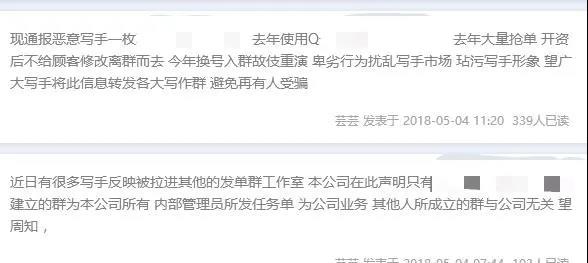
People’s Daily Online WeChat WeChat official account reported on May 13 that "a group of 700 or 800 writers once used up the one-day limit of ten accounts and failed to pay the monthly salary."

Yang Le first came into contact with ghostwriting of papers in his senior year: those who seek ghostwriting are called "clients", those who write contemporary pens are called "writers’ teachers", those who pull business are called "customer service", and those who convey writing requirements are called "supervisors" … An order writer can earn several hundred to several thousand yuan, and the intermediary can double the profit from it, so the quality of papers will follow, and it is common for "clients" to be blacked out after paying money.

After three years in the business, Yang Le found that there is a complete "industrial chain" behind every paper transaction.

Tomorrow’s defense, the "store" is empty.

"I will reply tomorrow. How can I answer such a paper?"

Yi Qi, who graduated from junior college this year, found a graduation thesis writing service through Taobao. As a result, the structure of the thesis obtained was chaotic, and the duplicate checking rate was much higher than the defense requirements. Yi Qi asked for revision, but "customer service" blacked him out.

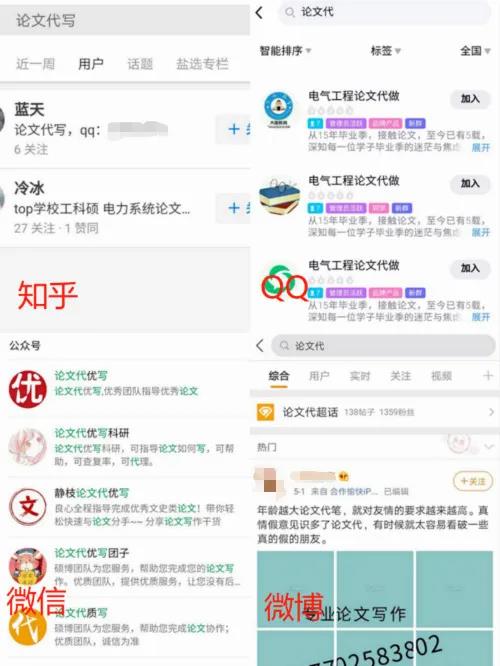
"Only a few days away from the defense, the paper hasn’t landed yet, and I thought of looking for a ghostwriter. There are many ghostwriting advertisements on the Internet. "

On April 13th, Yi Qi searched for "writing papers" in Taobao, and the page showed no relevant results. He also searched for "writing articles" and found a shop called "985 Shuobo Wenbi".

"Can you write a paper?" Yiqi left a message for the store.

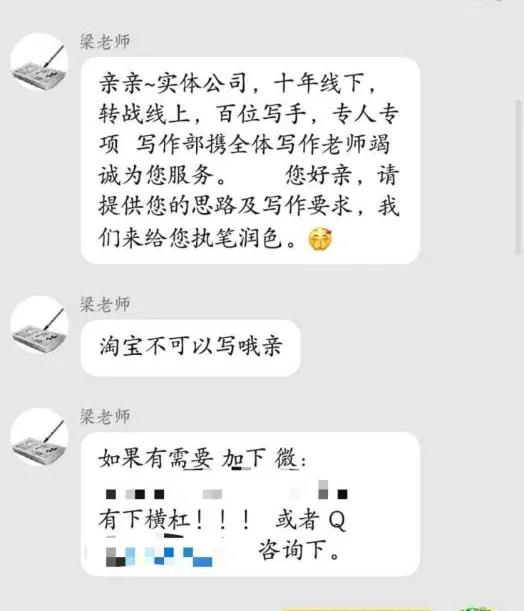
The other party replied: "Entity company, go online, 100 writers, special person … If necessary, add WeChat or QQ."

Taobao consultation screenshot. Photo courtesy of respondents

Yiqi added the WeChat provided by the store, and the other party claimed to be the company’s customer service, and would put forward pricing according to Yiqi’s requirements on the number of words in the paper and the duplicate checking rate.

"Why not communicate on Taobao?" Yi Qi said that if you don’t trade in Taobao, you can’t believe it easily.

The customer service said, "I think you may not know the rules. We do this professionally, not to say that we are not trading in Taobao, but it is more convenient to contact WeChat. "

Then Yi Qi received a screenshot with more than a dozen WeChat groups related to the paper.

Yi Qi was skeptical and put forward the demand: a specialized paper of 10,000 words, with a repetition rate below 30%, and a first draft on the 15th.

"800 yuan, 15th to the first draft, package, add money to help do the defense PPT. Taobao transaction needs to be paid in one lump sum, and WeChat transfer can pay 400 deposit first, and then pay the final payment after the paper arrives. " The customer service gave the price.

Considering the risk of "running away from the money" and possibly modifying it, Yiqi chose to pay the deposit by WeChat.

After paying the money, the customer service pulled a group, including a "supervisor" and a "writer teacher". "The customer service is responsible for receiving and collecting money, the supervisor is responsible for coordinating customers and writers, and writers write and modify papers as required." According to Yi Qi’s memory, the other party has a clear division of labor.

On April 15th, Yi Qi received the first draft of the paper after paying the final payment. After the click, "the whole person is not good": "None of the requirements put forward have been met. The structure and typesetting of the article are in a mess, and the repetition rate is 40% to 50%. It is simply copied and pieced together, and it is impossible to read it. "

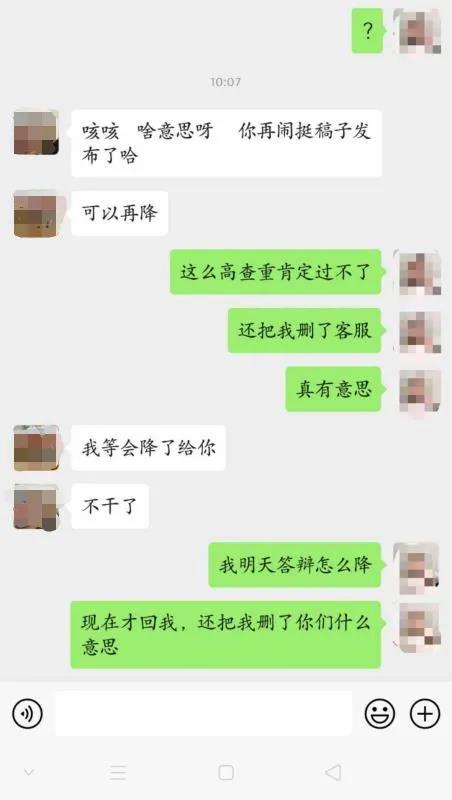
Yi Qi immediately raised a question in the group, and the writer said that it could be revised. "The check rate is so high, how to change it?" Yiqi found the previous customer service theory and asked for a refund, which was blacked out by the other party. The "supervisor" said in the group: "If you make trouble again, the manuscript will quit."

Screenshot of intermediary, writer chatting with customers. Photo courtesy of respondents

On the 17th, Yi Qi received the revised version, but it was still "a long story", so she had to change it herself. On the 18th, she took part in the defense.

Yiqi found Taobao customer service complaint and found that the store was gone. The customer service replied that the store was gone and could not complain. He remembers that during the communication, he asked the customer service for the link of their store through WeChat. The other party sent another store at that time, not the one that Yiqi first consulted.

"It’s the same group, but there are several Taobao shops and customer service WeChat. In this way, my first Taobao consultation record can’t be used to complain about another one. " Yi Qi suspects that the other party evades complaints and reports in this way.

"The paper still needs to be written by yourself." On April 18th, Yi Qi failed in the first defense. "Later, I did it myself, and the second defense passed."

From part-time job to full-time job

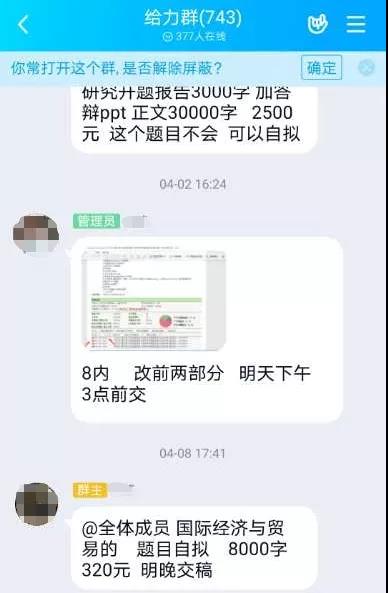
"International Economy and Trade, self-made topic, 8,000 words, 320 yuan." One day in April, a QQ group message popped up in Yang Le’s mobile phone.

In the paper writing group "Geili Group", Yang Le used to be a well-known "writer teacher". Even if he didn’t take orders for more than a year, the administrator occasionally asked him privately if he would take the job.

Papers to write group "single". Photo courtesy of respondents

"The first time I came into contact with writing papers was in my senior year. Some people sent papers to write part-time jobs in the student group." Yang Le contacted the advertiser and was drawn into the group of writing papers.

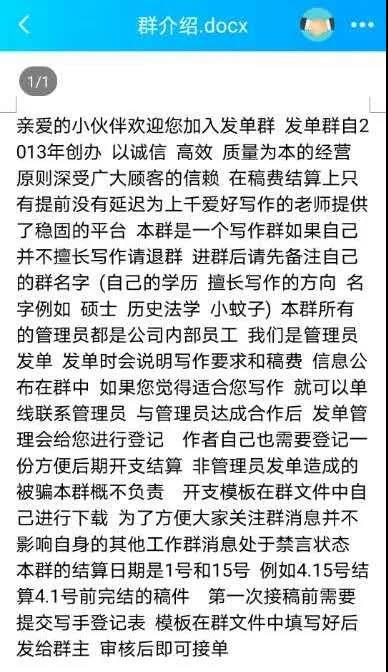
"People who have a’ studio’ in the group are actually intermediaries. They will give notes to each writer about the writing direction they are good at, and then send the requirements and prices of the order to the group. The writer contacts the intermediary to take orders according to his own situation. "

Introduction to the writing group of papers. Photo courtesy of respondents

Yang Le recalled that ghostwriting content generally includes course assignments, "small bills" for small papers and "big bills" for graduation papers, and the price depends on the number of words and the difficulty of operation. Take graduation thesis as an example. Generally, the fees paid to writers are 35-60 yuan/thousand words for undergraduate students, 150-200 yuan/thousand words for master students and 350 yuan/thousand words for doctor students. Orders for English and minority languages are more expensive.

"Generally, April to June and September to December are the peak seasons." Yang Le told reporters, "Near graduation and the end of the semester, the powerful writers in the group can earn tens of thousands of dollars a month."

During the period when Yang Le worked part-time as a ghostwriter, he could earn several thousand yuan a month. What impressed him the most was that "Geili Group" announced that the salary payment of some writers in that month might be delayed, because the one-day transfer quota of ten accounts was used up that day, and the salary had not been paid.

"If this is the case, the number of orders received in the month can be imagined."

As for the quality of papers, Yang Le said that most of the papers written by others are patchwork. "I know a writer. Once a client was dissatisfied with the first draft and asked him to revise it. He directly took the money and blacked it out. There are quite a few people who do this. Many writers have a limited level, and the intermediary will basically not verify the true and false academic qualifications. " He recalled that his degree in "Geili Group" was a master’s degree in returnees, but it was actually a domestic undergraduate degree.

Thesis ghostwriting is a part-time job for Yang Le, and some people have developed it into a full-time job.

"I have a classmate who took orders in the group at first, and later I met more customers and took orders directly.

Yang Le heard that the classmate didn’t find another job after graduation, and copied the model of "geili group" according to the gourd painting gourd ladle: he found three or four people as customer service, opened a shop on Taobao to take orders, and recruited writers among various student groups.

Intermediaries reap the benefits of fishermen.

"The biggest hidden rule in this line is that the intermediary presses the manuscript fee and takes advantage of the fisherman."

A client once told Yang Le that 320 yuan was paid to write a paper for him, and after that order was completed, the intermediary gave it to 160 yuan, Yang Le. "The price paid by the customer to the intermediary is generally 1.5 to 2 times that of the writer."

Under normal circumstances, the writer can’t contact the customer directly, and the requirements and amendments of the paper must be conveyed through the intermediary.

"This is to avoid private transactions between writers and customers." Yang Le introduced that if a writer violates the rules, the intermediary will publicize the illegal contents and punishment measures in the group, generally withholding the salary of the month, and immediately stop cooperation if it is serious.

The screenshot of the announcement of "Geili Group" provided by Yang Le shows: "Now a malicious writer is notified: QQ number # #, who left without modifying the customer after grabbing a large number of orders last year. This year, he changed his number and joined the group to repeat his old tricks. The despicable behavior disrupted the writer market and forwarded this information to major writing groups to avoid being deceived again."

Screenshot of the group announcement of the paper. Photo courtesy of respondents

In addition to avoiding private transactions of writers and maximizing the price difference, ensuring the number of writers is also one of the important conditions for intermediary profit.

Yang Le recalled that at most, he added more than a dozen papers to write for him, and the "Geili Group" was the only one left at present. The main reason is that this group is large in scale and has many orders.

"The number of writers in the group is generally kept at around seven or eight hundred, and there are more than a thousand people. The group owner and several administrators are intermediaries, others are writers, and administrators will regularly clean up people who don’t take orders for a long time. "

A group announcement of "Geili Group" shows that 20 yuan is rewarded for introducing undergraduate thesis writers into the group and 50 yuan is rewarded for introducing master thesis writers into the group. For writers who are more active and highly cooperative in the group, the intermediary will also develop them into regular employees.

"If you don’t want to write, you can come to work in the company." An administrator once sent an invitation to Yang Le: The company has offices in Liaoning and Shanghai, and the salary consists of basic salary and commission. The more orders, the higher the salary.

Expert: if the circumstances are serious, it is recommended to be sentenced.

"Avoid keywords, hide in e-commerce platforms, and induce transactions on social platforms." Netizens pointed out that this is the consistent routine of the current paper writing business.

On May 7, People’s Daily reporter searched some social and e-commerce platforms and found that with "writing papers" as the key word, relevant users could be found on WeChat and Zhihu; Searching for "paper generation" in Taobao, QQ and Weibo shows no results, but searching for "paper generation" can find related "goods" or users.

Screenshot of some platform search results

Taking Taobao as an example, a series of products appeared in the reporter’s search for "paper generation". Most of the product introductions include papers, blogs, articles, etc., and the names of shops are mostly "XXX Studio" and "XXX Cultural Society".

The reporter contacted a shop named "Sincere Senior School Students" through a product with a price tag of 200 yuan, and the text introduction was "Writing for High-end Masters and PhDs". He left a message saying that he wanted to consult an undergraduate thesis, and the other party replied "If you ask this, you will definitely do it, classmate". The reporter asked the reason, and the other party asked: "Do you think this is aboveboard? If you want to know more about it, you can chat on Q or WeChat or Taobao, otherwise it will be sealed. "

"Major e-commerce and social platforms should actively supervise illegal transactions, but it is not enough to rely on network shielding to cut off the industrial chain written by papers." Yin Bo, an associate professor at the Institute of Criminal Law Science of Beijing Normal University, pointed out.

In fact, the current supervision of writing papers in China is not random. In December 2015, China Association for Science and Technology and other seven departments jointly issued "Five Prohibitions for Publishing Academic Papers", resolutely resisting academic misconduct such as "third party" writing, voting and revising.

In July 2018, the Ministry of Education issued the "Notice on Strictly Investigating and Punishing the Sale and Writing of Dissertations in Colleges and Universities", demanding that the sale and writing of dissertations in colleges and universities be severely investigated.

In October 2019, 20 departments, including the Ministry of Science and Technology, jointly issued the Rules for the Investigation and Handling of Scientific Research Integrity Cases (Trial), which clearly defined the investigation process and handling measures of cases, and buying, selling and writing papers on behalf of others were included in the act of scientific research dishonesty.

Why is it still difficult to break the industrial chain of writing papers?

Jia Ting, the chief lawyer of Beijing Tingsheng Law Firm, believes that the reasons for the formation of the industrial chain are comprehensive: some institutions and industries only discuss papers in the assessment of talent training; The demand side of the paper is unwilling to study hard and thinks that money is everything, which leads to speculative psychology; Writers and intermediaries are mercenary and try their best to attract business.

Yinbo further pointed out that writing on behalf of a paper roughly includes three types of subjects: the demand side of the paper; Intermediaries providing services; The writer of the paper. Among them, intermediary agencies are the most harmful, and there is a gap in supervision, so it is more urgent to regulate them.

"At present, most of the constraints on writing papers rely on the self-discipline norms of universities and scientific research institutions and related administrative laws and regulations. These often belong to the internal norms of the academic community, and there is a lack of sufficient regulatory means for external operators, especially third-party intermediaries. " Inbo pointed out.

"Serious organization of buying and selling, writing papers on behalf of others can be considered as imprisonment." Both Yin Bo and Jia Ting believe that we can refer to the provisions of the Criminal Law on the crime of cheating in organizing exams, and include organizing and helping the sale of papers and writing on behalf of others into the criminal law norms, thus playing a deterrent role for all kinds of subjects involved. (At the request of the interviewee, Yi Qi and Yang Le are pseudonyms.)

(The original title is "Dear, do you need to write a paper?" 》)

Liu Zhenwei exposed 27 days to shoot "East into West" because he was harmed by Wong Kar-wai.


Jeffrey Lau


The masters attending the premiere of "Dong Chengxi on 2011" stood up and applauded to pay tribute to this meritorious director.


18 years ago, "East into West" can be described as a classic.

  Movie network news(Photo/Qian Jiayi/Yang Yaru) Although 18 years have passed, no one who has seen it will forget Tony Leung Chiu Wai’s sausage mouth, Joey Wong and Leslie Cheung’s flirting swords, the big boots on Zhong Zhentao’s head, the phrase "banana, you are a guava" and the funny performances of big names such as Jacky Cheung, Brigitte Lin, Maggie Cheung and Carina Lau. This popular film was shot in Liu Zhenwei in 27 days. Recently, Liu Zhenwei was at the premiere of the film, revealing the reason for the lack of shooting time, all because of Wong Kar-wai’s harm.


Classic stills of "East into West"


Now we can only appreciate the elegance of a generation of superstar Leslie Cheung through movies.

  "East into West is a movie I hate most, because I had to finish it in 27 days without a script, which was really painful." Liu Zhenwei looked a little sad. Referring to the reasons for being forced to be helpless, Liu Zhenwei revealed that it was all because of the snail speed of Wong Kar-wai’s filming. "I wanted to shoot &lsquo at the earliest; Ashes of time ’ The story when I was young, and then I called Wong Kar-wai. He said that it was very good. After we found the investment, Wong Kar-wai was responsible for shooting the first episode, and I will shoot the second episode. "

  Liu Zhenwei sighed, "As a result, a month passed, and I went to Wong Kar-wai’s crew to watch it again. He was still filming the scene on the day when he turned on the phone 30 days ago. I was so anxious that I was sweating. Later, the date of film delivery was approaching, and Wong Kar-wai said to let me shoot a top film quickly, so that he could finish the filming, so I only spent 27 days filming" East into West "and didn’t expect the film to sell well.


Tony Leung Chiu Wai’s classic sausage mouth


At that time, the cast of "East into West" was extremely luxurious, and it also became a swan song throughout the ages.


Zhong Zhentao’s classic stills in "Dong Cheng Xi Jiu" were released at the premiere of "Dong Cheng Xi Jiu 2011".

  As for the new version, Liu Zhenwei said, "Although I hate it the most, a reporter told me a few years ago that she would watch this movie regardless of her emotions, which moved me very much, so I told her that I would shoot a new one for them, so there was 2011."

  Liu Zhenwei said, "2011 is not just funny like the last one. This one adds a lot of warmth, and these warmth things come from Leslie Cheung. Leslie Cheung and I are very good friends, and I hope my brother can see 2011, which is also a memorial to him. " Liu Zhenwei said emotionally, "I hope everyone can feel the spirit of Liu Zhenwei: always love the people and things around us."

  It is reported that "2011 East into West" will be released nationwide on November 24th, which brings together Zhong Zhentao, Karen Mok, Eason Chan, Crystal, Deng Lixin, Kimi, Sitar tan and other stars.

It’s also a festival of the year when colorful folk customs welcome the Dragon Boat Festival.

CCTV News:Tomorrow (June 22nd) is the Dragon Boat Festival holiday. The reporter learned from china tourism academy that this year’s Dragon Boat Festival holiday, the number of tourists is expected to exceed the level of the same period in 2019, reaching 100 million, and the holiday trips will mainly focus on Zhou Bianyou and short-distance tours.

Following the unexpected release of the "May Day" labor holiday tourism demand, the market demand for Dragon Boat Festival holiday tourism is in a warm period. The reporter learned from a number of platforms that during the Dragon Boat Festival holiday this year, the average price of hotels and air tickets in China and many popular destinations will be lower than that during the May Day holiday. Beijing, Hangzhou, Guangzhou, Chengdu and Qingdao will become popular tourist destinations in China.

Dai Bin, Dean of china tourism academy:We predict that there will be 100 million people traveling during the Dragon Boat Festival holiday this year, and there will be 37 billion yuan in tourism consumption. What does this data mean? This means that compared with the same period last year, the number of tourists will increase by 30%, while tourism consumption will increase by 43%.

China tourism academy predicted that tourists from Guangdong-Hong Kong-Macao Greater Bay Area, the Yangtze River Delta, Beijing-Tianjin-Hebei, the middle reaches of the Yangtze River and Chengdu-Chongqing urban agglomerations will circulate and interact, and a "three-hour golden tourism circle" will be formed around major tourist cities, and the popularity of tourist resorts such as Beidaihe, Songshan and Conghua will gradually become apparent.

Dai Bin, Dean of china tourism academy:Because (Dragon Boat Festival holiday) only lasts for three days, compared with "May 1" Labor Day (holiday), it is mainly short-distance travel, mainly in Zhou Bianyou; Self-driving, individual travel, family, parent-child, study and summer vacation will become the key words of holiday travel.

Shunde, Guangdong: Colorful boats compete for beauty to welcome the Dragon Boat Festival "Night Dragon Tour"

It is also a traditional festival of Dragon Boat Festival, with dumplings and dragon boat races, which has long been a lively scene all over the country. This year, the dragon boat race held in Shunde is unique and eye-catching. What kind of dragon boat race is it? Now let’s take a look with the reporters at the reception desk.

General Station reporter Qu Baiyu:This is Ronggui Street in Shunde, Guangdong. Usually, people watch dragon boats faster than others. Today, I want to show you Bimei.

At the competition site, gongs and drums were loud, waves splashed and dragon boats fought brightly. Ten dragon boats from various clubs in Rong Gui decorated their bodies with gongs and drums, umbrellas and colored lights, and they "dressed up" for a trip to show their slender posture. "Night Dragon Tour" is rare in Guangdong, which is a unique feature of traditional dragon boat culture in Rong Gui. Different from the traditional Youlong, the night dragon with lights in Rong Gui not only retains traditional elements such as gongs, drums and umbrellas, but also uses LED lights to decorate the dragon boat, innovating the form of dragon boat competition, and skillfully blending water, lights and music.

Putian, Fujian: colorful folk customs of "dragon boat climbing" at sea welcome the Dragon Boat Festival.

As the Dragon Boat Festival approaches, Fujian will carry out special folk activities in many places. These two days, in Dongpu Town, Putian City, a huge sea dragon boat race was staged.

In Putian, Fujian, dragon boat racing is also called "dragon climbing boat". On the morning of 19th, Jicheng Village, Dongpu Town, Putian City ushered in a lively Dragon Boat Climbing. On the sea, the dragon boat players follow the rhythm of drums and raise their arms to paddle hard. On the beach, citizens and tourists shouted for fun, and the scene was crowded and lively.

Tourist Liao Kajia:I like watching the Dragon Boat Festival in China very much, because it is very lively and crowded, and it is very comfortable to watch together.

According to reports, during the Dragon Boat Festival, in addition to the dragon boat race at sea, villagers in Jicheng Village will also hold dragon dances and flower drums, and the folk performance team consisting of thousands of people will stretch for miles, which is very spectacular.

Putian citizen Li Jianhuang:We rushed back to our hometown from Yunnan for the traditional Dragon Boat Festival, and we were very happy. One is to unite everyone’s cohesion, and the other is to carry forward traditional culture.

It is understood that Putian has a wide range of rivers and waters, and the Dragon Boat Festival is the most important local folk activity every year. This year, Putian Dragon Boat Race Folk Games will span many counties and districts and will last until the beginning of July.

Henan Dragon Boat Festival: Drum-beating and Paddling Dragon Boat Race for the Dragon Boat Festival.

With the approach of the Dragon Boat Festival, a Dragon Boat Culture Festival was held in Zhumadian City, Henan Province these days, and everyone welcomed the Dragon Boat Festival by way of dragon boat race.

At the Dragon Boat Culture Festival in Zhumadian City, Henan Province, the 200-meter straight race and the 300-meter straight race were set up in the dragon boat competition. On the field, drums were rumbling and cheering, and Qi Xin, a 12-player dragon boat team, joined forces to paddle and cut waves and compete. The dragon boat race attracted many citizens and tourists to watch it. People took pictures by video and recorded wonderful moments.

Meng Xin ‘ai, a citizen of Zhumadian, Henan:Everyone wants to stick to the traditional culture, so everyone is very supportive of this movement and hopes to hold more such activities in the traditional culture in the future.

IPhone 16 Pro Max real machine exposure: the border is as narrow as 1.2mm

It is understood that Apple plans to release a new generation of 16 series in September this year. Recently, digital bloggers "Instant Digital" and "I Ice Universe" shared the screen cover drawings of iPhone 16 Pro Max, and said that the design was consistent with their actual measurement data, which made people believe in the existence of this new type of mobile phone.

If the border design on these CAD drawings is finally adopted, then iPhone 16 Pro Max will become one of the smartphones with the narrowest borders in the global market. According to the data, except for the iPhone 16 Pro Max, the border widths of the other three models are as follows: the border of the iPhone 16 is 2.0497mm;; IPhone 16 Plus frame is 2.0599mm;; The border width of iPhone 16 Pro and iPhone 16 Pro Max is 1.2mm respectively.

From the data point of view, the screen border control of these new machines is excellent, especially the iPhone 16 series, which is more intense in the positive visual effect with the large screen design. In terms of hardware configuration, all three phones will be equipped with A18 chipset, while iPhone 16 Plus and iPhone 16 ProMax will be equipped with A18 Pro chipset. At the same time, the new chipset is also manufactured by the latest N3E enhanced 3nm process from TSMC.

It is worth mentioning that the upgraded neural engine will greatly improve the artificial intelligence performance of the iPhone 16 series such as intelligent voice and machine learning. In addition, it is reported that the iPhone 16 series will have more exciting functions and features.


mobile.zol.com.cn
true

https://mobile.zol.com.cn/876/8760037.html
report
1221
It is understood that Apple plans to release a new generation of iPhone 16 series mobile phones in September this year. Recently, digital bloggers "Instant Digital" and "I Ice Universe" shared the CAD drawings of the screen cover of iPhone 16 Pro Max, and said that the design was consistent with their actual measurement data, which made people believe in the existence of this new type of mobile phone. If the border design on these CAD drawings is finally adopted …

Highly contagious! Emergency reminder in many places!

  recent days

  Many disease control departments have issued reminders:

  Winter is the most common season for chickenpox.

  The disease is highly contagious.

  The key to prevention is vaccination against varicella.

  This is also the most economical and effective measure.

  Chickenpox is known as "face to face biography"

  Kindergartens and primary schools are prone to collective outbreaks.

  Chickenpox is an acute respiratory infectious disease characterized by a rash caused by the initial infection of varicella-zoster virus.

  The disease is highly contagious, and people are generally susceptible to chickenpox. About 90% of susceptible people get sick after contacting patients, commonly known as "face-to-face transmission", which is easy to cause outbreaks, especially in infants and school-age children.

  Chickenpox has an acute onset, with symptoms such as fever, headache, fatigue, nausea and vomiting in the prodromal stage. After 1-2 days, a rash appears, with more on the trunk, less on the limbs, head and face, and less on the palms, soles and oral mucosa, which can be differentiated from hand, foot and mouth disease. Can be secondary to bacterial infection, pneumonia, encephalitis, hepatitis and other complications.

  Chickenpox is a self-limited disease with a natural course of 7-10 days. After the disease, it can gain lasting immunity. Isolation treatment should be carried out after the illness, until the chickenpox and herpes are all dry and scabbed, or not less than one week after the illness.

  Life-long immunity can be obtained after illness, sometimes the virus remains in the ganglion in a static state, and herpes zoster occurs after years of infection recurrence.

  Vaccinate against chickenpox

  Is the most effective means of prevention.

  1. Vaccination can effectively prevent varicella caused by varicella-zoster virus infection. The main target of vaccination is susceptible to varicella at the age of 12 months and above. Generally, vaccination for about 2 weeks can play a protective role.

  2 to carry out monitoring, strengthen the morning and afternoon inspection, kindergartens and schools found suspicious children should immediately take measures such as isolation, medical treatment, disinfection of supplies. Clear isolation period should be until all patients with varicella and herpes are dry and scabbed.

  3. Teachers and staff should maintain good personal hygiene, and classrooms and dormitories should be well ventilated.

  4. Clean and disinfect toys, personal hygiene products (cups, towels, etc.) and tableware; Disinfect activity rooms, bedrooms, classrooms, door handles, stair handrails, desktops, bathrooms, etc.

  5. Publicity and education; Use radio, blackboard newspaper, gallery and other forms to publicize the knowledge of prevention and treatment of respiratory diseases and improve students’ awareness of self-protection.

  Jiangsu can be vaccinated with varicella vaccine for free.

  Chickenpox is an infectious disease caused by varicella-zoster virus, which can occur all year round and is highly contagious. In recent years, routine monitoring of infectious diseases shows that public health emergencies related to chickenpox account for more than 80% of all public health emergencies related to infectious diseases, and all of them occur in kindergartens and schools, seriously affecting children’s health and normal teaching and living order. At the same time, the chickenpox epidemic in kindergartens and schools is easy to spread to communities and families, resulting in a wider spread.

  In order to effectively reduce the incidence of chickenpox, reduce the occurrence of public health emergencies caused by chickenpox, and prevent the cluster epidemic of chickenpox, with the consent of the provincial government, since January 1 this year, Jiangsu Province has included live attenuated chickenpox vaccine in children’s immunization program, and school-age children can be vaccinated with 2 doses of live attenuated chickenpox vaccine for free.

  Routine immunization procedures are as follows:

  The first dose was inoculated at the age of 12 to 18 months, and the second dose was inoculated at the age of 4. The interval between two doses of indirect inoculation is not less than 3 months.

  All school-age children born after January 1, 2017, who are included in the management of Jiangsu Children’s Vaccination Information System and have lived for more than 2 months can be vaccinated free of charge.

  Parents can bring their children to the vaccination clinic of the local community health service center for an appointment.

  Synthesis: Jiangsu CDC and Nanjing CDC.


[Editor in charge:

]

Dream fairy tale! The movie channel broadcast Cinderella at 22: 20 on March 3rd.


Special feature of 1905 film network The spring love movie is playing continuously, and it will be broadcast for you on March 3.


Simple Cinderella, how to become the prince’s lover?

Fantasy story — — Everyone knows the ending, but it’s still attractive


As the most film in history that is not afraid of being spoiled, I’m afraid there is no one who doesn’t know the story of Cinderella. The kind Cinderella met her evil stepmother and suffered all kinds of torture. Finally, she waited for the help of the fairy, turned into a princess and finally got married with the prince.


However, it is such a perfect fairy tale that will still touch the hearts of "Cinderella" in reality, waiting for a prince who really belongs to her to come.


It is precisely because the core fairy tale dream of girls is eternal that the story of Cinderella is often shot new.

Excellent visual effects — — Reproduce the real fairy tale world


This live-action version of Cinderella reproduces a real fairy tale world with excellent visual effects and artistic design.


The scene setting in the first half maintains realistic natural scenery, beautiful countryside and dreamy castle, and has the style of pastoral naturalism. In the second half of the magic moment, the dazzling golden carriage and crystal shoes will be unveiled, which will surely impress audiences of different ages.


Especially when the door of the golden carriage is opened, as the hearts of countless girls are opened. There is also the scene where the midnight bell rings, which can be called the brilliant fireworks over the classic palace, which is dizzying.


Gorgeous costumes — — Beauty never seen in fairy tales


If you just read fairy tales, you can never imagine how beautiful those crystal shoes are, and how amazing the four-seat skirt is to match such beautiful crystal shoes. The movie didn’t live up to those romantic fantasies. Cinderella shone from head to toe and earned enough attention.


All the costumes in Cinderella were designed by designer sandy powell, and preparations were started two years before the film started.


In order to make Cinderella’s blue dancing skirt flow like water when running, sandy powell used 12 layers of blue fabrics with different shades.


She has designed nine kinds of skirts. The final version of the skirt has 12 layers from the inside out, using more than three different fabrics such as silk, nylon and polyester fiber. The skirt is decorated with countless turquoise and tens of thousands of crystals. There are tights and several layers of petticoats inside, which took 18 tailors and 500 hours to complete.


In the film, Cinderella likes to communicate with animals, and butterflies are one of them. In order to match the plot, sandy powell also decorated Cinderella’s blue dance skirt with butterflies.


In the film, Cinderella’s crystal shoes can’t be put on in reality, and only appear in close-ups. You can only wear shoes with the same shape when shooting, and then make them look like crystal shoes with special effects.


Meet the movie channel Universal Cinema at 22:20 on March 3rd.

Let Cinderella share a fairy-tale girl dream with you!

Chinese traditional festival-Dragon Boat Festival

Legend of origin

The Dragon Boat Festival, also known as Duanyang Festival and Chung Wu Festival, is said to be the day when Qu Yuan, a great poet in ancient China, threw himself into the Guluojiang River to be martyred. For more than two thousand years, the fifth day of the fifth lunar month has become a traditional festival to commemorate Qu Yuan. According to historical records, on the fifth day of the fifth lunar month in 278 BC, Qu Yuan, a doctor and patriotic poet of the State of Chu, was filled with grief and indignation after hearing the news that Qin Jun had breached the capital of the State of Chu, and his heart ached, so he resolutely wrote Huai Sha. He threw himself into the Miluo River and died. People along the river have led boats to race to salvage, evoking souls along the water and throwing zongzi into the river to prevent fish and shrimp from eating into his body.

Today, the Dragon Boat Festival is still a festival that our people attach great importance to. On May 20th, 2006, this folk custom was approved by the State Council to be included in the first batch of national intangible cultural heritage list. Dragon Boat Festival is now a legal holiday in China.

Festival custom

01 Dragon Boat Race

Dragon boat race is the main custom of the Dragon Boat Festival. According to legend, people who originated in the ancient state of Chu were reluctant to part with the death of Qu Yuan, a sage, and many people rowed to catch up and save. They scrambled to catch up with each other and disappeared when they reached Dongting Lake. After that, I will row a dragon boat on May 5th every year to commemorate it. Dispel the fish in the river by rowing dragon boats, so as not to eat Qu Yuan’s body. The habit of racing is prevalent in Wu, Yue and Chu.

02 eat zongzi

Eating zongzi is another traditional custom of Chinese people. Zongzi, also known as "corn millet" and "zongzi". It has a long history and various patterns. From the Spring and Autumn Period to today, at the beginning of May every year, every family in China has to soak glutinous rice, wash zongzi leaves and make zongzi, with more varieties of colors. From the perspective of stuffing, there are many Beijing jujube dumplings with small dates in the north; In the south, there are many kinds of fillings, such as bean paste, fresh meat, ham and egg yolk, among which Zhejiang Jiaxing Zongzi is the representative. The custom of eating zongzi has been popular in China for thousands of years, and spread to Korea, Japan and Southeast Asian countries.

03 Artemisia argyi and calamus

A folk proverb says, "Willows are inserted in Qingming Festival, and Ai is inserted in Dragon Boat Festival". Every family sweeps the court, putting calamus and moxa sticks in the eyebrows and hanging them in the hall. Acorus calamus, Folium Artemisiae Argyi, Liuhua, Garlic and Dragon Boat Flower are made into human or tiger shapes, which are called Ai Ren and Ai Hu. It is made into garlands and ornaments, which are beautiful and fragrant, and women compete to wear them to drive away evil.

04 hanging bell statue

It is the custom of Dragon Boat Festival for Zhong Kui to catch ghosts. In the Jianghuai area, every family hangs bells and statues to ward off evil spirits. It is said that Emperor Kaiyuan of the Tang Dynasty returned to the palace from Lishan Mountain, and malaria was rampant. He dreamed that two ghosts, one big and one small, were wearing red crotch pants, stealing Yang Guifei’s sachet and Yu Di of the Ming Dynasty, and ran around the temple. GREAT GHOST wears a blue robe and hat, catches the kid, gouges out his eyes and swallows it in one gulp. When the Emperor of the Ming Dynasty asked questions, GREAT GHOST said, "My surname is Zhong Kui, that is, I am not the best in martial arts. I am willing to rid your majesty of demons." After the Ming Emperor woke up, malaria was cured, so Wu Daozi, a painter, painted a portrait of Zhong Kui catching ghosts according to what he saw in his dream, and ordered all the people to post it during the Dragon Boat Festival to exorcise evil spirits.

05 series baisuo

It is made of five-color silk, also known as Baisuo, Longevity Cord, Continuity Cord, Bing Shao, Five-color Cord, Zhu Suo and so on. Or hanging on the door, or wearing children’s neck, or tying children’s arms, or hanging on bed curtains, cradles, etc., it is said that it can avoid disasters, protect health and prolong life. In Ying Shao’s "Customs Tongyi" in the Han Dynasty, it is recorded: "On May 5, the five colors were given to continue life, and the popular saying was beneficial to human life." "The Chronicle of Jingchu’s Age" says: "It is not a disease to tie the arms with colorful silk, which is called" Bing Bing ".

06 drink realgar wine

Painting forehead is the custom of daubing children’s forehead with realgar on Dragon Boat Festival, which is said to ward off poisonous insects. The typical method is to draw the word "Wang" on children’s foreheads with realgar. One is to borrow realgar to drive away the poison, and the other is to borrow tiger’s forehead ("Wang" is like a tiger, and the tiger is the king of beasts, because it is replaced by a tiger) to suppress evil spirits. Qing Fucha Dunchong’s "Yanjing Year’s Chronicle": "From the first day of the first lunar month, take realgar and sprinkle it with wine, and apply it to the collar and nose and ears of children to avoid poison."

07 Dai Xiangbao

The sachet, also called sachet, sachet, purse, etc., is wrapped with colored silk thread and sewn with rags. It is filled with spices (made from Chinese herbal medicines, such as Radix Angelicae Dahuricae, Rhizoma Chuanxiong, Radix Scutellariae, Herba Paicao, Rhizoma Kaempferiae, Gan Song, and Radix Kaempferiae), which is worn on the chest and smells fragrant. Chen Shiliang’s Guang Ji at the Age of Years quoted Miscellaneous Notes at the Age of Years as saying, "Duanwu is made of red and white colors, and colored lines run through it, making it look like a flower." The contents of these carry-on bags have changed from sweat-absorbing mussel powder, talisman to exorcise evil spirits, copper coins and realgar powder to sachets filled with spices, and their production has become increasingly exquisite, becoming a unique folk art of the Dragon Boat Festival.

08 collecting miscellaneous drugs

Herb picking is also one of the oldest customs of Dragon Boat Festival. "Xia Xiaozheng" contains: "Store medicine this day to remove poisonous gas." Volume 22 of "Collection of Miscellaneous Drugs" quoted the lost article of "Collection of Miscellaneous Drugs at the Age of Jingchu": "On May 5, competing for miscellaneous drugs can cure all diseases." There is a record of catching toads in May in Qi Min Yao Shu Miscellaneous Notes in the late Wei Dynasty, which is also used for pharmacy.

09 Mulan decoction

It is an ancient custom recorded in "Da Dai Li" to bathe in orchid soup at noon. At that time, orchids were not today’s orchids, but Eupatorium odoratum of Compositae, which had fragrance and could be decocted and bathed. "Nine Songs in the Cloud" also has the sentence "Bathing orchid soup will make you fragrant". "The Chronicle of Jingchu’s Age": "May 5th is called the Orchid Bathing Festival." "Five Miscellanies" records that people in the Ming Dynasty took a bath with five-colored grass at noon because "orchid soup is not available." Later, it was usually fried cattails, wormwood and other herbs to take a bath.

10 doucao

Fighting grass was popular in the Southern and Northern Dynasties, and it was called "stepping on a hundred herbs", and it was called "fighting grass" or "fighting a hundred herbs" in the Tang Dynasty. "The Story of Jingchu’s Age": "On May 5th, the four people stepped on a hundred herbs together, and there was another scene of fighting a hundred herbs." After that, it is not limited to the Dragon Boat Festival.

Original title: Chinese traditional festival-Dragon Boat Festival

Read the original text