Strengthening confidence, opening up new opportunities, strengthening foundation, increasing kinetic energy and providing superior services —— A first-line observation of Heilongjiang large-scale proj

  Xinhua News Agency, Harbin, March 2nd Title: Strong foundation, increased kinetic energy and excellent supply — — First-line observation of Heilongjiang large-scale project construction in northeast old industrial base

  Xinhua News Agency reporter Qiang Yong

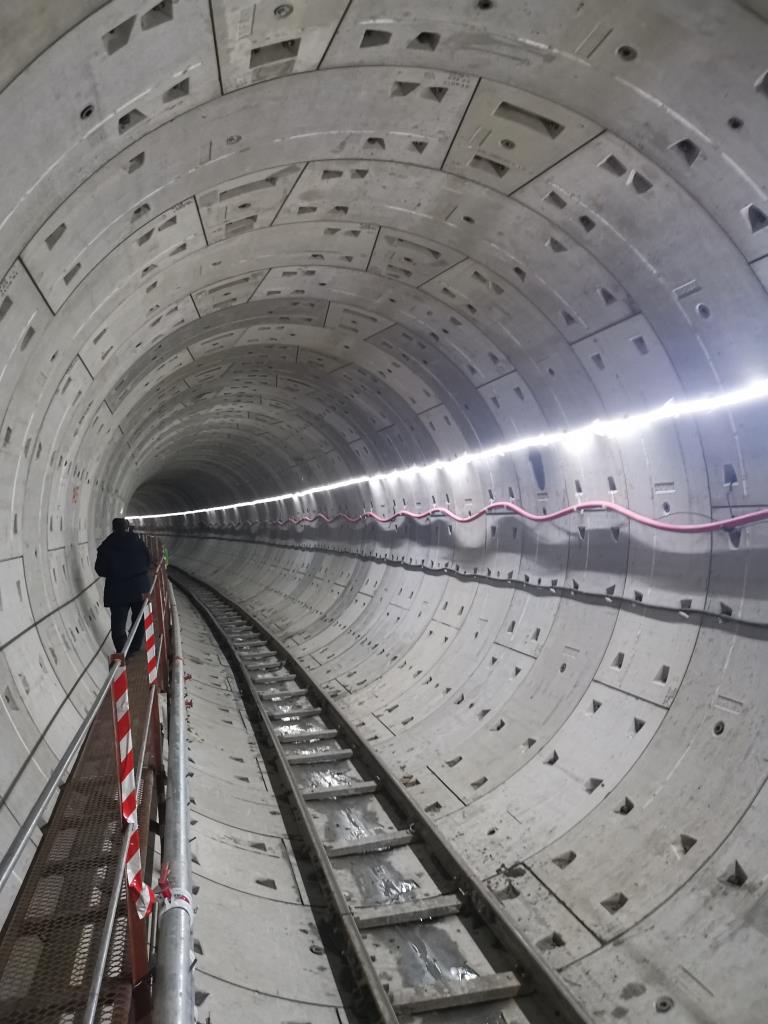
  At the Northwest Ring Highway Bridge Station of Harbin Metro Line 3, Heilongjiang Province, there is still some snow on the ground that has not melted. Under the ground more than 20 meters deep, with the rumbling roar, the huge shield machine slowly broke through the ground.

  "The construction team overcomes difficulties such as the difficulty of winter construction in Northeast China, and does not stop work in winter to grab the progress and construction period." Chen Peijun, assistant manager of the construction branch of Harbin Metro Group Co., Ltd., said that the entire northwest ring project will be completed in 2024, when Line 3 will be fully connected.

  Northwest Ring Project of Harbin Metro Line 3. Xinhua News Agency reporter Qiang Yong photo

  Spring is chilly, and the construction of large projects in Heilongjiang, the northernmost province in China, continues to heat up: the construction of Daqing polycarbonate joint project with a total investment of 6.5 billion yuan is in full swing, the second phase expansion project of Harbin Airport is accelerated, and the comprehensive management of wetland protection and restoration in Xiaoxing’ anling is accelerated … … Heilongjiang seized the "bull’s nose" of project construction and released an important signal to boost the real economy of the old industrial base.

  Liu Wei, deputy director of the Development and Reform Commission of Heilongjiang Province, said that Heilongjiang has taken "five grasping" measures such as information platform scheduling, satellite image monitoring and land supply progress to accelerate the construction of major infrastructure and industrial projects. By mid-February, there were 46 provincial-level key projects under construction in winter, 150 projects could be resumed before the end of March and more than 500 projects before the end of April.

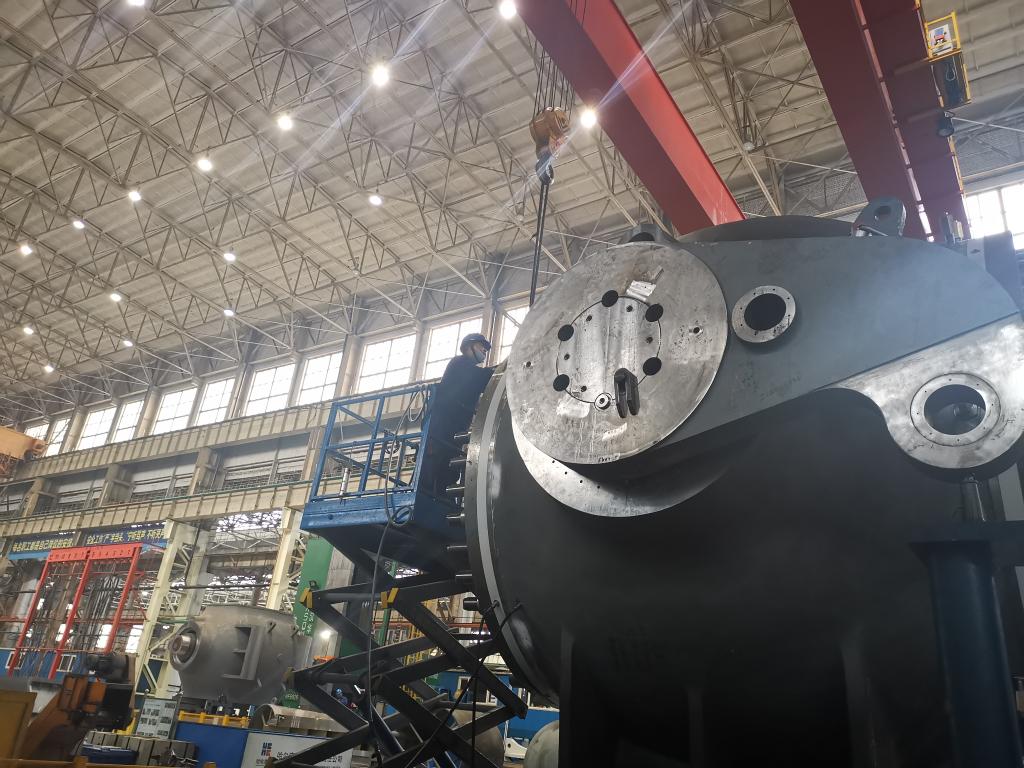
  Harbin Electric Machinery Factory Co., Ltd. Hydropower Branch of Harbin Electric Power Group. Xinhua News Agency reporter Qiang Yong photo

  The appearance of the workshop, a provincial key project and a new energy industry incubation platform construction site in Jiamusi City, has begun to take shape. Qin Mingze, the project manager, said that the whole plant area has completed more than 80% of the project, and after formal production, it can achieve an annual output of 300 sets of wind power equipment such as wind turbines and towers.

  The "four beams and eight pillars" of large-scale project construction supporting stable investment are reshaping the economic development map of the old industrial base. Among the provincial key projects in Heilongjiang Province this year, industrial projects account for more than 60%, among which there are many leading projects that can promote urban industrial upgrading and even leap-forward development, which is expected to become a "new engine" for local accelerated development.

  In Daqing, an oil city, the polycarbonate joint project started in the snow in early February. At present, all large-scale equipment has been hoisted, and it has gradually shifted to the stage of prefabrication and welding of process pipelines. The first phase of the project is planned to be put into production before the end of 2023, which will be used to produce toluene, propylene, phenol, polycarbonate and other products.

  In Hegang, a coal city, China Minmetals Group and other Fortune 500 companies were introduced to promote graphite industry to become the second largest industry after coal-related industries. Wang Jionghui, chairman of China Minmetals Group (Heilongjiang) Graphite Industry Co., Ltd., said that the company and the research team of Harbin Institute of Technology set up a "Touyan" workstation to push forward scientific and technological projects in the graphite field.

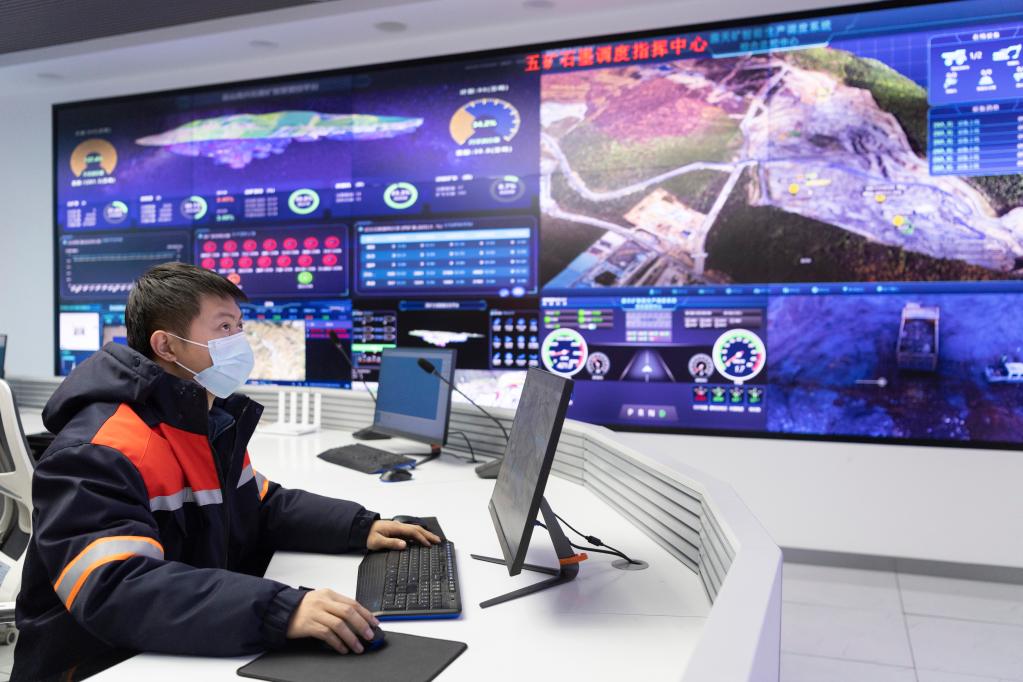
  China Minmetals Group (Heilongjiang) Graphite Industry Co., Ltd. Dispatching Command Center. Xinhua News Agency reporter Xie Jianfei photo

  Focusing on optimizing the business environment, Heilongjiang strengthened the working mechanism of leaders at all levels to contract enterprises, vigorously promoted the action of "10,000 cadres entering 10,000 enterprises", and escorted the project construction and enterprise production. Qiqihar has established a "working platform for leading contracting enterprises (projects)", which realizes intelligent management and improves the efficiency of contracting.

  At the same time, Heilongjiang focuses on urban renewal, rural infrastructure construction, and modern industrial system to extend the chain and strengthen the chain. Up to now, the province has a total of 10,600 reserve projects with a planned total investment of 2 trillion yuan.

Seven years after The Return of the Great Sage, the man finally came back to sprint for the Spring Festival.

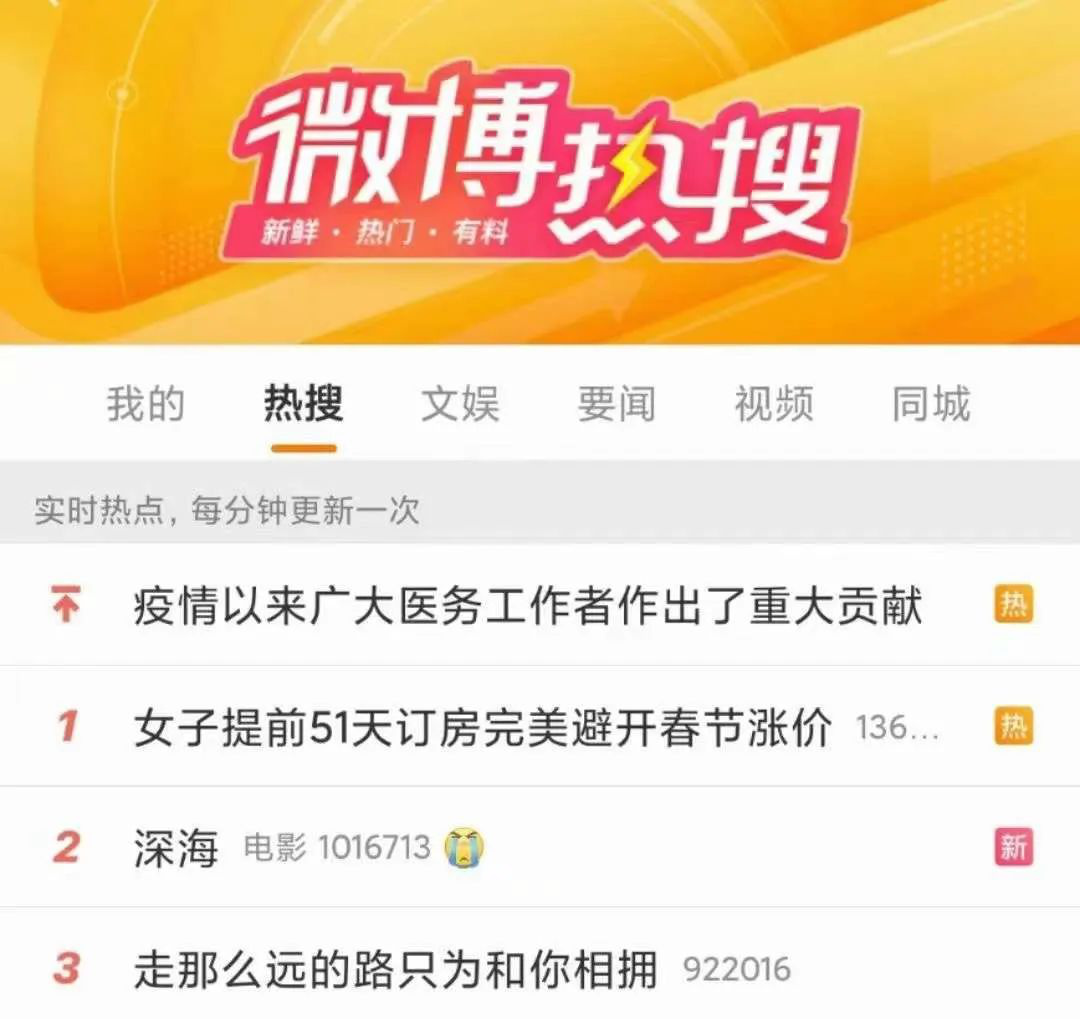
Special feature of 1905 film network After the animation film was screened in 100 cities, the title topic rushed to the top of the hot search that night.


Judging from the feedback and attention on the internet, most of the attention comes from the director of the film.


The animated film he directed seven years ago (hereinafter referred to as "The Return of the Great Sage") was never optimistic, and countless people voiced it, making it a myth of "tap water".


Box Office, Flowers, Awards … … One after another, in the eyes of everyone, this animated film is a landmark work of "the rise of the country". Countless viewers expect him to launch a sequel and turn this IP into a series of works.


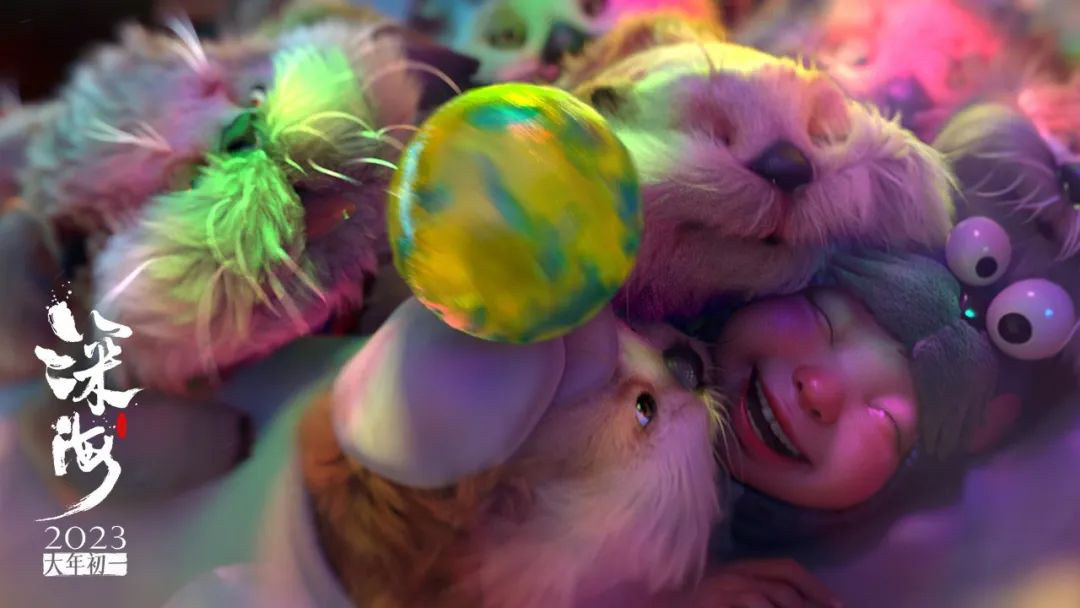
But he didn’t. Instead, he buried himself in the technical research and development of a concept in The Return of the Great Sage, and co-produced a brand-new original IP animated film Deep Sea.


Yi Qiao can’t be underestimated, too. As a producer, he has released such works, and the box office and word of mouth need not be repeated.


These two animators, who have been successful in the outside world, may have already explored their own "methodology" in business, but it seems that they did not put all this on Deep Sea, but chose a new beginning.


This has also become the key to our attempt to enter the Deep Sea. Why not use the past success to create a topic for the new work and bring more box office?


In an exclusive interview with the 1905 film network, producer Yi Qiao used their answers to string together the adventures belonging to Deep Sea.


01.


Yi Qiao is a person who boasts a high tear point, but after reading the script of Deep Sea for the first time, "I cried". At that time, he decided to make this story with the animator. As for the past experience, logic and methodology, it is no longer important.


Because in Deep Sea, he saw the sincerity of the creator and Tian Xiaopeng’s self-dissection once again.


In 2015, "The Return of the Great Sage" became the key word of that summer, and the striped house film industry under Light Media also began to explore and expand the animated film market, and invested in many animated film companies in one breath, including the October culture founded by Tian Xiaopeng.


Yi Qiao and Tian Xiaopeng, then the president of the striped house film industry, visited many successful overseas animation companies, looked at the achievements of others and then looked at their own achievements. "We are all thinking that we should do something different."


Tian Xiaopeng thought of the opening title of The Return of the Great Sage, so he threw out an idea, which covered the content of China’s unique ink and wash style. Is it possible to turn it into a whole film?


After returning home, Tian Xiaopeng almost declined all kinds of invitations such as interview announcements and plunged into creation. Yi Qiao also devoted himself to the creation and development of Ne Zha and other works.


The stories of two people are not parallel lines. They still talk about stories and creations. Yi Qiao will also introduce the excellent animators he meets to each other, including the director. "They are both creators who cherish each other very much.".


Yi Qiao still remembers that when we first talked about cooperation with jiaozi, the other party was just the boss of an animation outsourcing company, and directly released the lofty ambition of "I want to make a great movie, and if I want to turn the animation upside down, I will make trouble". It’s embarrassing to dig at the ground, but it’s just enough to prove the "genius" of the creator. In the movie, he shouted the sentence, "My life is up to me."

So is Tian Xiaopeng’s creation.


In 2012, he almost sold iron to do animation. He was an animation director to the outside world, but he was a director without a masterpiece, and even worried that his children would not mention their father at school.


This sentiment was put in the movie The Return of the Great Sage — —


"Hello, Great Sage! You are the Great Sage of Qitian. I’m sorry! "

"I’m not, I can’t fly, I’m not awesome, so don’t follow me."


In Tian Xiaopeng’s mind at that time, he may have self-distrust, and he may bring down his family. If his works are smashed, he may make his children lose face in front of his classmates.


When the first preview of "The Great Sage Comes Over" came out, there were various questions on the Internet. Why is the Monkey King a horse face? Why The Journey to the West, magic change?


The first appearance of the film was in the media attention unit of the film channel of the Shanghai International Film Festival in 2015. At that time, the propagandist tried every means to invite the media rushing around in various press conferences, hoping that everyone could leave the film for 2 hours.


In the end, the film became a success, and it broke through 100 million in four days after its release.


However, this did not bring enough excitement and joy to Tian Xiaopeng. In Yi Qiao’s view, "The Return of the Great Sage has a high box office, but it has brought him a greater impact and left him in a slightly closed state." A good creator never plunges himself into the mud. "He begins to think about how to dispel the haze and what is the motivation to live after success."


This is the beginning of every project that Yi Qiao did in the past. He first asked the creator why he made this film. This time, he threw the question back to himself.


Simple and sincere expression has become the stamina given to Yi Qiao by Deep Sea. On the way home from Tian Xiaopeng’s studio, Yi Qiao is still immersed in it. The car is quiet, and the outside of the car is noisy and noisy. "I will think why I cry, why I am willing to abandon everything I have done before for it."


Thinking about it, the answer is simple, "the vitality of the director."


02.


There is no absolute conclusion about the definition of commercial film in the market, but at least from the concept of labeling, the story of Deep Sea is not commercial.


The film tells about a little girl named Betelgeuse, who represents many ordinary people in life. "We want to be an ordinary hero and express people’s inner difficulties. If we fall into darkness, what can we support to go out?"


In the whole creative process, Yi Qiao heard all kinds of negative questions more than once. Do you really want to do this? Is it too risky?


He has been working all the way from Xuanfa to now, and he is very clear that this is an adventure. However, he also understands that there is no formula for high-box-office movies. It is impossible to say that simply making a sequel will succeed. Even if you end up making "The Great Sage 2" and "Nezha 2", if you don’t have enough vitality, "it is just a simple upgrade and meaningless."


During his tenure in the striped house film industry, Yi Qiao met many animators. He said something similar to almost every co-director, "I cut all the back roads. Don’t blame me for not being so mature, and I don’t blame you for not doing it … … We must travel all over Qian Shan, and we will encounter many obstacles, but we can spend three to five years to do it. If it is, it may be that we are on the right path; It didn’t work. It must be not done well enough. The market will not live up to any good work. "


It seems so this time, but only the second half is retained. The success or failure of the adventure of Deep Sea still needs the market and audience. It’s just that "Deep Sea" lasted more than 3 or 5 years, and it was done for 7 years.


In 2017, Tian Xiaopeng invited Yi Qiao to the company and showed him the achievements of the past two years. "We have been talking about the story, but I didn’t expect him to take action. I didn’t even expect that he made the whole system. It is very touching."


It was only a 3-minute clip, and how to turn it into more than 100 minutes of content became the biggest problem faced by the team of Deep Sea. Budget, research and development, personnel … … All problems are stuck around 2020.


After finishing Ne Zha, Yi Qiao left the striped house, joined the October culture and devoted himself to the team of Deep Sea. "Reorganize and start again, and the team has expanded from 60 people to 200 people now."


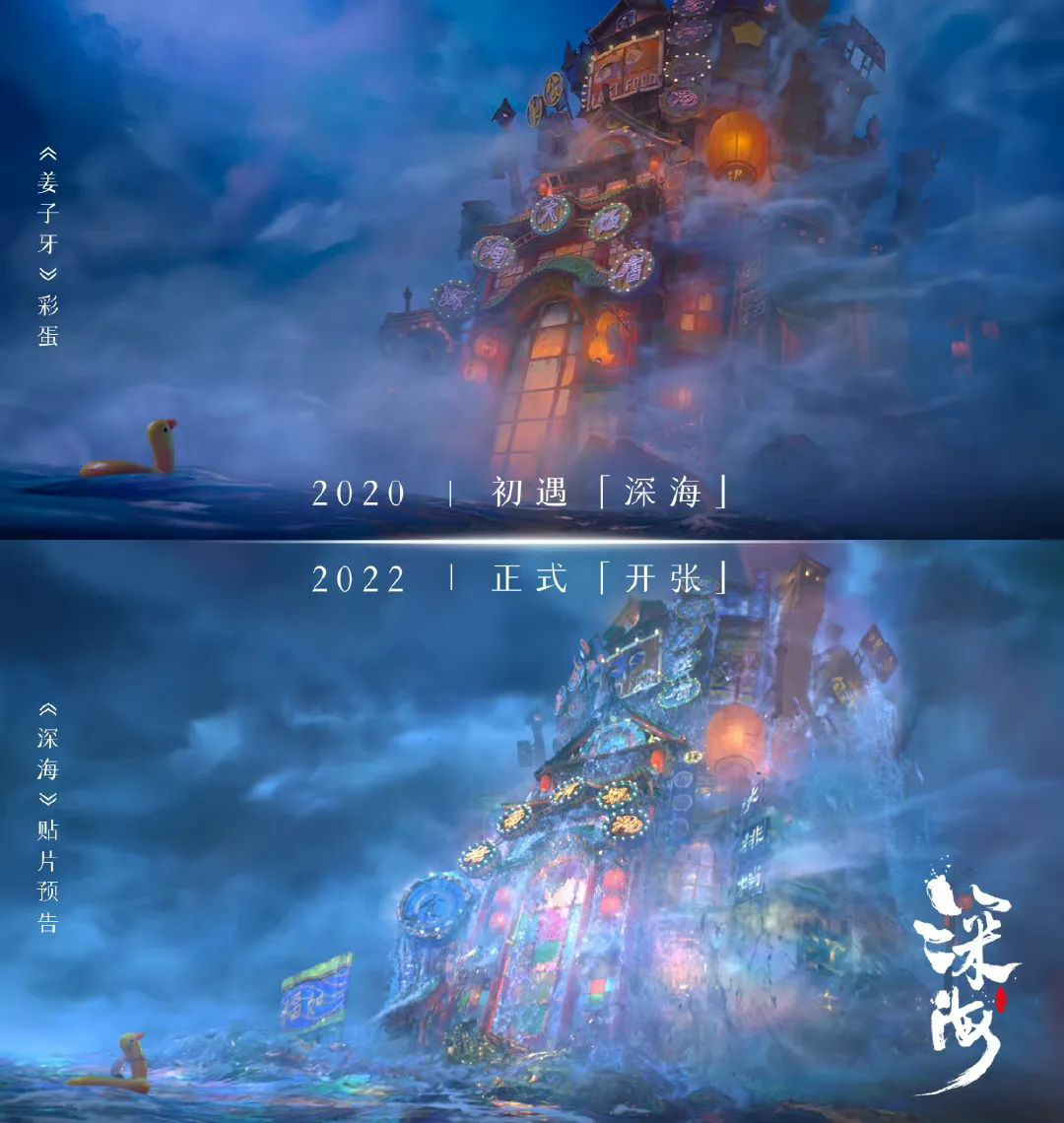
In the National Day of 2020, the film Legend of Deification was released, and the audience was amazed by the eggs at the end of the film "Deep Sea". At that time, it was less than two years before the scheduled release of Deep Sea.


This process is grinding, and the team hopes to mass-produce, but if the quality can’t be guaranteed, mass production will only be empty talk. "It took almost one and a half years, and at the end of 2021, we really started to finish all the scenes and gradually entered the stage of mass production."


03.


In 2019, the phrase "My life is up to me" started the pursuit of golden sentences in the whole market, and many animated films began to pursue "burning".


"Deep Sea" didn’t, and its story was not appropriate. "This is a story about facing yourself."


Yi Qiao knows very well that after meeting the audience, this story "should cause considerable controversy." "Deep Sea" will have some thresholds, but no one can say where the thresholds will go.


In the whole creative process, Tian Xiaopeng will also consider the market and feel that it is appropriate to integrate into the joke, but Yi Qiao thinks instead, "We are not selling jokes. It is better to remove what is imposed and not affect the style of the whole film."


After the first screening of the film, as Yi Qiao predicted, some people thought the story was simple, while others were poked by stories and emotions. Just from the team’s point of view, "Tian Dao and I are both pursuing, hoping that this movie is meaningful." We hope to make a good-looking movie. "


There is no IP, no stars, and even the promotion of Deep Sea borrows from the past successful cases of two animators and faces the market with a brand-new attitude.


Now, the movie "Deep Sea" has seen the world. What will happen to the follow-up market?


Yi Qiao has no answer.


Tian Xiaopeng wrote lyrics to The Clown, the promotion song of the movie Deep Sea. There is a sentence in it, "He is very grandiose and says that he has magic. People come and go and others treat him as a joke. Don’t laugh at him."


Yes, don’t laugh at him. Deep Sea is an adventure, and adventure never has a definite answer.


Regulations on the punishment of managers of state-owned enterprises

  Xinhua News Agency, Beijing, May 28th

Regulations on the punishment of managers of state-owned enterprises

  Chapter I General Provisions

  Article 1 In order to standardize the punishment of managers of state-owned enterprises and strengthen the supervision of managers of state-owned enterprises, these Regulations are formulated in accordance with the Law of People’s Republic of China (PRC) Municipality on Administrative Punishment of Public Officials (hereinafter referred to as the Administrative Punishment Law of Public Officials) and other laws.

  Article 2 The managers of state-owned enterprises mentioned in these Regulations refer to the following public officials in state-funded enterprises:

  (a) personnel who perform the duties of organization, leadership, management and supervision in wholly state-owned companies and enterprises;

  (2) Persons who are nominated, recommended, appointed and approved by party organizations or state organs, wholly state-owned companies, enterprises and institutions, and who perform the duties of organization, leadership, management and supervision in state-owned holding and shareholding companies and their branches;

  (3) Personnel who engage in organization, leadership, management and supervision in state-owned holding and shareholding companies and their branches on their behalf with the approval or research decision of organizations responsible for managing and supervising state-owned assets in state-funded enterprises.

  The organs and units that appoint and remove managers of state-owned enterprises (hereinafter referred to as the appointment and removal organs and units) shall impose sanctions on illegal managers of state-owned enterprises, and the provisions of Chapters II and III of the Law on Administrative Punishment of Public Officials and these Regulations shall apply.

  Article 3 The disciplinary work of managers in state-owned enterprises shall adhere to the leadership of the Communist Party of China (CPC), the principle of the Party governing cadres, strengthen the construction of managers in state-owned enterprises, and promote the high-quality development of state-owned enterprises.

  Article 4 The appointment and removal organs and units shall strengthen the education, management and supervision of the managers of state-owned enterprises. The punishment given to the managers of state-owned enterprises should adhere to fairness and collective discussion and decision; Insist on combining leniency with severity and combining punishment with education; Adhere to the principle of the rule of law, take facts as the basis, take the law as the criterion, and protect the legitimate rights and interests of managers and related personnel of state-owned enterprises according to law.

  Article 5 Institutions that perform the responsibilities of investors or departments with cadre management authority shall, in accordance with laws, regulations and relevant provisions of the state, guide state-owned enterprises to integrate and optimize supervision resources, promote the connection between investor supervision and discipline inspection supervision, patrol supervision, audit supervision, accounting supervision and social supervision, improve a coordinated and efficient supervision mechanism, establish an internal supervision and management system that cooperates with and restricts each other, and enhance the systematicness, pertinence and effectiveness of supervision over state-owned enterprises and their managers.

  Article 6 The punishment given to the managers of state-owned enterprises shall be based on clear facts, conclusive evidence, accurate characterization, proper handling, legal procedures and complete procedures, which shall be appropriate to the nature, circumstances and degree of harm of their illegal acts.

  Chapter II Types and Application of Punishment

  Seventh types of punishment are:

  (1) warning;

  (2) recording a demerit;

  (3) recording gross demerits;

  (4) demotion;

  (5) Dismissal;

  (6) expulsion.

  Article 8 The period of punishment is:

  (1) Warning, 6 months;

  (two) demerit, 12 months;

  (3) Gross demerit, 18 months;

  (4) demotion and dismissal for 24 months.

  The punishment decision shall take effect as of the date when it is made, and the punishment period shall be counted from the date when the punishment decision takes effect.

  Ninth managers of state-owned enterprises have two or more illegal acts that need to be punished at the same time, and their punishments should be determined separately. If the types of punishments that should be given are different, the heaviest punishment shall be implemented; If more than one punishment of the same kind should be given below dismissal, the punishment period may be determined at least one punishment period and less than the sum of multiple punishment periods, but the longest period shall not exceed 48 months.

  Article 10 If a state-owned enterprise commits an illegal act or the decision made collectively by the managers of the state-owned enterprise is illegal and should be investigated for legal responsibility, the leaders who are responsible and the managers of the state-owned enterprise who are directly responsible shall be punished.

  If two or more managers of state-owned enterprises jointly violate the law and need to be punished, they shall be punished accordingly according to their respective responsibilities.

  Eleventh managers of state-owned enterprises in any of the following circumstances, can be given a lighter or mitigated punishment:

  (a) take the initiative to account for the illegal acts that I should be punished;

  (two) to cooperate with the investigation and truthfully explain my illegal facts;

  (three) to report the illegal acts of others, which are verified by investigation;

  (four) take the initiative to take measures to effectively avoid, recover losses or eliminate adverse effects;

  (5) playing a secondary or auxiliary role in joint illegal acts;

  (six) take the initiative to hand in or refund the illegal income;

  (seven) belong to promote the reform of state-owned enterprises due to lack of experience, first try mistakes;

  (eight) other lighter or mitigated circumstances as prescribed by laws and regulations.

  Giving a lighter punishment means giving a lighter punishment within the range of punishment that should be given to the illegal acts stipulated in these regulations.

  Mitigating the punishment refers to reducing the punishment by one file in addition to the punishment range that the illegal acts stipulated in these regulations should be subject to.

  Article 12 If the manager of a state-owned enterprise commits a minor illegal act and falls under one of the circumstances specified in the first paragraph of Article 11 of these Regulations, he may be reminded by conversation, criticized and educated, ordered to check or admonished, exempted or not punished.

  If the managers of state-owned enterprises are held hostage or coerced to participate in illegal activities because they don’t know the truth and do repent after criticism and education, they may be mitigated, exempted or not punished.

  Thirteenth managers of state-owned enterprises in any of the following circumstances, should be given a heavier punishment:

  (1) Whoever intentionally violates the law again during the punishment period shall be punished;

  (two) to prevent others from reporting and providing evidence;

  (three) collusion or forgery, concealment or destruction of evidence;

  (4) shielding the co-conspirators;

  (5) Coercing or instigating others to commit illegal acts;

  (6) Refusing to hand in or refund the illegal income;

  (seven) other aggravating circumstances as prescribed by laws and regulations.

  A heavier punishment refers to a heavier punishment within the range of punishment that should be given to illegal acts stipulated in these regulations.

  Fourteenth managers of state-owned enterprises shall not be promoted to posts, post grades and titles during the punishment period; Among them, those who have been recorded, recorded, demoted or dismissed shall not be promoted to the salary level. Those who have been removed from their posts shall be demoted in their posts or post grades, and their salaries and benefits shall be reduced at the same time. If dismissed, the employer shall terminate the labor contract according to law.

  Article 15 The property illegally obtained by the managers of state-owned enterprises and their own property used for illegal acts shall be returned to the original owners or holders, except for those that should be confiscated, recovered or ordered to make restitution by the relevant authorities according to law.

  The appointment and removal organs and units shall correct the positions, ranks, grades, positions and staff grades, professional titles, treatment, qualifications, academic qualifications, degrees, honors, awards and other benefits obtained by managers of state-owned enterprises due to illegal acts or suggest relevant organs, units and organizations to correct them according to regulations.

  Sixteenth retired managers of state-owned enterprises who have committed illegal acts before or after retirement should be punished, no decision on punishment will be made, but they can be investigated; Those who should be punished by demotion, dismissal or dismissal according to law shall be treated accordingly in accordance with the provisions, and the illegally obtained property and personal property used for illegal acts shall be dealt with in accordance with the provisions of Article 15 of these regulations.

  Chapter III Illegal Acts and Their Applicable Punishment

  Seventeenth managers of state-owned enterprises have one of the following acts, according to the provisions of Article 28 of the Law on Administrative Punishment of Public Officials, be given a demerit or a gross demerit; If the circumstances are serious, he shall be demoted or removed from his post; If the circumstances are serious, be dismissed:

  (1) Spreading remarks that are detrimental to upholding and improving the basic socialist economic system;

  (two) refusing to implement or disguised not to implement the relevant decision-making arrangements for the reform and development of state-owned enterprises and party building;

  (3) Harming national security and national interests in foreign economic cooperation, foreign aid and foreign exchanges.

  Publicly publishing articles, speeches, declarations and statements that oppose the guiding ideology of the country established by the Constitution, the Communist Party of China (CPC)’s leadership, the socialist system and reform and opening up will be dismissed.

  Eighteenth managers of state-owned enterprises have one of the following acts, according to the provisions of Article 30 of the Law on Administrative Punishment of Public Officials, given a warning, demerit or gross demerit; If the circumstances are serious, he shall be demoted or dismissed:

  (a) in violation of the provisions of the decision-making procedures, responsibilities and authority to decide on major decision-making matters of state-owned enterprises, important personnel appointment and removal matters, major project arrangements, large-scale capital operation matters;

  (2) Deliberately evading, interfering with or undermining collective decision-making, and individuals or a few people decide on major decision-making matters, important personnel appointment and dismissal matters, major project arrangements, and large-scale capital operation matters of state-owned enterprises;

  (three) refusing to implement or arbitrarily change the major decisions made by the party committees (groups), shareholders (general meetings), boards of directors, workers’ congresses and other collectives of state-owned enterprises according to law;

  (4) Refusing to implement, or in disguised form, delaying the implementation of decisions made by institutions, industry management departments and other relevant departments that perform the responsibilities of investors according to law.

  Article 19 Managers of state-owned enterprises who commit any of the following acts shall be given a warning, demerit or gross demerit according to the provisions of Article 33 of the Law on Administrative Punishment of Public Officials; If the circumstances are serious, he shall be demoted or removed from his post; If the circumstances are serious, be dismissed:

  (1) Taking advantage of his position, embezzling, stealing, defrauding or illegally occupying or misappropriating the property and customer assets of the enterprise and its affiliated enterprises by other means;

  (2) taking advantage of his position to extort or illegally accept other people’s property and seek benefits for others;

  (3) Bribing bribes to state organs, state-funded enterprises, institutions and people’s organizations, or to state employees, employees of enterprises or other units, foreign public officials and officials of public international organizations for the purpose of seeking illegitimate interests;

  (4) Taking advantage of the influence of authority or position, in violation of regulations, seeking personal gain for himself or others in major matters concerning the rights and interests of investors of state-owned assets in enterprises, as well as in engineering construction, asset disposal, publication and distribution, bidding and other activities;

  (5) conniving at or acquiescing in the personal gain of a specific related person by taking advantage of the influence of his own authority or position in major matters concerning the rights and interests of investors in state-owned assets and in the business management activities of the enterprise;

  (six) in violation of regulations, privately divide the state-owned assets to individuals in the name of the unit.

  Those who refuse to correct a specific related person for holding a post, taking a part-time job or engaging in business activities in violation of regulations, and do not obey the post adjustment, shall be removed from their posts.

  Article 20 If the manager of a state-owned enterprise commits any of the following acts, he shall be warned, given a demerit or given a serious demerit according to the provisions of Article 35 of the Law on Administrative Punishment of Public Officials; If the circumstances are serious, he shall be demoted or dismissed:

  (1) Exceeding the total wages or paying wages, or setting and distributing wage income in other forms such as allowances, subsidies and bonuses in addition to the total wages;

  (two) the total wage budget management is not implemented, or the total wage filing or approval procedures are not fulfilled as required;

  (three) in violation of regulations, self salary, incentives, allowances, subsidies and other welfare monetary income;

  (four) in training activities, office space, official vehicles, business entertainment, travel expenses and other aspects beyond the prescribed standards and scope;

  (five) public travel or disguised public travel in the name of study and training, investigation and research, and employee recuperation.

  Twenty-first managers of state-owned enterprises who commit any of the following acts shall be given a warning, demerit or gross demerit according to the provisions of Article 36 of the Law on Administrative Punishment of Public Officials; If the circumstances are serious, he shall be demoted or removed from his post; If the circumstances are serious, be dismissed:

  (a) in violation of regulations, individuals run enterprises through business, own shares or securities of unlisted companies (enterprises), engage in paid intermediary activities, register companies outside the country (territory) or invest in shares and other profit-making activities;

  (2) Taking advantage of his position to run an enterprise similar to the enterprise he works for for others;

  (three) in violation of regulations, without approval in the enterprise funded by the enterprise or other enterprises, institutions, social organizations, intermediaries, international organizations, etc.;

  (four) approved to work part-time, but in violation of regulations to receive salary or other income;

  (five) the use of enterprise insider information or other undisclosed information, business secrets, intangible assets, etc. for personal gain.

  Article 22 If the managers of state-owned enterprises infringe upon the legitimate rights and interests of the clients or social public interests in the course of performing their duties of providing social public services, and are verified by the regulatory authorities and put forward suggestions for punishment, they shall be given a warning, demerit or gross demerit according to the provisions of Article 38 of the Law on Administrative Punishment of Public Officials; If the circumstances are serious, he shall be demoted or removed from his post; If the circumstances are particularly serious, they will be expelled.

  Article 23 If the managers of state-owned enterprises commit any of the following acts, resulting in the loss of state-owned assets or other serious adverse consequences, they shall be given a warning, demerit or gross demerit according to the provisions of Article 39 of the Law on Administrative Punishment of Public Officials; If the circumstances are serious, he shall be demoted or removed from his post; If the circumstances are serious, be dismissed:

  (1) Interception, occupation, misappropriation or default of budgetary revenues that should be turned over to the state treasury;

  (two) in violation of regulations, do not perform or do not correctly perform the duties of investment management;

  (three) in violation of regulations, related transactions, financing trade, false transactions, false joint ventures, affiliated operations and other activities;

  (4) Failing to register or failing to register the property rights of state-owned assets within the time limit prescribed by the state, or forging, altering, leasing, lending or selling the property rights registration certificate (form) of state-owned assets;

  (five) refusing to provide relevant information or compiling false data, resulting in distortion of the performance evaluation results of state-owned enterprises;

  (6) Concealing the real situation of the enterprise, failing to truthfully provide relevant information and materials to intermediary service institutions such as accounting firms, law firms and asset appraisal institutions, or colluding with intermediary service institutions such as accounting firms, law firms and asset appraisal institutions to falsify.

  Twenty-fourth managers of state-owned enterprises who commit any of the following acts shall be given a warning, demerit or gross demerit according to the provisions of Article 39 of the Law on Administrative Punishment of Public Officials; If the circumstances are serious, he shall be demoted or removed from his post; If the circumstances are serious, be dismissed:

  (1) Money laundering or participating in money laundering;

  (2) Absorbing clients’ funds without accounting, illegally absorbing public deposits or absorbing public deposits in disguised form, and participating in private lending in violation of regulations or in disguised form;

  (3) Issuing loans in violation of regulations, or writing off bad debts and disposing of non-performing assets by reducing, suspending, reducing, deferring, and extending the loan principal;

  (4) Issuing financial bills and providing guarantees in violation of regulations, and accepting, paying or guaranteeing illegal bills;

  (five) in violation of the fiduciary duty, unauthorized use of client funds or other entrusted or trusted assets;

  (6) Forging or altering currency, precious metals, financial bills or securities issued by the state;

  (7) Forging, altering, transferring, leasing or lending business licenses or approval documents of financial institutions, and establishing financial institutions and issuing stocks or bonds without approval;

  (8) fabricating and disseminating false information that affects securities and futures trading, manipulating the securities and futures markets, providing false information or forging, altering or destroying trading records to trick investors into buying and selling securities and futures contracts;

  (9) Making false claims or participating in insurance fraud;

  (ten) stealing, buying or illegally providing other people’s credit card information and other citizens’ personal information.

  Twenty-fifth state-owned enterprise managers have one of the following acts, resulting in adverse consequences or influence, according to the provisions of Article 39 of the Law on Administrative Punishment of Public Officials, given a warning, demerit or gross demerit; If the circumstances are serious, he shall be demoted or removed from his post; If the circumstances are serious, be dismissed:

  (1) divulging the inside information or business secrets of the enterprise;

  (2) Forging, altering, transferring, leasing or lending administrative license certificates and qualification certificates, or leasing or lending the name of a state-owned enterprise or the font size in the enterprise name;

  (three) in violation of regulations, borrowing or borrowing local government debts in disguise;

  (four) in violation of regulations outside People’s Republic of China (PRC), causing major engineering quality problems, causing major labor disputes or other serious consequences;

  (five) failure to perform or fail to perform the duties of safety production management according to law, resulting in production safety accidents;

  (6) Formalistic and bureaucratic behaviors such as perfunctory response, buck passing, or one-sided understanding, mechanical implementation of the party and state line, principles and policies, and major decision-making arrangements;

  (7) Refusing, obstructing or delaying the work of investor supervision, audit supervision and accounting supervision carried out according to law, or refusing to rectify the problems found by investor supervision, audit supervision and accounting supervision, prevaricating and making false rectification;

  (eight) do not provide relevant information, submit relevant reports or fulfill the obligation of information disclosure, or cooperate with other subjects to engage in illegal acts;

  (nine) do not perform their statutory duties or illegally exercise their functions and powers, infringing upon the legitimate rights and interests of workers;

  (ten) in violation of regulations, refuse or delay the payment of small and medium-sized enterprises, wages of migrant workers, etc.;

  (eleven) instigating, instigating, forcing, conniving, shielding subordinates in violation of laws and regulations.

  Chapter IV Procedure of Punishment

  Article 26 The appointment and removal organs and units shall, in accordance with the cadre management authority, punish the managers of state-owned enterprises who commit illegal acts as stipulated in the Law on Administrative Punishment of Public Officials and these Regulations according to law, so as to protect the legitimate rights and interests of the managers of state-owned enterprises and related personnel.

  The appointment and removal organs and units shall, in combination with the organizational forms and organizations of state-owned enterprises and other actual conditions, clearly define the internal departments or institutions (hereinafter referred to as the undertaking departments) that undertake the disciplinary work of managers of state-owned enterprises, their responsibilities, authorities and operational mechanisms.

  Article 27 The investigation and handling of managers of state-owned enterprises suspected of violating the law shall be carried out by two or more staff members, and shall be handled according to the following procedures:

  (a) with the consent of the person in charge of the appointment and removal organ or unit, the undertaking department shall make a preliminary verification of the clues that need to be investigated and handled;

  (II) After preliminary verification, if the undertaking department thinks that the manager of the state-owned enterprise is suspected of violating the Law on Administrative Punishment of Public Officials and the provisions of this Ordinance and needs further verification, it shall file a case with the approval of the principal responsible person of the appointment and removal organ or unit, inform the manager of the state-owned enterprise under investigation in writing (hereinafter referred to as the respondent) and his unit, and notify the supervisory organ with management authority;

  (3) The undertaking department is responsible for further investigating the illegal acts of the investigated person, collecting and verifying relevant evidential materials, obtaining information from relevant units and personnel, forming a written investigation report, and reporting to the person in charge of the appointment and removal organ or unit, and the relevant units and individuals shall truthfully provide information;

  (4) The undertaking department will inform the investigated person of the facts found in the investigation and the basis for the proposed punishment, listen to their statements and arguments, and verify and record the facts, reasons and evidence presented by them. If the facts, reasons and evidence presented by the investigated person are established, they shall be adopted;

  (5) The undertaking department shall, after examination, put forward suggestions for handling, report to the leading members of the appointment and removal organs and units for collective discussion according to procedures, make a decision on giving punishment, exempting punishment, not giving punishment or withdrawing the case to the person under investigation, and notify the supervisory organ with management authority;

  (6) The appointment and removal organ or unit shall, within one month from the date of making the decision in Item 5, Paragraph 1 of this Article, notify the person under investigation and his unit in writing of the decision to punish, exempt from punishment, refuse to punish or dismiss the case, and announce it within a certain range. If it involves state secrets, commercial secrets or personal privacy, it shall be handled in accordance with relevant state regulations;

  (seven) the undertaking department shall put the relevant decisions and implementation materials into the personal files of the investigated person, and at the same time collect relevant materials to form the working files of the punishment case.

  It is strictly forbidden to collect evidence by threats, temptations, deception and other illegal means. Evidence collected by illegal means shall not be used as the basis for punishment. The punishment shall not be aggravated because of the respondent’s defense.

  Twenty-eighth major illegal cases in the investigation process, if necessary, you can ask the supervisory organs with management authority to provide necessary support.

  If the illegal situation is complex, involves a wide range or has a significant impact, and it is difficult for the appointment and removal organ or unit to investigate and verify, with the consent of the person in charge of the appointment and removal organ or unit, the supervisory organ with management authority can be consulted for handling.

  Twenty-ninth to punish the managers of state-owned enterprises, it shall make a decision within 6 months from the date of filing the case; If the case is complicated or there are other special circumstances, it may be appropriately extended with the approval of the principal responsible person of the appointment and removal organ or unit, but the extension period shall not exceed 6 months.

  Thirtieth decided to give punishment, it shall make a written decision on punishment.

  The written decision on punishment shall specify the following items:

  (a) the name, work unit and position of the manager of the state-owned enterprise (hereinafter referred to as the punished person);

  (2) Illegal facts and evidence;

  (three) the types and basis of punishment;

  (four) refuses to accept the punishment decision, the way and time limit for applying for review and appeal;

  (five) the name and date of the organ or unit that made the decision on punishment.

  The written decision on punishment shall be stamped with the seal of the organ or unit that made the decision.

  Thirty-first people involved in the investigation and handling of illegal cases of managers of state-owned enterprises shall voluntarily withdraw under any of the following circumstances, and the respondents, prosecutors and other relevant personnel may ask them to withdraw:

  (1) Being a close relative of the respondent or the prosecutor;

  (2) Having served as a witness in this case;

  (3) He or his close relatives have an interest in the case under investigation;

  (four) other circumstances that may affect the impartial investigation and handling of the case.

  The withdrawal of the principal person in charge of the appointment and removal organ or unit shall be decided by the person in charge of the organ or unit at the next higher level; The withdrawal of other personnel involved in the investigation and handling of illegal cases shall be decided by the person in charge of the appointment and removal organ or unit.

  If the appointment and removal organ or unit finds that the personnel involved in the disciplinary work should be avoided, it can directly decide that the personnel should be avoided.

  Article 32 If the managers of state-owned enterprises are investigated for criminal responsibility according to law, the appointment and removal organs and units shall be punished according to the effective judgments, rulings and decisions of judicial organs and the facts and circumstances identified.

  If the managers of state-owned enterprises are subject to administrative punishment according to law and should be punished, the appointment and removal organs and units can be punished according to the facts and circumstances determined by the effective administrative punishment decision after verification.

  After the appointment and removal organ or unit makes a decision on punishment according to the provisions of the first and second paragraphs of this article, if the judicial organ or administrative organ changes the original effective judgment, ruling or decision according to law, which has an impact on the original decision on punishment, the appointment and removal organ or unit shall make corresponding treatment again according to the changed judgment, ruling or decision.

  Article 33 Where an appointment and removal organ or unit punishes the managers of state-owned enterprises who are deputies to people’s congresses at all levels or members of committees at all levels of the China People’s Political Consultative Conference, it shall notify the relevant Standing Committee of the People’s Congress, the Presidium of the People’s Congress of townships, nationality townships and towns or the Standing Committee of the People’s Political Consultative Conference of China.

  Article 34 If the managers of state-owned enterprises are suspected of violating the law and have been placed on file for investigation, it is not appropriate to continue to perform their duties, the appointment and removal organs and units may decide to suspend them from performing their duties. Managers of state-owned enterprises shall not leave the country or resign from public office without the consent of the appointment and removal organ or unit that decided to file the case during the investigation; Their appointment and removal organs and units, as well as organs and units at higher levels, shall not exchange, promote, reward or go through retirement procedures.

  Article 35 If it is found in the investigation that the managers of state-owned enterprises have suffered false reports, false accusations, frame-ups, insults and slanders for performing their duties according to law, resulting in adverse effects, the appointment and removal organs and units shall promptly clarify the facts, restore their reputations and eliminate the adverse effects in accordance with regulations.

  Article 36 If the managers of state-owned enterprises are punished by demotion, dismissal or dismissal, the relevant personnel departments shall, within one month after the decision is made, handle the procedures for changing their posts, positions, wages and other relevant benefits according to the management authority, and change or terminate the labor contract according to law; Under special circumstances, with the approval of the principal responsible person of the appointment and removal organ or unit, the processing period may be appropriately extended, but the longest period shall not exceed 6 months.

  Thirty-seventh managers of state-owned enterprises who have been punished other than dismissal, show repentance during the period of punishment, and there is no illegal situation that should be punished again, the punishment will be automatically lifted after the expiration of the punishment period.

  After the punishment is lifted, the post, rank, level, post and staff level, professional title and salary level of assessment and promotion will no longer be affected by the original punishment. However, the post, rank, grade, post and staff grade, professional title, salary and treatment grade, etc. before being punished are not restored.

  The appointment and removal organs and units shall, in accordance with the relevant provisions of the state, correctly treat and rationally use the managers of state-owned enterprises who have been punished, adhere to paying equal attention to incentives and supervision, and create a good environment for entrepreneurs.

  Chapter V Review and Appeal

  Article 38 If the person being punished refuses to accept the punishment decision, he may, within one month from the date of receiving the punishment decision, apply to the appointment and removal organ or unit that made the punishment decision (hereinafter referred to as the original punishment decision unit) for review. The original punishment decision unit shall make a review decision within 1 month after receiving the application for review.

  If the person being punished delays the application period for review due to irresistible reasons or other legitimate reasons, he may apply for an extension of the time limit within 10 working days after the obstacle is removed; Whether to approve or not shall be decided by the original punishment decision unit.

  Thirty-ninth people who are still dissatisfied with the review decision can appeal to the higher authorities and units within one month from the date of receiving the review decision. The organ or unit that accepts the complaint (hereinafter referred to as the complaint organ) shall make a decision within 2 months from the date of acceptance; If the case is complicated, it may be appropriately extended, but the extension period shall not exceed one month at most.

  If the person who has been punished delays the application period for appeal due to irresistible reasons or other legitimate reasons, he may apply for an extension of the time limit within 10 working days after the obstacle is removed; Whether to approve or not shall be decided by the appeal organ.

  Article 40 After the original punishment decision-making unit receives the application for review and the appeal organ accepts the appeal, the relevant undertaking department shall set up a working group to read the original case materials, and if necessary, conduct an investigation, collect and verify relevant evidence materials, and get to know the situation from the relevant units and personnel. The working group shall study collectively, put forward opinions on handling, report to the original punishment decision unit and the leading members of the appeal organ for collective discussion to make a review and appeal decision, and notify the supervisory organ with management authority. The decision of review and appeal shall be notified in writing to the punished person and his unit within 1 month from the date of making it, and announced within a certain range; Involving state secrets, commercial secrets or personal privacy, it shall be handled in accordance with relevant state regulations.

  During the period of review and appeal, the execution of the original punishment decision shall not be stopped.

  Managers of state-owned enterprises are not subject to heavier punishment because they file a review or appeal.

  Adhere to the separation of review and appeal from the original investigation, and the original investigation and contractor shall not participate in the review and appeal.

  Article 41 If an appointment and removal organ or unit finds that the punishment decision made by the organ, the unit or the lower-level organ or unit is indeed wrong, it shall promptly correct it or order the lower-level organ or unit to correct it in time.

  If the supervisory organ finds that the appointment and removal organ or unit should be punished but fails to give it, or the punishment given is illegal or improper, and puts forward supervision suggestions according to law, the appointment and removal organ or unit shall adopt it and inform the supervisory organ of the implementation, and shall explain the reasons if it is not adopted.

  Forty-second in any of the following circumstances, the original punishment decision unit and the appeal organ shall revoke the original punishment decision and make a new decision, or the appeal organ shall order the original punishment decision unit to make a new decision:

  (a) the illegal facts on which the punishment is based are unclear or the evidence is insufficient;

  (two) in violation of the procedures stipulated in these regulations, affecting the fair handling of cases;

  (three) beyond the authority or abuse of power to make a disciplinary decision.

  Forty-third in any of the following circumstances, the original punishment decision unit and the appeal organ shall change the original punishment decision, or the appeal organ shall order the original punishment decision unit to change it:

  (a) the application of laws and regulations is indeed wrong;

  (2) There is indeed an error in the determination of the circumstances of the illegal act;

  (3) Improper punishment.

  Forty-fourth the original punishment decision unit and the appeal organ think that the facts of the punishment decision are clear and the applicable law is correct, and they should be maintained.

  Article 45 If the decision on the punishment of the managers of state-owned enterprises is changed and it is necessary to adjust the positions, post grades, salary and treatment grades of the managers of the state-owned enterprises, it shall be adjusted in accordance with the provisions. If the punishment decision of the managers of state-owned enterprises is revoked and it is necessary to restore the positions, post grades and salary levels of the managers of the state-owned enterprises, corresponding positions and posts shall be arranged according to the original positions and post grades, and their reputations shall be restored within the scope of the announcement of the original punishment decision.

  Management personnel of state-owned enterprises whose punishment is revoked or mitigated due to the circumstances stipulated in Article 42 and Article 43 of this Ordinance shall be appropriately compensated for the loss of their remuneration and benefits in combination with their actual performance and performance contribution.

  The decision to maintain, change or cancel the punishment shall be served and announced in accordance with the provisions of Item 6, Paragraph 1, Article 27 of these Regulations within 1 month after it is made, and shall be deposited in the file of the person being punished.

  Chapter VI Legal Liability

  Article 46 If the appointment and removal organs, units and their staff members are under the circumstances stipulated in Articles 61 and 63 of the Law on Administrative Punishment of Public Officials in the disciplinary work of managers of state-owned enterprises, the responsible leaders and directly responsible personnel shall be dealt with according to the provisions of the Law on Administrative Punishment of Public Officials.

  Article 47 If the relevant organs, units, organizations or personnel refuse to carry out the punishment decision or have the circumstances stipulated in Article 62 of the Law on Administrative Punishment of Public Officials, they shall be dealt with by their superior organs, competent departments, institutions that perform the responsibilities of investors or appointment and removal organs and units in accordance with the provisions of the Law on Administrative Punishment of Public Officials.

  Forty-eighth relevant units or individuals who distort or fabricate facts and falsely accuse or frame managers of state-owned enterprises by means of reporting shall bear legal responsibilities according to law.

  Forty-ninth in violation of the provisions of this Ordinance, which constitutes a crime, shall be investigated for criminal responsibility according to law.

  Chapter VII Supplementary Provisions

  Article 50 Where the State has other provisions on the accountability of managers of illegal financial and cultural state-owned enterprises, they shall also apply.

  Fifty-first before the implementation of these regulations, if a case that has been closed needs to be reviewed and appealed, the provisions at that time shall apply. For cases that have not been closed, if the provisions at the time of the act are not considered illegal, the provisions at that time shall apply; If the provisions at the time of the act are considered illegal, it shall be dealt with in accordance with the provisions at that time, but if these regulations are not considered illegal or dealt with lightly according to these regulations, these regulations shall apply.

  Article 52 These Regulations shall come into force as of September 1, 2024.
Intangible heritage "touching the net" promotes protection and inheritance

"Online Snack Street", "Intangible Music Week" and "Intangible Online Shopping Festival" … Nowadays, many online intangible cultural heritage projects are becoming popular objects of netizens.

In recent years, with the rapid development of digital economy, the traditional industries have been constantly stimulated to change, and intangible cultural heritage has also been transformed into "online celebrity" by the express train of digital economy. In particular, the continuous introduction of relevant policies has brought unprecedented opportunities to the road of non-legacy "online celebrity". The "14th Five-Year Plan for the Protection of Intangible Cultural Heritage" recently released by the Ministry of Culture and Tourism emphasizes the use of short videos, live broadcasts and other new media to cultivate a number of "online celebrity" brands.

The data shows that there are nearly 900,000 intangible resources in China, but not all intangible resources are suitable for commercialization. Some "online celebrity" non-legacy projects have also caused some doubts. Some people think that they lack creativity, while others are worried about over-exploitation. This shows that non-legacy "touching the net" should balance the relationship between protection, inheritance and innovation and development, and can’t take care of one thing at a time and put the cart before the horse.

Specifically, first of all, we should take people as the core and make the non-legacy "live". Intangible cultural heritage is a people-centered live transmission, which should comprehensively consider the characteristics of non-genetic inheritors, disseminators and consumers, so as to inject more vitality into the intangible cultural heritage "online celebrity" market.

Secondly, make good use of digital media technology to make the intangible cultural heritage more "sensible". The blessing of new media such as short videos and live broadcasts can make the intangible heritage "audible", "tangible" and "taken away". However, we should also pay attention to the limitations of digital media in displaying intangible culture, and avoid making intangible brand-building stop at the surface and become a mere formality.

Finally, reasonably promote the development of non-legacy brands to make the transformation more "orderly". We should further improve the design and production level of intangible products, and at the same time, promote the transformation and upgrading of intangible brands in an orderly manner. Expand the brand influence and industrial chain of non-legacy products on the premise of maintaining the original product form and cultural essence.

Non-genetic inheritance not only needs to protect traditional skills, but also needs to continuously expand non-genetic broadcasting channels. Only by reasonably balancing the relationship between the two can the road of "online celebrity" be more stable, better and farther. (Wei Sun)

From now on, Wuhu will focus on rectification for one month!

Announcement No.6 on "Leave a message and I’ll do it" series activities;

"Special Action of Dregs Transportation Renovation and Law Enforcement"

From July 22nd to August 10th, the fifth phase of the series of activities of "Leave a message and I’ll do it" was carried out by the Municipal Clean Office, and 551 pieces of oil-proof mats were given to marinated duck stalls in the whole city (including 154 in Jinghu District, 129 in Yijiang District, 112 in Jiujiang District, 75 in Sanshan Economic Development Zone and 81 in Economic and Technological Development Zone), so as to clean up the accumulated sidewalks. There were 73 cases of administrative law enforcement (17 natural persons and 56 merchants), with a total fine of 10,650 yuan. The awareness of business owners has been improved, and with positive influence and effect, they will "look back" in due course.

In order to continue to do a good job in the "clean things" that the masses feel every day, according to the concerns of the masses, after research, it is decided to determine the theme of the sixth activity as "special action for the remediation and law enforcement of muck transportation". The relevant matters are hereby announced as follows:

I. Action content

Adhere to the principle of "centralized rectification, strict law enforcement and long-term implementation", fully implement the main responsibility of muck transport enterprises and the requirements of "six hundred percent" civilized construction, and impose administrative penalties on muck vehicles for disturbing people at night, spilling pollution, unclean body, unlicensed transportation, speeding and overloading (barbaric driving) and other violations according to law. Transport enterprises and construction units that violate the provisions in special actions shall be subject to the system of "four investigations in one case" (drivers, transport vehicles, transport enterprises and construction enterprises) in addition to administrative punishment according to law, and relevant responsibilities shall be investigated according to law.

Second, the action time

From August 15 to September 15, the follow-up was transferred to normalization inspection and law enforcement.

Third, the reporting channels

The "I love Wuhu, I want to be clean, and I’ll take photos" hand-picked platform opens the video uploading function, and people can find the "hand-picked" function through the platform (Wanshitong APP, Dajiang Kankan APP, Alipay and WeChat "Wanshitong" applet, and report the found muck management problems according to the prompt requirements).

Tel: 0553-5858110(24-hour reception), 5012288.

Fourth, the reward method

The fifth special action has been rewarded, and the sixth special action will continue to be rewarded with messages. After the end of this special action, if the message or telephone call from the Municipal Clean Office is of high quality, it will be awarded the title of "Clean Guardian" (the rewarded personnel will not be rewarded repeatedly) and will be awarded the 200 yuan Prize for each person’s value.

V. Disciplinary measures

1. If the muck vehicles spill pollution, the construction waste transport unit shall be fined not less than 5,000 yuan but not more than 20,000 yuan according to Article 30 of the Wuhu Construction Waste Management Regulations. If the construction site does not meet the requirements of civilized construction, a fine of not less than 10,000 yuan but not more than 100,000 yuan shall be imposed according to the provisions of Article 115th of the Law of People’s Republic of China (PRC) on the Prevention and Control of Air Pollution; Other illegal acts shall be given administrative punishment according to relevant laws and regulations.

2. The muck transport enterprises and vehicles that have serious violations of laws and regulations, such as unlicensed transport, serious car body pollution, large-scale road pollution, and stealing construction waste, shall be banned from operating qualifications in accordance with regulations.

Complaint Tel: 0553-5013091.

Attachment:

1. Information Table of Key Unearthed Sites in Wuhu City (23 in total);

2. List of construction waste transport enterprises and muck transport vehicles in Wuhu City (a total of 30 enterprises and 451 muck transport vehicles).

Wuhu is the cleanest city in China.

Work leading group office

August 15, 2022

Attachment 1:

Information table of key unearthed sites in Wuhu city

(23 in total, including the site to be excavated in the near future, not limited to the following list)

Positive list: the vehicle capacity is clean and tidy, the signs are intact, the vehicle is sealed and sealed, the vehicle is driven in a civilized way, and the entrance and exit of the construction site are clean and orderly.

Negative list: muddy car body, incomplete logo, airtight car body, rough driving, unlicensed transportation, not driving according to the prescribed route and time, dumping muck, messy entrance and exit of the construction site, and failure to apply for construction waste disposal permit at the construction site.

zone

Project name

Development enterprise

Owner’s unit

traffic unit

jing hu district

(6 in total)

1. Tiancheng Binjiang House

Anhui kecheng house purchasing

Luxing company

2. Wutong Lane Project of Phase II of Ancient City

Wuhu real estate investment

Qiangfeng company

3. Neighborhood Center (intersection of Zheshan Road and Yijiang Road)

Livable company

Zhengfeng company

4. Yuejiangwang Earthwork Backfill Project

Xinwan house purchasing

Jihe company

5. Shenshan Smart Sports Ecological Park (to be unearthed in the near future)

City key department

Jiangcheng Hongyao company

6. The project of collecting railway houses and building the second bid section of the hub project in the station area

City key department

Shuntong company

jiujiang district

(10 in total)

7. the lake and the mountains are covered with clouds

Weixing house purchasing

Jiurui company

8. Weixing Tanyue Community

Weixing house purchasing

Shuntong company

9. Plots 1 and 3 of Weixing Sky City

Weixing house purchasing

Shuntong company

10. Plots 2 and 4 of Weixing Sky City

Weixing house purchasing

Dasheng company

11. Neighbourhood Center (Yuncong Road plot)

Livable company

Zhijie company

12. Zhongjiang New Town 2005 Parcel Project

Sanwan house purchasing

Shuntong company

13. Jiangbei Second Road, Highway Bridge Connection Project of Wuhu Yangtze River Highway Bridge of Shanghehang Railway

Nanjing jiuda

Beikun company

14. Sai Wan Garden Resettlement Community

Hunan liujian

Qiangfeng company

15 Anhui Haichuang New Energy Materials Co., Ltd.

China railway 19 th bureau

Zhengfeng company

16. Xinyi Jiangbei Photovoltaic Module Cover Project

Tianjiu company

Jihe company

yijiang district

(3 in total)

17. Earthwork of plots 1# and 2# on the south side of Dafa Eshan Road

Maoyin house purchasing

Kunlun company

18. Emerald Riverside Phase II

Liangxu corporation consulting

Luxing company

19. An Normal University Liberal Arts Complex

China construction 5 th division

Zhijie company

Economic development zone

(2 in total)

20. Neighborhood Center (intersection of songshan road and Qiandao Lake Road)

Livable company

Luxing company

21. Pingping Project of Fenghesheng Intelligent Equipment Project

Economic development zone jianguanchu

Shuntong company

Sanshan Economic Development Zone

(2 in total)

22. Sanshan Jinyu International Commercial Plaza (to be unearthed in the near future)

Weixing house purchasing

Dexiang company

23. Yunjin Community in Zhongcheng Times (to be unearthed in the near future)

Chengyuan house purchasing

Anping company

Attachment 2:

List of construction waste transport enterprises and muck transport vehicles in Wuhu City

(A total of 30 enterprises, 451 muck transport vehicles)

serial number

name of the company

business address

transport vehicle

one

Wuhu Luxing Earthwork Engineering Co., Ltd. (15 vehicles in total)

Room 1620, Office B#, New Metropolis, Jinghu Century City, Jinghu District

Anhui B54888, Anhui B54785, Anhui B54769, Anhui B54796, Anhui B54727, Anhui B54789, Anhui B54730, Anhui B54709, Anhui B54758, Anhui B54767, Anhui B54775, Anhui B54819, Anhui b54744.

2

Wuhu Qiangfeng Earthwork Engineering Co., Ltd. (15 vehicles in total)

Room 102, Unit 1, Building 9, Shen ‘ao Garden, Shenxiang Town, Jiujiang District

Wan B54887, Wan B54621, Wan B54859, Wan B54540, Wan B54857, Wan B54852, Wan B54751, Wan B54889, Wan B54872, Wan B54728, Wan B29130, Wan B31911, Wan B39082.

three

Anhui Jiangcheng Hongyao Earthwork Co., Ltd. (17 vehicles in total)

6517, No.2, Liansheng Commercial Plaza, Wuhu, Jinghu District

Wan B55269, Wan B55263, Wan B55213, Wan B55293, Wan B55163, Wan B55399, Wan B55373, Wan B55322, Wan B55313, Wan B55366, Wan B05978, Wan B12678, Wan B09096.

four

Wuhu Chengguang Earthwork Co., Ltd. (15 vehicles in total)

Room 101-102, Building 19, Central City, Yijiang District

Wan B55599, Wan B55523, Wan B55585, Wan B55545, Wan B55563, Wan B55597, Wan B55505, Wan B5560, Wan B55509, Wan B55432, Wan B06817, Wan B12186, Wan B13618.

five

Wuhu Dongfeng Construction Co., Ltd. (13 vehicles in total)

No.288-1, Limin West Road, Yijiang District

Wan B54867, Wan B54809, Wan B54878, Wan B54838, Wan B54816, Wan B54860, Wan B54881, Wan B54895, Wan B54876, Wan B54886, Wan B55248, Wan B13133, Wan B16888.

six

Wuhu Jihe Earthwork Co., Ltd. (25 vehicles in total)

A918 Huijin Square, Jinghu District

Anhui B55291, Anhui B55296, Anhui B55228, Anhui B55287, Anhui B55222, Anhui B55223, Anhui B55210, Anhui B55226, Anhui B55277, Anhui B55216, Anhui B55663, Anhui B55680, Anhui B55608.

seven

Wuhu Anping Earthwork Engineering Co., Ltd. (14 vehicles in total)

Room 3101, Unit 1, Building D2, Central City, Yijiang District

Anhui B55330, Anhui B55392, Anhui B55307, Anhui B55323, Anhui B55306, Anhui B55395, Anhui B55360, Anhui B55326, Anhui B55372, Anhui B55339, Anhui B55677, Anhui B00020, Anhui B22837.

eight

Wuhu Dasheng Earthwork Engineering Co., Ltd. (10 vehicles in total)

Floor 1#2, Building 3, Leyuan Community, Jinghu District

Wan B54817, Wan B54865, Wan B54808, Wan B54828, Wan B54883, Wan B54869, Wan B54882, Wan B54858, Wan B54835, Wan B54897.

nine

Wuhu Dexiang Earthwork Engineering Co., Ltd. (11 vehicles in total)

2B100, Liansheng International Commercial Plaza, Jinghu District

Anhui B55110, Anhui B55115, Anhui B55158, Anhui B55177, Anhui B55160, Anhui B55197, Anhui B55189, Anhui B55303, Anhui B55103, Anhui B55113 and Anhui B15830.

10

Wuhu Jinyao Earthwork Engineering Co., Ltd. (10 vehicles in total)

Room 1621, Office Building B#, New Metropolis, Jinghu Century City, Jinghu District

Anhui B55386, Anhui B55179, Anhui B55025, Anhui B54917, Anhui B55047, Anhui B55200, Anhui B55198, Anhui B55242, Anhui B55141 and Anhui B55203.

11

Wuhu Kunlun Construction Engineering Co., Ltd. (18 vehicles in total)

401, 403, 405 and 407, No.1 Office Building, Baizhuang Fortune Plaza, Jiujiang District

Wan B54792, Wan B54732, Wan B54757, Wan B54683, Wan B54715, Wan B55300, Wan B54790, Wan B54770, Wan B54779, Wan B54673, Wan B54773, Wan B54793, Wan B54723.

twelve

Wuhu Lubao Automobile Transport Co., Ltd. (15 vehicles in total)

3-2603, Building 10#, Xinli Eton Mansion, Jinghu Century City, Jinghu District

Anhui B54898, Anhui B54523, Anhui B54806, Anhui B54855, Anhui B54815, Anhui B54875, Anhui B54879, Anhui B54885, Anhui B54861, Anhui B54900, Anhui B54877, Anhui B54738, Anhui B54702.

13

Wuhu Weifeng Earthwork Engineering Co., Ltd. (17 vehicles in total)

Jinding 1412, 99 Jingjie, Jinghu District

Anhui B55310, Anhui B55273, Anhui B55480, Anhui B55499, Anhui B55461, Anhui B55317, Anhui B55438, Anhui B55428, Anhui B55448, Anhui B08699, Anhui B11660, Anhui B11899, Anhui B08311.

14

Wuhu Shuntong Earthwork Engineering Co., Ltd. (17 vehicles in total)

No.21 Nibu West Road, Gaoan Street, Yangtze River Bridge Comprehensive Economic Development Zone

Wan B54247, Wan B54731, Wan B54752, Wan B54782, Wan B54512, Wan B54513, Wan B54637, Wan B54739, Wan B54735, Wan B54613, Wan B06016, Wan B05776, Wan B29192.

15

Wuhu Zhengfeng Road Transport Co., Ltd. (10 vehicles in total)

Room 1106, Office Building B#, New Metropolis, Jinghu Century City

Anhui B55078, Anhui B55015, Anhui B55272, Anhui B55211, Anhui B55281, Anhui B55239, Anhui B55236, Anhui B55208, Anhui B55050 and Anhui B55517.

16

Wuhu Zhijie Earthwork Engineering Co., Ltd. (15 vehicles in total)

Room 1076, Building 2A, Zone 1, Nanxiang Wanshang Business Logistics City

Wan B54632, Wan B54651, Wan B54635, Wan B54645, Wan B54643, Wan B54697, Wan B54619, Wan B54631, Wan B54625, Wan B54623, Wan B16260, Wan B12992, Wan B16289.

17

Wuhu Jiurui Earthwork Co., Ltd. (17 vehicles in total)

Room 619, No.1 Office Building, Baizhuang Fortune Plaza, Jiujiang District

Anhui B55260, Anhui B55253, Anhui B55207, Anhui B55297, Anhui B55243, Anhui B55379, Anhui B55353, Anhui B55652, Anhui B55692, Anhui B55657, Anhui B55697, Anhui B07196,

Anhui B00193, Anhui B01836, Anhui B03344, Anhui B18994 and Anhui B02187.

18

Wuhu Jinkun Earthwork Engineering Co., Ltd. (15 vehicles in total)

Room 101, Unit 1, Building 10, Zone D, Longhu Xincheng Community, sanshan district

Wan B19889, Wan B07567, Wan B06588, Wan B18169, Wan B11616, Wan B15979, Wan B17868, Wan B05585, Wan B11131, Wan B15911, Wan B17369, Wan B39230, Wan B07930.

19

Wuhu Chengjian Earthwork Co., Ltd. (10 vehicles in total)

Room 502, No.1 Office Building, Baizhuang Fortune Plaza, Jiujiang District

Wan B01893, wan B09369, wan B11589, wan B14577, wan B10499, wan B10577, wan B19817, wan B10306, wan B06198, wan B16977.

twenty

Wuhu Junsheng Earthwork Engineering Co., Ltd. (29 vehicles in total)

Room 1709, Division 1, Fudi Nanduhui, Yijiang District

Wan B02289, Wan B01033, Wan B01056, Wan B01295, Wan B02322, Wan B02331, Wan B01536, Wan B03710, Wan B21550, Wan B23031, Wan B00343, Wan B07888, Wan B29878. Anhui B25508, Anhui B08410, Anhui B23785, Anhui B05637, Anhui B00362, Anhui B32153, Anhui B39206, Anhui B36355, Anhui B36201, Anhui B36698 and Anhui B36368.

21

Wuhu Jianglu Earthwork Co., Ltd. (16 vehicles in total)

No.36, Building C, Lugang Community, Yijiang District

Wan B01466, Wan B04400, Wan B01971, Wan B01777, Wan B03593, Wan B23839, Wan B01573, Wan B17930, Wan B22099, Wan B01903, Wan B00392, Wan B23397, Wan B15975.

22

Wuhu Dinghong Earthwork Co., Ltd. (16 vehicles in total)

No.44-1, Senhai City Garden, Yijiang District

Wan B02456, Wan B11846, Wan B01899, Wan B02080, Wan B07150, Wan B06037, Wan B23823, Wan B01270, Wan B05408, Wan B00086, Wan B10428, Wan B00022, Wan B04489.

23

Wuhu Huawen Municipal Engineering Co., Ltd. (19 vehicles in total)

27#401, Sunshine Huayu, Century City, Jinghu District

Wan B00145, Wan B00400, Wan B00409, Wan B00891, Wan B01789, Wan B02213, Wan B02520, Wan B02603, Wan B04970, Wan B07788, Wan B29362, Wan B13522, Wan B13599.

24

Wuhu Junhui Earthwork Engineering Co., Ltd. (11 vehicles in total)

Room 1412, Jingjie Building, Jinghu District

Anhui B21501, Anhui B29739, Anhui B10416, Anhui B28706, Anhui B29180, Anhui B28003, Anhui B27321, Anhui B28821, Anhui B29470, Anhui B04971 and Anhui B29986.

25

Wuhu Fang Wei Earthwork Engineering Co., Ltd. (19 vehicles in total)

Room 2414, Building 1, Baizhuang Times Square, Lugang Street, Yijiang District

Wan B00888, Wan B04123, Wan B29115, Wan B02630, Wan B09455, Wan B00372, Wan B23853, Wan B01410, Wan B21789, Wan B25246, Wan B21975, Wan B22925, Wan B26178.

26

Wuhu Songjiang Qingyun Service Co., Ltd. (19 vehicles in total)

Room 01, Building 8, Taiyuan New Village, Jinghu District

Wan B07743, Wan B08249, Wan B34131, Wan B06435, Wan B01157, Wan B01229, Wan B09923, Wan B22500, Wan B22299, Wan B07480, Wan B02182, Wan B03100, Wan B02176.

27

Anhui Zhongken Construction Engineering Co., Ltd. (10 vehicles in total)

Room 201, Shop 1#, Baizhuang Golden Tower, Dagongshan Road, Yijiang District

Anhui B37491, Anhui B36011, Anhui B38311, Anhui B38391, Anhui B36965, Anhui B38820, Anhui B28255, Anhui B30811, Anhui B37902 and Anhui B36125.

28

Wuhu Lufan Transport Co., Ltd. (10 vehicles in total)

No.11, Longgeng Formation, Yumin Village, Gaoan Street, Sanshan Economic Development Zone

Anhui B38099, Anhui B29863, Anhui B36211, Anhui B36846, Anhui B38030, Anhui B36617, Anhui B35867, Anhui B35957, Anhui B28588 and Anhui B37262.

29

Wuhu Shunli Transport Co., Ltd. (12 vehicles in total)

South of Yaoshi Brewery, No.99 San ‘e Road, Sanshan Street, Sanshan Economic Development Zone

Wan B13866, Wan B35895, Wan B38976, Wan B38710, Wan B38688, Wan B29806, Wan B38037, Wan B37465, Wan B35712, Wan B38645, Wan B38686, Wan B36436.

30

Wuhu Runfa Logistics Co., Ltd. (11 vehicles in total)

No.27, Gongjian District 2, Matang New Town, Yijiang District

Anhui B39603, Anhui B38227, Anhui B37945, Anhui B36338, Anhui B37108, Anhui B38700, Anhui B37328, Anhui B28899, Anhui B38721, Anhui B29823 and Anhui B31162.

Wuhu

Source | Dajiang Information

Original title: "From now on, Wuhu will focus on rectification for one month! 》

Read the original text

China’s Intangible Glory of the Times

China’s Intangible Glory of the Times

—— Sidenotes on the announcement of 2020 "China Intangible Cultural Heritage Person of the Year"

Guangming Daily reporter Zhang Yuling Liu Meng

  Lantern Festival is not only a traditional festival in China, but also a national intangible cultural heritage project. On such a special day, China’s non-legacy people welcome another year’s grand event. Guided by the Intangible Heritage Department of the Ministry of Culture and Tourism, sponsored by Guangming Daily, and jointly promoted by Guangming.com and Guangming Daily, a "cultural power", the 2020 "China Intangible Heritage Person of the Year" selection campaign was announced. Ten representatives who worked hard in the intangible heritage field, such as Zhang Boli, Chen Zhenglei, Yang Rang and Chao Ge Jin, came to the front desk, telling their own intangible heritage stories and life feelings and sharing their intangible fate and cultural feelings. Sincere feelings and simple words show the unique style of the times, and let people see the great vitality of Chinese excellent traditional culture.

China's Intangible Glory of the Times

  Sweep and watch more exciting.

  The great war exam shows great strength.

  Just the day before, he won the honorary medal of "National Advanced Individual for Poverty Alleviation" in the Great Hall of the People. The next day, he appeared in the venue of non-legacy figures. Qiao Jin Shuangmei, a county-level representative inheritor of Yi people’s hand embroidery from Daliangshan, can be described as "double happiness".

  "This modern Yi embroidery on my body is implanted with fashion design in traditional patterns, with black, red and yellow as the main colors, and a small tricolor culture represents good luck." Qiao Jin Shuangmei’s Yi costume is a "new work" for embroidered mothers to get rid of poverty. "The story of Yi embroidery and I can’t be finished in three days and three nights. If I am grateful in my heart, I can’t finish it in three days and three nights!" After receiving the trophy of "China Intangible Cultural Heritage Person of the Year", her tone was a little excited. "Intangible cultural heritage has changed the fate of women in the mountains; A small embroidery needle has become a secret weapon to get rid of poverty and get rich. "

  Another Song Shuixian, dressed in national costume, is a national representative inheritor of the ponytail embroidery of the Shui nationality in Guizhou. She also led the villagers to turn their ancestral embroidery skills into a golden rice bowl to get rid of poverty and get rich, and also learned to bring goods through the Internet, so that the Shui nationality embroidery can walk out of the mountains and into the lives of modern people.

  The overall victory in getting rid of poverty and the great victory in the fight against epidemic diseases have been engraved in the annals of 2020, and they have also left a unique contribution to the world. Like Qiao Jin Shuangmei and Song Shuixian, Zhang Boli, the "people’s hero", completed the identity transformation on this stage.

  In last year’s anti-epidemic battlefield, Academician Zhang Boli and Wuhan "treated each other with sincerity", which was touching. He has won many awards, but it is the first time that he won the award as a national representative inheritor of traditional Chinese medicine preparation methods. Because he couldn’t go to the event site on official business, Zhang Boli waited at the other end of the connection screen early. He said excitedly: "Chinese medicine participated in the fight against the epidemic all the time and played a very important role at all stages. It can be said that Chinese medicine has also become the highlight of China’s fight against the epidemic."

  Indeed, in the soul-stirring struggle against the epidemic, ancient Chinese medicine has contributed outstanding eastern power. Data show that more than 70,000 people in COVID-19 have used traditional Chinese medicine, and the total effective rate of traditional Chinese medicine is over 90%.

  "As a big country, our science and technology progress and industry progress, so does our culture. Carrying forward traditional culture is the foundation of a big country. " Zhang Boli firmly said, "Intangible cultural heritage has important cultural value, and the annual event of intangible cultural heritage is a very meaningful activity. I am honored to receive this honor and will continue to work hard to spread the excellent Chinese culture."

  Don’t change your mind when you are moving forward.

  Concentrated and calm, with soft and soothing music, Chen Zhenglei, the national representative inheritor of Tai Ji Chuan (Chen Tai Ji Chuan), and his two disciples stretched their muscles, introduced the old and brought forth the new, braked by static, talked with heaven and earth with softness, and blended with nature, and showed the beauty of rigidity, charm and coordination of Tai Chi at the event site.

  Tai Ji Chuan and the boat to send the king were officially listed in UNESCO’s representative list of human intangible cultural heritage, which became a milestone event for China in 2020. At this point, the number of human non-legacy in China has increased to 42, ranking first in the world, condensing the inheritance, persistence and dedication of generations of non-legacy people.

  Winning the "China Intangible Cultural Heritage Person of the Year" is the highest praise for Chen Zhenglei’s incessant practice and skills spread over the past 60 years. From a person, a family, leading a team, a set of boxing around the world; From Chenjiagou, Henan to more than 100 teaching points in more than 60 countries; From books only in Chinese to translated into 9 languages and published in more than 100 countries, Chen Zhenglei admits that "it is full of hardships along the way", but the "initial heart" that supports the eleventh descendant of Chen Tai Ji Chuan is: "We must carry forward Tai Ji Chuan left by our ancestors and make greater contributions to human health."

  In October, 2020, General Secretary of the Supreme Leader wrote back to the teachers and students of China Theatre Academy, saying that people are the key to the prosperity and development of drama. In 2020, "China’s Person of the Year" was brilliant, and three "actors" on the opera stage won awards: Wang Fang, the national representative inheritor of Kunqu Opera, Yao Xuanqiu, the national representative inheritor of Chaozhou Opera, and Zhu Shihui, the national representative inheritor of Peking Opera.

  Different plays and different performances, but the same roles are "inheritors" and have the same "initial heart": the play is bigger than the sky, and every play and every role should be performed well; It is necessary not only to sing and play on the stage, but also to take the disciples, pass them on from generation to generation.

  In October, 2020, General Secretary of the Supreme Leader inspected Chaozhou and pointed out that Chaozhou intangible cultural heritage represented by Chaozhou embroidery, Chaozhou porcelain, Chaozhou sculpture, Chaozhou opera, congou tea and Chaozhou cuisine is a treasure of Chinese culture. "Chaozhou opera is sung in local dialects, and the story of Chaozhou opera is the story of Chaoshan people, which is deeply loved by Chaoshan people at home and abroad." Yao Xuanqiu, the 85-year-old national representative inheritor of Chaozhou Opera, has retired for more than 20 years, but he has been busy with the inheritance work. She led a group of Chaozhou opera people to make unremitting efforts to make Chaozhou opera with a history of more than 500 years more and more popular among young people.

  Chaozhou opera is more "trendy" and clowns are not "ugly". Zhu Shihui, the "first clown in Beijing Opera", understands his role and initial intention as follows: "There are four major businesses in Beijing Opera: life, beauty, purity and ugliness, and each business has its own beauty. The clown is a comedian in Beijing Opera. We must temper and improve our performances, so that the clown can also have his own artistic beauty and bring laughter and joy to the audience. "

  Wang Fang couldn’t come to Beijing to attend the meeting. In the remote connection, she explained the reason. "2021 is the centenary of the founding of the Communist Party of China (CPC). We are taking the time to rehearse an original modern Su Ju" Gusu Family "and present it to the Communist Party of China (CPC) for a hundred years." Wang Fang said, "As party member, I am very happy to present a sincere birthday gift to the party on this special day; As a non-genetic inheritor, we will continue to work hard to carry forward fine traditions, persist in innovation, and do a good job in inheritance and communication! "

  In the continuous struggle, the roots are deep and leafy.

  "A handful of soil raised his heavy feelings, and a book recorded his hot heart. He made folk art enter the room, transcending time and space, and nourishing the hearts of Chinese people."

  When 91-year-old Yang Xian walked slowly onto the podium with crutches, the audience gave a warm and lasting applause. Established the first folk art department in China at the Central Academy of Fine Arts; It is the first time to systematically sort out the folk culture of the Yellow River basin and write Fourteen Walks of the Yellow River-two firsts have made Yang Xian’s academic peak.

  Why do you want to measure the mother river with your footsteps and devote yourself to folk art in the sea of Wang Yang by means of field investigation? "The society is constantly changing, and many things disappear like the tide. I am in a hurry! In the history of more than 5,000 years of civilization in China, the Yellow River Basin has more than 3,000 years, and it is the national political, economic and cultural center. The Yellow River culture has absorbed many ethnic cultures and is the most representative, so I have to go! " Yang Xianrang’s "foresight" coincides with the judgment of the Central Committee’s "Symposium on Ecological Protection and High-quality Development of the Yellow River Basin": the Yellow River with nine twists and turns rushes forward, shaping the national character of the Chinese nation’s unremitting self-improvement with indomitable majestic momentum, which is an important foundation for the Chinese nation to strengthen its cultural confidence.

  Times make heroes, and greatness comes from the ordinary. In this year, more researchers, curators, designers, artists and entrepreneurs participated in the large-scale pattern of non-legacy work, and promoted the non-legacy cause to take root and last forever.

  Cross-border innovation made Sun Huaibin, vice president of China National Textile and Apparel Council, the "Person of the Year in China". Textile non-legacy involves many categories, wide coverage and rich varieties, including traditional crafts such as spinning, dyeing, weaving and embroidery, and various national costumes. Sun Huaibin believes that as the textile and garment industry chain moves towards the high end, increasing the exploration of textile non-legacy resources, non-legacy fashion, industrialization and internationalization will continue to inject new vitality into the high-quality development of the textile industry.

  Chao Ge Jin Shi, member of the Chinese Academy of Social Sciences and director of the Institute of Ethnic Literature, has won the "China Intangible Cultural Heritage Person of the Year" for many years. In his view, intangible cultural heritage is the common people’s culture, which was often only protected by the common people themselves in history, but this practice is far from enough today: "Knowledge is being refined, and people’s understanding of traditional culture is also improving, especially the intangible cultural heritage of the international community is also worthy of attention, and it is necessary to learn from the advanced international experience and combine the characteristics of China. In this way, with the management guidance of the government, the active input of the masses, the in-depth participation of scholars, the extensive support of intermediary organizations, and the joint efforts of various forces, we can contribute to the development of non-genetic inheritance’ China Experience’ and’ China Program’. "

  Guangming Daily (14th edition, March 1, 2021)

Boost foreign trade expectations with a long-term view

  According to the data released by the General Administration of Customs recently, the import and export of goods in China increased by 4.8% year-on-year in the first quarter of this year, and the export increased by 8.4%, reversing the slight decline in foreign trade from January to February, and the foreign trade showed accelerated growth on a monthly basis. The export growth data is even brighter. In March, exports increased by 23.4% year-on-year and 48.4% quarter-on-quarter, which was significantly higher than the export level from January to February. These data show that the advantages of China’s foreign trade development have emerged, showing strong resilience and a smooth start.

  At present, due to the persistent geopolitical conflicts, the tightening of monetary policies in major countries, high inflation and the uncertainty of global financial markets, the trade of all countries in the world is tightening, and the foreign trade competition is becoming increasingly fierce. China’s high labor productivity, constantly improving R&D level, strong industrial supporting capacity, large-scale market space, strong policy guarantee and continuous release of institutional innovation dividends constitute the comprehensive advantages of foreign trade toughness and stability, which reflects strong foreign trade competitiveness. To realize the strategy of strengthening the country by trade, we must take stabilizing confidence and boosting expectations as the basic foothold, and promote foreign trade subjects to have firm confidence in facing difficulties and turn it into positive and effective action consciousness, so as to better cope with various risk challenges and promote the leap from quantitative change to qualitative change in foreign trade.

  Expectation refers to a kind of psychological activity, which is a future psychological judgment formed on the basis of understanding the reality. In economics, expectation is the judgment of different subjects in the economy, such as government, enterprises and people, on the economic development trend, and accordingly they take corresponding actions. Generally speaking, with sufficient information, economic subjects can better understand the long-term factors affecting economic development, make correct judgments and take rational actions. However, under the condition of asymmetric information, economic subjects may only pay attention to the current situation and be influenced by short-term factors, forming irrational expectations for the future, making wrong judgments and behaviors, and affecting long-term economic development. At present, China’s foreign trade shows a stable and positive trend in the complex external environment, but there are also short-term fluctuations and difficulties. If foreign trade expectations weaken and irrational expectations appear, it will not be conducive to the stability and long-term sustainable development of foreign trade. Therefore, we must focus on the long-term, boost the good expectations of foreign trade development, guide foreign trade-related subjects to correctly understand the fundamentals of China’s foreign trade development, rationally judge the comprehensive advantages and long-term foundation of foreign trade development, and take scientific and reasonable actions.

  To boost foreign trade expectations, we must strengthen our faith. Eliminate the interference of short-term factors and bad news in foreign trade, emphasize the long-term belief in foreign trade development, and make long-term plans. It is not the short-term performance of some indicators that will boost the good expectations of foreign trade, and it is even more impossible to simply adopt a short-term single policy based on the ups and downs of some indicators. Instead, we should focus on the long-term development of trade, continuously adjust and improve policies, make a good combination of foreign trade policies, and put forward scientific and clear path plans for long-standing problems in foreign trade. Only in this way can foreign trade subjects comprehensively and rationally grasp the current situation and future of foreign trade, strengthen their beliefs and continue to exert their strength. A few days ago, the the State Council executive meeting put forward the idea of "continuously enriching, adjusting and perfecting relevant policies, and implementing a combination of policies to stabilize foreign trade", which brought good expectations for foreign trade development from a policy perspective.

  To boost foreign trade expectations, it is necessary to effectively implement and coordinate various policies and measures. According to the current situation of foreign trade development, in view of various deep-seated problems and constraints in foreign trade development, we should earnestly implement various policies to stabilize foreign trade and strengthen foreign trade, pay attention to coordinating and connecting all policies and measures, promote the balanced linkage among long-term foreign trade goals, key tasks, macro policies and reform measures, avoid policy conflicts and overlapping of executive agencies, strengthen policy synergy and improve good expectations for the effectiveness of foreign trade policy implementation.

  To boost foreign trade expectations, we need to strengthen publicity and communication to reduce information asymmetry. Through various channels, strengthen publicity and communication with foreign trade subjects, and strengthen foreign trade subjects’ cognition of various support policies and comprehensive advantages of foreign trade; Through the scientific interpretation of the strategy of strengthening the country by trade, we will increase the publicity of scientific planning and effective programs for foreign trade development, and enhance the rational expectations of foreign trade subjects for China’s high-level opening up. Respond to the demands and concerns of foreign trade enterprises in a timely manner, strengthen information symmetry, break down information barriers, and actively guide the healthy development of foreign trade subjects’ psychological expectations.

  It is also necessary to deepen the reform of foreign trade system to boost foreign trade expectations. With the goal of building a new open economic system at a higher level, we should continue to create a first-class foreign trade business environment, take the construction of a free trade pilot zone and a free trade port as an opportunity, deepen institutional reform in key areas of foreign trade, fully implement reform measures, promote foreign trade liberalization and facilitation, effectively transform government functions, build a service-oriented government, and create an open, transparent, fair competition, open and innovative foreign trade environment. At the same time, it will promote foreign trade subjects to form a positive understanding of future development space and opportunities, boost development expectations and activate foreign trade momentum. (This article Source: Economic Daily Author: Lan Qingxin)

Accelerate the development of new foreign trade formats and new models.

Cross-border e-commerce has maintained strong growth, overseas warehouses have become an important platform, and market procurement and trade methods have developed rapidly.
Accelerate the development of new foreign trade formats and new models.

Expand the pilot scope of the cross-border e-commerce comprehensive experimental zone, actively promote the development of overseas warehouses, and support qualified places to develop offshore trade … Around accelerating the development of new foreign trade formats and new models, the the State Council executive meeting held recently determined a series of measures. Relevant persons pointed out that the new format and new mode are the effective force of China’s foreign trade development and an important trend of international trade development. The policy measures put forward at this meeting involve a variety of new formats and new models, which are highly targeted and help to further promote the upgrading of foreign trade and cultivate new competitive advantages.

The scale of cross-border e-commerce has increased nearly 10 times in five years.

In recent years, new foreign trade formats and new modes in China have developed rapidly, and cross-border e-commerce is one of them. According to the data of the General Administration of Customs, in 2020, the import and export of cross-border e-commerce in China was 1.69 trillion yuan, a year-on-year increase of 31.1%.

Since the beginning of this year, cross-border e-commerce has continued to maintain strong growth. Gao Feng, spokesman of the Ministry of Commerce, said that in the first quarter of this year, the import and export of cross-border e-commerce reached 419.5 billion yuan, a year-on-year increase of 46.5%. There are the following new features: First, from the perspective of channels, cross-border e-commerce relies mainly on third-party platforms and gradually develops various new channels such as independent websites, social networking sites and search engine marketing. Second, from the main point of view, from the early individual and trade-oriented enterprises to the integration of trade-oriented enterprises and production enterprises, many production enterprises have changed from offline to online, and the digitalization level has improved significantly. Third, from the product point of view, from simply paying attention to cost performance to paying attention to brands, quality, standards and services, customized and personalized products have grown rapidly.

"In terms of scale and speed, the development of cross-border e-commerce has maintained a double-digit growth rate in recent years. The total scale has increased nearly 10 times in five years, and its proportion in foreign trade has continued to increase, especially under the impact of the epidemic, which has played an important role in stabilizing foreign trade." Zhang Jianping, director of the Regional Economic Cooperation Research Center of the Research Institute of the Ministry of Commerce, told this reporter that in order to further promote the development of cross-border e-commerce, it is necessary to continue to increase support, such as expanding the pilot scope of the cross-border e-commerce comprehensive experimental zone, optimizing the list of cross-border e-commerce retail imports, facilitating the management of cross-border e-commerce import and export returns, and formulating guidelines for cross-border e-commerce intellectual property protection.

Improve the digital and intelligent level of overseas warehouses

In the process of cross-border e-commerce development, overseas warehouses are important support points. The data shows that there are more than 1,800 overseas warehouses of cross-border e-commerce in China, which are distributed in Russia, Japan, South Korea, the United States and other countries and regions, and the growth rate will reach 80% in 2020, covering an area of over 12 million square meters.

"Overseas warehouses have become a new type of foreign trade infrastructure supporting the development of cross-border e-commerce, and are an indispensable and important link and platform for the development of cross-border e-commerce. By setting up overseas warehouses in the destination country, and then transporting the goods in batches, sorting, packaging and transporting them according to the local market, logistics efficiency can be effectively improved and comprehensive operating costs can be reduced. Especially during the epidemic prevention and control period, the advantages of overseas warehouses are prominent, because there is sufficient stocking, and local logistics can deliver faster. " Zhang Jianping said.

The the State Council executive meeting proposed to encourage traditional foreign trade enterprises, cross-border e-commerce and logistics enterprises to participate in the construction of overseas warehouses, improve the digitalization and intelligence level of overseas warehouses, promote small and medium-sized enterprises to borrow ships to go out to sea, and drive domestic brands and dual-innovation products to expand the international market space.

Zhang Jianping said that a series of measures not only focus on promoting more market players to participate in the construction of overseas warehouses, but also emphasize the application of new technologies, which will provide more powerful support for the development of overseas warehouses. "With the increasing support from all sides, there is still a lot of room for the development of overseas warehouses in the future, especially the construction of a new generation of intelligent logistics system, which will make overseas warehouses operate more efficiently and play a more important role, thus promoting cross-border e-commerce. Make greater contributions to stabilizing foreign trade and promoting the transformation and upgrading of foreign trade."

Actively develop the way of market procurement trade.

Focusing on new formats and new models, the the State Council executive meeting proposed to actively develop market procurement trade methods.

As a new trade model created for foreign trade transactions of "multi-variety, multi-batch and small-batch" in specialized markets, market procurement trade has developed rapidly in many places in recent years. Recently, in Dongguan, Guangdong Province, the export scale of the pilot market procurement trade of Da Lang Wool Trade Center launched at the end of last year exceeded 10 billion yuan. Up to now, 1,487 pilot operators of procurement trade in Dongguan market have been registered, and the export commodities involve furniture, daily necessities, textiles and clothing, etc., and are exported to 141 countries and regions.

"Market procurement trade mode has the characteristics of fast customs clearance and convenience. Foreign trade operators can purchase goods in the approved market gathering area and go through export customs clearance procedures at the purchasing place. Accelerating the development of market procurement trade methods will help enhance the ability to collect goods and brand influence, and further tap the trade potential. " Zhang Jianping said.

In addition, the executive meeting of the State Council proposed to guide foreign trade comprehensive service enterprises to improve the efficiency and risk control level of centralized tax refund, support enterprises in comprehensive bonded areas and pilot free trade zones to carry out bonded maintenance, and support qualified places to develop offshore trade.

Zhang Jianping said: "Next, we should speed up the development of new foreign trade formats and new models, strengthen the protection of intellectual property rights, formulate relevant rules in digital trade, and further promote international exchanges and cooperation. In this process, the Pilot Free Trade Zone can play a more active role and continue to promote the high-quality development of foreign trade. " (Reporter Qiu Haifeng)


Summary of 2017 genre films: the action film of multi-point flowering in the film market topped the list.

1905Film network feature  Film Bureau of State Administration of Press, Publication, Radio, Film and Television2017yeartwelvemoon31The data released in the evening shows that:2017In, the total box office of national movies was559.11100 million yuan, a year-on-year increase13.45%; Among them,Domestic film box office301.04100 million yuan, accounting for the total box office53.84%The number of domestic films exceeding 100 million has reached51Department.


The volume of the film market is growing steadily, and the creation of film content is also moving towards quality and diversification. Looking back on another year of China’s film industry, filmmakers once again offered coverage to the audience.Action, comedy, fantasy, suspenseAnd many other types of rich masterpieces. We witnessed the box office spectacle of 10.858 billion action movies, followed comedies and walked through the spring, summer, autumn and winter with a smile, and were moved by the amazing fantasy world in the movies and the humanistic feelings of the excellent works.


China movies in 2017 are "exciting enough, lively enough and worth watching".

The action movie "Wolf Warriors 2" dominated by 10.85 billion yuan achieved a new height in domestic films.


Action movies play an important role in all kinds of movies, and only such works can give full play to the sports characteristics of movies. In 2017, 28 domestic action movies landed in mainland cinemas, which captured 10.858 billion box office in one fell swoop, including 11 movies with over 100 million yuan, followed by Wolf Warriors 2 and. This data ranks first among all types, showing the unshakable dominance of such subjects.

"Wolf Warriors 2" stills


Among all these 28 works, Wolf Warriors 2, a phenomenal explosive work, has to be mentioned.5.68 billion single box office volume, nearly 160 million people watching movies.It not only helped the film successfully rank among the TOP100 in the global box office list, but also achieved a new height of domestic films from many angles. The title of the first box office in 2017 and the box office champion in mainland film history is only a part. Wolf Warriors 2 proves with its own strength that the theme of the main melody can be perfectly compatible with the creation of commercial films, and the story full of feelings for home and country can touch countless audiences. Like Wolf Warriors 2, the film "Hunting in the Sky", which focuses on the theme of military action, was released in the National Day file, and it also achieved more than 320 million success.

Stills of "England vs. England"


Apart from Jason Wu and his "Wolf Warriors 2", another kung fu movie star also made an eye-catching performance in the film market in 2017. He is Jackie Chan, whom we are most familiar with. The action comedy "Kung Fu Yoga" in the Spring Festival has a total box office of over 1.64 billion. Exotic family fun stories and cool kung fu fighting scenes vividly show Jackie Chan’s personal film style. On the National Day, however, he subverted the past and appeared in a slightly old-fashioned style, bringing a serious theme and a cold action style. Adding up the data of the two works, Jackie Chan’s box office contribution to the 2017 domestic action movie has exceeded 2.1 billion.


Comedy films are on the rise rapidly, and the explosions "Shame" and "Tianzhu" win the schedule with laughter.


Comedy movies have brought new changes and opportunities to China film market again and again, and created countless box office myths of "Little Soldiers Make Great Achievements". In 2017, the comedy film genre still gathered the most creativity of China filmmakers, and the number of 43 cinema films stood out among all types. At the same time, the box office is still laughing and cursing all the way, and the success of 4.338 billion yuan has increased rapidly compared with last year.

Stills of "The Iron Fist of Shame"


Mahua FunAge’s team, which has sprung up in the film market in the past two years, after becoming the dark horse of the year, launched the masterpiece "The Iron Fist of Shame" in the National Day of 2017. A solid script that has been tested by hundreds of drama stages, as well as wonderful interpretations by Allen, Mary, Shen Teng and others, remake a story of men and women who are not novel, giving a different feeling. During the 11th holiday, "The Iron Fist of Shame" took the lead in the film market, eventually attracting 2.2 billion yuan, and the audience scored more than 9 points, achieving a double harvest at the box office and word of mouth.

Poster of "Make a scene in Tianzhu"


Ranked second is the box office of nearly 720 million. This film is Wang Baoqiang’s directorial debut, and it also achieved good market response when it was released in the Spring Festival in 2017. Looking at the popular schedules of the whole year, such as the New Year’s Eve, there are many comedies. This fully shows that comedy is still the most popular theme for the audience. It not only makes us say goodbye to the past in laughter, but also makes us welcome the future with a brand-new attitude.

Next page:Fantasy type highlights the film industry level, and the volume advantage of single box office is obvious.

NASA funds "frozen dormancy" to study interstellar travel or come true

  "The earth is the cradle of human beings, but human beings cannot live in the cradle forever." This is the heroic words of tsiolkovsky, the father of modern rockets. So far, man has landed on the moon and looked at his home from another perspective. However, one big step for mankind is not far enough. The inability to support transportation and the lack of dry food supplies have restricted human beings from leaving the "cradle", realizing interstellar travel and sailing, and looking for "relatives" who go to the earth.

  Of course, all this has been realized in science fiction movies — — In a series of sci-fi movies such as Avatar in Interstellar, astronauts use the technology of "freezing dormancy" to reduce the metabolism of their bodies and realize long-distance interstellar travel with less supplies. Recently, NASA officially announced that it will fund SpaceWorks in Atlanta to develop a similar "suspended animation" technology to put astronauts into a short-term frozen sleep state during the long interstellar travel.

  In real space missions, the supply needed by human astronauts will have a direct impact on mission execution. Obviously, putting astronauts into a short-term frozen sleep state will make space travel go further and more efficient. ● Wang Tengteng, a reporter from Nanfang Daily in Beijing, planned and coordinated Zhang Zhichao.

  1. Freezing dormancy improves the efficiency of space travel.

  According to reports, during the interplanetary voyage, the frozen dormancy cabin designed by SpaceWorks will make astronauts enter an inert and numb state, that is, a short-term frozen dormancy state. In this state, the physiological activities of astronauts are reduced, usually manifested in the decrease of body temperature and metabolic rate. This will greatly reduce the astronauts’ demand for external materials, and then greatly reduce the supplies they carry.

  John Bradford, CEO of SpaceWorks, said that the "suspended animation" of human astronauts has always been regarded as the best solution for long-term space flight. According to the design scheme, the sleeping cabin of SpaceWorks is very small, located near the central node or crew cabin of the spacecraft, allowing astronauts to enter and exit directly. Brad Ford said: "We believe that 4-mdash; The supply demand of six astronauts can be reduced to 5-mdash; 7 tons, not the current 20-mdash; 50 tons. The space required for the astronaut habitat is about 20 square meters, while most current designs require 200 square meters. "

  When the astronauts are in a frozen hibernation state, they will be covered with various sensors, so that other awake astronauts can monitor their status at any time. Astronauts will get the nutrients needed to maintain human body function through total parenteral nutrition intravenous injection, which can be excreted with urine. Astronauts will sleep for 14 days under the low temperature induced by this drug, and then wake up for 2-mdash; Three-day shift change to meet the dormancy needs of other astronauts.

  2. Cooling process or damage to cells

  It can be seen that astronauts’ freezing and dormancy can maximize the space and load utilization of spacecraft. The key is to reduce the consumption of astronauts during flight, that is, to minimize the metabolic rate of the human body.

  There is no doubt that low temperature can reduce the metabolic rate of living things. Animals such as frogs and snakes all hibernate to reduce their metabolic rate. However, it is worth noting that the freezing dormancy of astronauts is not the same as the "human freezing" technology used by Du Hong, a female writer in Chongqing, China. The first problem to be solved in astronaut’s freezing and dormancy technology is the damage caused by low temperature to astronauts’ life.

  Technically, human freezing dormancy refers to freezing human to -196℃ in a very short time, stopping cell activity and prolonging human life cycle indefinitely. Theoretically, freezing dormancy can be done. But at present, from the technical point of view, human beings can’t freeze and sleep and wake them up. The main problem is that when the body temperature drops to -5℃, the water in the cells will freeze and form ice crystals. These ice crystals can penetrate the cell membrane and cause serious tissue damage. In other words, people who sleep through freezing will not be able to wake up again.

  The mechanism of long-term preservation of cells at low temperature is that the metabolism of cells slows down rapidly at low temperature. The lower the storage temperature, the slower the metabolism and the longer the storage time. For example, the blood in the blood center is often stored at -5℃, and the storage time is generally one month. Of course, if the damage to cells caused by low temperature is not considered, the blood should be preserved for a longer time if it is stored at -196℃.

  But cryopreservation itself can also kill cells and damage tissues. The SpaceWorks funded by NASA has not announced how to deal with these risks, but we might as well take a look at these risks and the current research on how to deal with them. These risks include both chemical damage and physical damage.

  The main culprit of chemical damage is the oxygen we live on. Needless to say, the importance of oxygen, but its other side is to destroy the essence of life molecules through oxidative decomposition. Especially when cells actively use oxygen, they will generate a large number of free radicals which are more active than molecular oxygen. Under normal circumstances, cells use a series of enzymes to directly or indirectly combat the damage caused by oxygen and its free radicals. However, with the decrease of temperature, although the speed of destruction also decreases, the resistance ability accelerated by enzyme catalysis will also decrease sharply with the drastic decrease of enzyme activity, and the originally balanced chemical reaction will eventually fall to the destructive side. This cannot be ignored.

  The second is physical damage, which mainly refers to the damage to cells caused by liquid freezing at extremely low temperature. According to the research of Liqun He, a professor at the Institute of Cryobiology, University of Science and Technology of China, the only way to achieve freezing dormancy is to treat each cell at low temperature. In practical application, the first step of cryopreservation of cells is to add cryoprotectant (CPA) to cells and then cool them safely. It is worth noting that the temperature is not low enough to meet the requirements of freezing dormancy, but -15℃— The low temperature process of -60℃ is fatal to cells.

  3. The cooling process is difficult to operate.

  Adding solute to water will lower the freezing point of water. Generally speaking, the higher the solute concentration, the lower the freezing point, so the first step of successful cryopreservation is to add appropriate CPA, and high concentration solute has osmotic damage to cells, so it should be appropriate. Since 50 years ago, a British research group accidentally discovered that glycerol is an effective cryoprotectant for sperm and red blood cells, although new CPAs, such as ethylene glycol, methanol, propylene glycol and dimethyl sulfoxide, are constantly emerging, and some of them are more effective, glycerol is still one of the effective CPAs.

  According to Liqun He and others, the experiment shows that after adding CPA, the cells are dehydrated first, and the volume begins to shrink, then CPA infiltrates and the volume expands. If the concentration of CPA is too high, its volume will shrink excessively and even exceed the tolerance limit of cells, resulting in damage.

  During the cooling process, when the temperature drops to about -5℃, the cells and transmitters around them are not frozen, and they are all in a supercooled state, at -5℃— Between -15℃, the extracellular solution begins to freeze. If it is assumed that the cell membrane prevents the ice crystals from growing into the cell, the cell is still in a supercooled state without freezing. At this time, the chemical potential of water inside the cell increases, water begins to seep out of the cell, and then freezes outside the cell, and then the reaction of the cell depends on the cooling rate. Liqun He said that if the cooling is too fast, the cells will not have enough time to maintain the osmotic pressure balance of the internal and external solutions by oozing water, so that the intracellular solutions will be too cold, and eventually the cells will start to freeze.

  Generally speaking, cooling too fast or too slow can kill cells. At the slow cooling rate, the low-temperature damage comes from the "solution effect", which leads to severe dehydration of cells. Under rapid cooling, the low temperature damage is caused by deadly intracellular ice. For a specific cell, there must be an optimal cooling rate with the highest cell recovery rate. The cooling rate is slow enough to prevent intracellular ice and fast enough to minimize the "solution effect".

  According to reports, in addition to the above method, there is also a cooling method to make the cytoplasm glassy at present. Using ultra-fast cooling (> 106℃/min) or using high concentration CPA, the cytoplasm will form glassy state instead of intracellular ice. However, ultra-fast cooling is technically difficult. Several CPAs that can effectively improve the cooling damage in slow cooling can also be used to promote vitrification, but the required concentration is too high and it is too toxic to cells and tissues.

  It should be noted that the cooling rate is too high or too low relative to the water permeability of cell membrane and related to the type of cells. Different cells have different permeability to water, which leads to different optimal cooling rates for different cells. Think about it carefully, the human body is composed of countless cells, and there are many differences between brain cells and liver cells. It is very difficult to target these cells with drugs, and it needs precise control. If you don’t pay attention, you can cause irreversible damage to cells. Compared with the current difficulty of oocyte cryopreservation, sperm or blood, it is almost impossible to accurately cool different cells.

  Whether you can wake up is the key.

  However, it is more difficult than accurately cooling different cells to reheat them. If astronauts can’t wake up from hibernation, what’s the point of freezing hibernation? How to rewarming cells safely is the "last mile" and the key point of freezing dormancy technology.

  As mentioned above, in the process of injecting CPA into cells to cool down, cells are easily damaged. Similarly, in the process of rewarming, CPA must be pulled out of the cell, which is also full of danger. If the CPA is excessively diluted when it is taken out, the cells will absorb too much water and expand beyond the allowable upper limit, which will also cause cell damage.

  Liqun He said that whether the rewarming process poses a threat to the survival of cells depends first on whether the previous cooling process induces intracellular ice or cell dehydration. If there is intracellular ice, rapid rewarming can prevent ice crystals from growing and destroying cells. However, even if there is no intracellular ice formation during slow cooling, the response of cells to rewarming rate depends on freezing conditions and cell types.

  Moreover, it is also a big problem whether the body of the astronauts after waking up will be negatively affected. When the human muscles are in a static state for a long time, their functions will inevitably deteriorate to some extent. Although the similar "suspended animation" technology developed by SpaceWorks only allows the astronauts to sleep for 14 days, I believe everyone who has experienced it knows what it feels like to lie in bed for half a month.

  This edition of pictures: information pictures