Donghua Energy joined hands with CNNC to build a zero-carbon industrial park. The price of raw materials soared for half a year, and the net profit dropped by more than 80%.

Changjiang business news ● Changjiang Business Daily reporter Ming Hongze

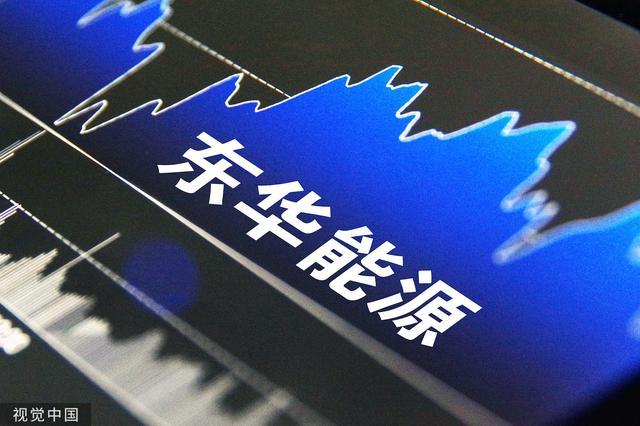
Donghua Energy (002221.SZ), which constantly promotes the industrial layout, has made heavy moves again.

On the evening of September 6, Donghua Energy announced that the company will join hands with China National Nuclear Corporation to jointly promote the high-temperature gas-cooled reactor project, and it is estimated that the investment will exceed 100 billion yuan in the next five years to jointly build a zero-carbon industrial park. The two sides have also conducted in-depth cooperation in other areas.

Donghua Energy said that the above actions will be conducive to the company’s industrial transformation and upgrading, and greatly reduce the production cost of the process.

Donghua Energy was established in 1996. After more than 20 years of development, it has become one of the top 500 Chinese enterprises. The company’s main business was once dominated by trade, and it is the largest LPG trader in the world and the largest LPG importer in China. In recent years, the company has actively implemented industrial transformation, and now it has become the largest propane dehydrogenation manufacturer in the world.

In the past 10 years, Donghua Energy has achieved a continuous increase in net profit attributable to shareholders of listed companies, but since last year, net profit has declined. In the first half of this year, the company’s net profit was only 146 million yuan, down more than 80% year-on-year.

Donghua Energy explained that geographical conflicts, overlapping epidemics, soaring raw material prices and insufficient downstream demand led to a sharp drop in net profit.

Deep binding with CNNC

A paper announcement by Donghua Energy surprised the market.

According to the latest announcement, on September 6th, Donghua Energy and China National Nuclear Corporation (hereinafter referred to as "China National Nuclear Corporation") signed the Strategic Cooperation Agreement (hereinafter referred to as "Agreement"), which is valid for 10 years.

China National Nuclear Corporation (CNNC) is a super-large state-owned key enterprise directly managed by the central government and belongs to the industry giant.

According to the agreement, the two sides will jointly promote the high-temperature gas-cooled reactor project, and it is estimated that the investment will exceed 100 billion yuan in the next five years to jointly build a zero-carbon industrial park.

In addition, the two sides will jointly establish a hydrogen energy alliance, set up a hydrogen energy research institute and a pilot plant, focus on the thermochemical hydrogen production technology route in the preparation of green hydrogen, and develop solid-state storage materials and equipment for hydrogen.

At the same time, in order to build a hydrogen energy industrial chain and effectively deepen strategic cooperation, the two sides will actively promote CNNC or its member units to become strategic investors of Donghua Energy (accounting for 5%-15% of the shares), and appoint directors to participate in the management of Donghua Energy’s board of directors, so as to create a model of mixed ownership reform of "central enterprises+private enterprises". In addition, according to the principle of "giving priority to quality and price", Donghua Energy (Ningbo factory and Zhangjiagang factory) will be provided with economic and zero-carbon power supply.

The reporter of Changjiang Business Daily found that the cooperation between Donghua Energy and China National Nuclear Corporation not only involves a joint investment of 100 billion yuan in the next five years, but also involves a strategic investment in Donghua Energy, which is deeply tied with its equity relationship and has also made specific agreements on power supply. From this, it can be seen that the two are truly deepening comprehensive cooperation.

Investing 100 billion yuan in the next five years, if it is an enterprise of Donghua Energy, it is not generally difficult.

By the end of June this year, Donghua Energy’s total assets were 36.957 billion yuan, with a total market value of 15.748 billion yuan. With such a volume, it’s hard to imagine that you want to invest hundreds of billions. Holding hands with China National Nuclear Corporation, Donghua Energy will become impossible.

For the above cooperation, Donghua Energy said that the synergy effect on the company’s existing business is significant, which is conducive to the transformation and upgrading of the industry and is expected to greatly reduce the production cost of the process. If both parties cooperate on specific projects within the scope agreed in this agreement, it will have a positive impact on the company’s future performance.

Continuous large-scale investment is under financial pressure

Not only is it difficult to achieve a single investment of 100 billion yuan, but at present, Donghua Energy is also under greater financial pressure.

The semi-annual report shows that as of the end of June this year, Donghua Energy’s asset-liability ratio reached 66.43%. At the end of the period, although the company had 9.037 billion yuan of monetary funds on its books, its short-term debt reached 12.788 billion yuan, which showed obvious short-term debt repayment pressure.

Donghua Energy, originally engaged in trade business, is the largest LPG trader in the world and the largest LPG importer in China. In recent years, the company has actively implemented industrial transformation, and now it has become the largest propane dehydrogenation manufacturer in the world. Its industrial transformation is mainly implemented through investment construction and extended mergers and acquisitions.

In 2015, the first phase project of Zhangjiagang Yangzijiang Petrochemical Co., Ltd. was put into production, which is an important symbol of Donghua Energy’s strategic transformation, upgrading and layout of alkane resources comprehensive utilization industry. In that year, the production facilities of the 660,000-ton propane dehydrogenation to propylene project and the 400,000-ton/year polypropylene project were basically produced at full capacity.

Zhangjiagang Yangzijiang Petrochemical Department was established by Donghua Energy in 2011 with a capital contribution of 560 million yuan, with a shareholding ratio of 56%. In May 2015, the company acquired the remaining 44% equity at a price of 500 million yuan. From 2017 to 2019, Donghua Energy also successively acquired 100% equity of Baoying Jinfan, 100% equity of Polyentang Electronics, 100% equity of Tiansheng Port, and partial equity of Ningbo New Materials to carry out industrial transformation layout.

In 2019, the company announced that it would invest 16.67 billion yuan to build a comprehensive utilization project (Phase I) of alkane resources in Maoming. In order to strengthen the comprehensive utilization of hydrogen energy, in July last year, the company threw out acrylonitrile and its supporting projects to extend the industrial chain, with an estimated investment of more than 6.5 billion yuan.

At present, the company has three production bases in Zhangjiagang, Ningbo and Maoming, and some production capacity is still under planning and construction.

Donghua Energy said that the company will build the world’s largest olefin industrial base based on green chemicals, and plan 10 million tons of polypropylene and multi-copolymerization.

In recent years, the company’s investment cash flow has continued to flow out. From 2020 to the first half of this year, their net outflows were 1.054 billion yuan, 2.852 billion yuan and 1.911 billion yuan respectively.

Because of this, the company bears great financial pressure. In the next five years, the company and China National Nuclear Corporation will jointly invest 100 billion yuan, which will inevitably aggravate its financial pressure.

At one time, Donghua Energy showed strong profitability. In 2016, the company realized a net profit of 470 million yuan. From 2017 to 2020, its net profit increased slowly, but both exceeded 1 billion yuan. In 2021, its net profit dropped by 5.82% to 1.14 billion yuan.

However, in the first half of this year, the company’s performance fell sharply. The semi-annual report shows that its operating income was 15.192 billion yuan, up 6.54% year-on-year, the corresponding net profit was 146 million yuan, and the net profit after deducting non-recurring gains and losses was 95 million yuan, down 80.60% and 86.53% year-on-year.

Donghua Energy explained that geopolitical conflicts triggered international turmoil and superimposed global epidemics, which led to a sharp rise in propane prices. Downstream, due to the epidemic, construction was insufficient, and performance dropped significantly due to the squeeze at both ends.

Will Donghua Energy’s ability to resist risks be enhanced by accelerating industrial layout and financial pressure?

Reporting/feedback

[Ground Evaluation Line] Caiyun Online Review: Let the theme education release lasting effectiveness

  Duan Zongke, Special Commentator of Caiyun Online Review

  On January 8th, the educational summary meeting on the theme of "Do not forget your initiative mind, Remember Mission" was held in Beijing. General Secretary of the Supreme Leader attended the meeting and delivered an important speech. He stressed that the whole party should take this theme education as a new starting point, constantly deepen the party’s self-revolution, continue to promote the party’s Do not forget your initiative mind and keep in mind its mission.

  Summing up does not mean reaching the end, but starting a new journey on the basis of learning from experience. Theme education has a deadline, but Do not forget your initiative mind, keep in mind that the mission is never ending. General Secretary of the Supreme Leader pointed out that our party must always win the support and support of the people and write the great achievements of the Chinese nation for a thousand years, and must always bear in mind its initial heart and mission. This requires us to take Do not forget your initiative mind, bearing in mind the mission, as the eternal task of strengthening Party building, and the lifelong task of self-purification and promotion of cadres in party member, and make unremitting efforts for a long time to make the theme education release lasting effectiveness.

  Solidly summarize and improve the "storage battery"Under the strong leadership, deployment and promotion of the CPC Central Committee with the Supreme Leader as the core, and taking the lead in setting an example, the theme education of "Do not forget your initiative mind, Remember the Mission", a serious and profound baptism of party spirit, stirred up the whole party and achieved a series of major achievements. In order to release the lasting effectiveness of theme education, it is necessary to look back on the practical process in an all-round way and sum up successful experiences, so as to accumulate strong energy and lay a solid foundation for deepening the party’s self-revolution. Of course, summing up can’t be a complacent introduction of experience and a simple piling up of achievements, but should be refined and sublimated on the basis of summing up and summarizing. It is more important to look at the problem from a developmental perspective and a practical attitude. Only by constantly optimizing the measures of "keeping the original heart, taking the mission, finding the gap and grasping the implementation" can we inject lasting kinetic energy into the self-revolution.

  Ignite the long-term mechanism "engine"."Resolutely remove all factors that weaken the party’s advanced nature and damage the party’s purity, resolutely remove all cancers that breed on the party’s body, and resolutely guard against all dangers that violate the initial heart and mission and shake the party’s foundation." This is a long-term and systematic project, which must be done for a long time. It is inseparable from strong institutional guarantee to continuously promote the Do not forget your initiative mind of the whole party and keep in mind its mission. Although the theme education has come to an end, Do not forget your initiative mind’s mission needs not only immediate "immediate change", but also long-term management. Since the 18th National Congress of the Communist Party of China, the CPC Central Committee with the Supreme Leader as the core has attached great importance to institutional governance. At the Fourth Plenary Session of the 19th CPC Central Committee, it was proposed to establish a system of Do not forget your initiative mind and keeping the mission in mind. On the basis of summing up, establishing a simple, pragmatic and accurate long-term mechanism will undoubtedly ignite the engine of keeping the original heart and carrying out the mission.

  An "accelerator" to stimulate the vitality of the grassroots.General Secretary of the Supreme Leader pointed out that the mission of Do not forget your initiative mind and Mindfulness should be realized through the joint efforts of the whole Party. The key to running China well lies in the Party, and the most solid and active source of strength for the Party’s work lies in the grassroots. Doing a good job of summing up and upgrading is to start a new journey, build a long-term mechanism to promote going deep, going real and going far. Besides these, it is also essential to stimulate the vitality of the grassroots, give birth to Do not forget your initiative mind, and keep in mind the vivid and vivid grassroots innovation practice. "Bearing in mind the initial heart and mission, we must persist in serving the people wholeheartedly." Do not forget your initiative mind, whether the measures to keep in mind the mission are effective or not, and whether the results are remarkable or not, must be tested by the masses’ sense of gain. To this end, it is necessary to give full play to the initiative of grassroots innovation and creation, and to refuel and add strength to the release of lasting effectiveness of theme education with colorful grassroots practices.

  "You can’t expect to declare success through one or two educational activities. ‘ The revolution has not yet succeeded, and comrades still have to work hard ’ This sentence is always going on. " Ending is not ending, and summing up is not ending. "Do not forget your initiative mind, keep in mind the mission" is always on the road, so that the theme education will release lasting effectiveness, and our party will surely lead the great ship "China" to a brighter future.

Mila Tang Jian: Building ChatGPT in the field of life science and developing drugs with generative artificial intelligence.

"I have always been interested in biology. When I was in high school, my teacher told us that the 21st century was the century of biology. When I studied artificial intelligence, I believed that the 21st century was the century of artificial intelligence."

During the scientific lecture "Understanding the Future" hosted by the Future Forum, Tang Jian, an associate professor at the Research Center for Artificial Intelligence in Quebec, Canada (Mila) and a professor of artificial intelligence at the Canadian Institute of Advanced Studies (CIFAR), introduced the application of generative artificial intelligence in life sciences: how to build a "ChatGPT" in life sciences. He said, "Later, I felt that it might be the best choice if I could do something in the field where artificial intelligence and biology intersect."

Today, he is not only studying AI and biology at the same time, but also "left-handed scientific research and right-handed entrepreneurship". He said that he is a person who is willing to accept new things and challenges. From scientific research to entrepreneurship, many things are different, and it is difficult to carry out interdisciplinary cooperation, but this also reflects the value of doing these things.

Figure | Tang Jian (Tang Jian’s personal homepage)

According to reports, Tang Jian University studied geography at the beginning, transferred to the Department of Mathematics in his sophomore year, and successfully applied to the Department of Computer Science in his senior year. In his computer learning career, he first studied traditional machine learning, and in the last year of his doctoral degree, he turned to deep learning.

After graduating from the doctor’s degree, he officially embarked on the road of scientific research and made many achievements in the field of graphic representation learning. As one of the representative scholars in this field, his network representation learning method LINE (large-scale information network embedding) has been widely used, with more than 5,000 references.

"The double revolution of artificial intelligence and biotechnology broke out, and we are in the best era of doing research."

In 2018,Tang JianStart the research on the intersection of artificial intelligence and biology. At that time, he applied the graph representation learning technology to the research in the field of drug discovery, and did a lot of work in the prediction of three-dimensional structure of small molecules and the design of macromolecular proteins.

But a few years ago, only a few people devoted themselves to the research in this direction. In the past two years, more and more investment has been injected into this field. Tang Jian believes that the reason for this change is that artificial intelligence has brought great breakthroughs to the structural prediction and biological field in protein, and the spread of the COVID-19 epidemic has also aroused people’s focus on health and biomedicine.

"Now we are in the best era, because we are experiencing the dual technological revolution of artificial intelligence and biotechnology." Tang Jian said, "Therefore, we have seen great opportunities for generative artificial intelligence in the field of drug discovery, especially protein design."

Based on his accumulation in scientific research, he devoted himself to entrepreneurship and set up the artificial intelligence-driven biopharmaceutical company Baiao Geometry in 2022.

Build an AI macromolecular drug design platform to provide innovative drugs to save patients’ lives.

existTang JianIt seems that perhaps it is the entrepreneurial idea that has sprouted since childhood and the character of constantly seeking self-breakthrough that drives him to embark on the road of entrepreneurship.

The Baiao Geometry Company, founded by him, aims to develop a programmable protein by integrating the technologies of generative artificial intelligence and geometric deep learning, so as to overcome the problems of long cycle, high cost and low success rate of traditional macromolecular pharmacy and provide innovative drugs to save patients’ lives.

Tang Jian is mainly responsible for technical work in this company, and designs antibodies by building artificial intelligence models. As a new diffusion generation model, this model can model the amino acid sequence and three-dimensional structure of protein at the same time, and show the relationship between them, so as to generate protein with specific functions.

At present, the team has set up an AI macromolecular drug design platform, and is building a wet experiment verification platform for Qualcomm macromolecular drugs. At the same time, it also launched TorchProtein, an open source machine learning platform for macromolecules, in conjunction with companies such as NVIDIA, Intel and IBM.

"I hope that the technology I have made can really push several drugs into the clinic, solve more complicated diseases like cancer and save patients’ lives." Tang Jian said. In addition, he also said that with the development trend of intelligence, digitalization and automation in the biomedical field becoming inevitable, he expected to become a world-famous and international high-tech company in this field.

Based on generative artificial intelligence, build "ChatGPT" in life science field

In addition to starting a business, Tang Jian’s scientific research work at hand is also being carried out simultaneously. Based on generative artificial intelligence, he and his team have carried out research on three-dimensional structure prediction of small molecules and protein design of large molecules in the field of biomedicine.

In the prediction of the three-dimensional structure of small molecules, the team mainly modeled them based on the diffusion generation model. Specifically, a completely random structure is taken as the initial structure, and after several rounds of optimization, it finally converges to a stable protein structure. Each step of the optimization process is also called denoising. In addition, on the basis of expanding the research, the prediction of the complex structure was realized.

In the design of macromolecular proteins, the team proposed to design protein structure and sequence based on diffusion generation model, which not only realized the generation of antibody CDR Loop structure and sequence, but also designed α -helix transmembrane proteins with a specified number.

Not only that, the team also conducted research on antibody design and optimization. For example, it cooperated with the research team from Fudan University. Based on the antibody CR3022 obtained from newly crowned patients, it first designed the sequence with AI model, and then tested it on the wet experimental platform of Qualcomm, and finally successfully found the antibody molecule with strong affinity.

For generative artificial intelligence, its most critical ability is that it can generate new data. Then, if it is used in the biomedical field, it can help to generate a brand-new protein and help people find better drugs.

As a typical generative artificial intelligence model, ChatGPT has spread all over the world since it was introduced at the end of 2022. It can talk and communicate like a human being, and complete tasks such as writing papers and coding. "It is essentially a chat robot." Tang Jian said. As a large-scale pre-training language model, ChatGPT first pre-trains a large number of text and code data on the Internet, and then further optimizes it to enable it to be used for tasks such as dialogue.

The development of biotechnology, such as gene sequencing and gene synthesis, has brought a lot of data to the biomedical field. Therefore, Tang Jian believes that in the near future, people can also use these data to build ChatGPT in the field of life sciences.

Reporting/feedback

[Li Xiang China] Correctly understand and grasp the socialist nature of Chinese modernization.

1661136875848

  Author: Huang Kun, Deputy Director and Professor of Chinese Modernization Research Center of the Party School of the Central Committee of the Communist Party of China (National School of Administration)

  On July 26th, 2022, General Secretary of the Supreme Leader emphasized at the seminar for leading cadres at the provincial and ministerial levels on "Learning the spirit of the important speech of General Secretary of the Supreme Leader and Meeting the 20th Party Congress" that "the modernization we are advancing is the socialist modernization led by the Communist Party of China (CPC), and we must persist in promoting the great rejuvenation of the Chinese nation with Chinese modernization", and clearly pointed out the socialist nature of Chinese modernization. Scientific understanding and grasping the socialist nature of Chinese-style modernization is of great significance to deeply understand Chinese-style modernization and ensure its stability and far-reaching development.

  Adhering to Chinese modernization to promote the great rejuvenation of the Chinese nation has made it clear that only socialism can save China and only socialism can develop China.

  Exploring the road of national rejuvenation has started since the Chinese nation faced the invasion of western powers in modern times, which is manifested in the hard exploration of utensils, systems and ideas in order to save the weak China. Due to class attributes and historical limitations, these explorations ended in failure. The real opening of the road to national rejuvenation began with the founding of the Communist Party of China (CPC) and the struggle for national independence and people’s liberation. Since its birth, the Communist Party of China (CPC) has devoted himself to the prosperity of the country, the happiness of the people and the rejuvenation of the nation. The dream of rejuvenation and modernization runs through the whole century of party history and has become the biggest theme of the Communist Party of China (CPC)’s century-long struggle.

  During the period of the new-democratic revolution, the Communist Party of China (CPC) fought for national independence and people’s liberation through arduous armed struggle, united and led the people of the whole country to overthrow the three mountains of imperialism, feudalism and bureaucratic capitalism, and established a new China, which created fundamental social conditions for realizing Chinese modernization and promoting the great rejuvenation of the Chinese nation. During the period of socialist revolution and construction, the party led the people to overcome a series of severe challenges in politics, economy and military affairs, successfully completed socialist transformation, realized the transformation from new democracy to socialism, established a brand-new socialist system with strong vitality on the ancient land of China, and laid a fundamental political premise and institutional foundation for realizing Chinese modernization and promoting the great rejuvenation of the Chinese nation. In the new era of reform, opening-up and socialist modernization, the Party United and led the whole Party and the people of all ethnic groups throughout the country, made a historic decision to shift the work center of the Party and the state to economic construction and carry out reform and opening-up, successfully created Socialism with Chinese characteristics, and provided new and energetic institutional guarantee and rapid development material conditions for realizing Chinese modernization and promoting the great rejuvenation of the Chinese nation. Since the 18th National Congress of the Communist Party of China, Socialism with Chinese characteristics has entered a new era. With great historical initiative, great political courage and strong responsibility, our party has provided a more perfect institutional guarantee, a more solid material foundation and a more active spiritual force for realizing Chinese modernization and promoting the great rejuvenation of the Chinese nation. The great rejuvenation of the Chinese nation has shown unprecedented bright prospects.

  It is through the unremitting struggle and exploration in the past century that we have found the correct way to realize the great rejuvenation of the Chinese nation, that is, the road of modernization in Socialism with Chinese characteristics and China. "Promoting the great rejuvenation of the Chinese nation with Chinese modernization" is an important experience for the success of our cause. In essence, Chinese-style modernization is socialist modernization, the concretization of Socialism with Chinese characteristics’s development path and the realistic path of the great rejuvenation of the Chinese nation. Chinese-style modernization, like Socialism with Chinese characteristics, is the inevitable result of the historical logic, theoretical logic and practical logic of China people’s long-term struggle in modern times, which has a profound historical origin and a broad realistic foundation. Historical facts show that the closed and rigid old road is a dead end, and the evil road of changing the flag is a dead end. Only the Socialism with Chinese characteristics road and the Chinese modernization road are the new road, the right road and the main road to develop and strengthen China and prosper and stabilize China. Only socialism can save China and only socialism can develop China. Socialism with Chinese characteristics and Chinese modernization not only point out the direction for realizing the Chinese dream of national rejuvenation, but also provide the fundamental guarantee for realizing the Chinese dream of national rejuvenation. The great practice of modernization in Socialism with Chinese characteristics and China has not only enabled our country to develop rapidly, improved the living standards of our people, and enabled the Chinese nation to catch up with the trend of the times and usher in the bright future of great rejuvenation, but also enabled the people of China and the Chinese nation to make great contributions to world peace and development. As it turns out,To build a powerful socialist modernization country in an all-round way and realize the great rejuvenation of the Chinese nation, we must unswervingly adhere to and develop Socialism with Chinese characteristics and Chinese modernization.

  Adhere to the leadership of the Communist Party of China (CPC), and clarify the essential characteristics and fundamental guarantee of Chinese modernization.

  The party’s leadership is the root and lifeline of the party and the country, and it is the interest and destiny of the people of all ethnic groups in the country. The Communist Party of China (CPC)’s leadership is the most essential feature of Socialism with Chinese characteristics, and it is also the most essential feature of Chinese modernization. Adhering to the party’s leadership over Chinese modernization is fundamentally related to the future and destiny of Chinese modernization and the fundamental guarantee for Chinese modernization to adhere to the socialist direction.

  Chinese-style modernization is a modernization with a specific development process, stages and social attributes, which is different from both western developed countries and other developing countries. Its task is more arduous, its course is more complicated and its nature is more special. From the development process, Chinese modernization is a "parallel" modernization. Different from the "series" modernization development process in western developed countries, industrialization, urbanization, agricultural modernization and informatization develop in sequence, while China’s modernization is the "parallel" superposition development of industrialization, informatization, urbanization and agricultural modernization, with multiple modernization processes developing in coordination and multiple modernization goals being realized simultaneously. From the development stage, Chinese modernization is catch-up modernization. As a developing country, China’s modernization was launched only after the success of modernization in developed countries. The problems it encountered were very different from the international environment, and even faced with the obstruction and containment of developed countries. The tasks it faced were more arduous and special, and the development environment was more complicated and uncertain. In particular, the world today is experiencing a great change that has never happened in a hundred years. China’s socialist modernization is facing a more severe domestic and international situation, and the risks and challenges are obviously increasing. From the perspective of social attributes, Chinese modernization is socialist modernization. The nature of socialism is the most remarkable and fundamental social attribute that China’s modernization is different from the western modernization.China’s socialist modernization can’t follow the modernization road of western developed countries’ internal oppression and exploitation, foreign aggression and plunder, and create an unequal international political and economic order. Instead, it puts more emphasis on the people-centered development thought and the international relations concept of the community of human destiny, and embarks on a socialist modernization road with China characteristics.

  The essential requirements of Socialism with Chinese characteristics and the unique and arduous modernization of China make it particularly important to uphold the leadership of the Party. We must uphold and strengthen the Party’s overall leadership, lead the way for China’s modernization, create a stable and United political situation, maintain the stability and continuity of the country’s major policies, mobilize the people’s enthusiasm and creativity in participating in national construction and governance, and concentrate the strength of the whole party and society to continue their struggle to realize the Chinese dream of becoming a socialist modernization power and the great rejuvenation of the Chinese nation.

  Adhere to the fundamental purpose of people first, and clarify the people-centered development thought and the essential attribute of modernization with human modernization as the core.

  "China’s modernization is a modernization with a huge population and the common prosperity of all the people", which shows the socialist nature of Chinese modernization. Chinese-style modernization insists on the supremacy of the people in its fundamental purpose, people-centered in its fundamental position, constantly promoting the all-round development of people and realizing the common prosperity of all people, which embodies the essential attribute of Chinese-style modernization with human modernization as its core and the social nature of socialism.

  The supremacy of the people is a valuable experience of the Communist Party of China (CPC)’s century-long struggle, and it is the root of the great achievements of Chinese modernization. The foundation of Chinese modernization lies in the people, the subject lies in the people and the strength lies in the people. Chinese modernization always insists on development for the people, development depends on the people, and development results are shared by the people. General Secretary of the Supreme Leader pointed out: "The people are both creators and witnesses of history, and they are both historical ‘ People in the play ’ And historical ‘ The playwright ’ " . The Communist Party of China (CPC)’s revolution, construction and reform are all realized in the process of maintaining flesh-and-blood ties with the people and relying on them closely. The people are the main body and source of strength for Chinese modernization. The Fifth Plenary Session of the 18th CPC Central Committee clearly put forward that we should adhere to the people-centered development thought, and take enhancing people’s well-being, promoting people’s all-round development and making steady progress towards common prosperity as the starting point and the end result of economic development. Chinese modernization takes the people as the center, emphasizes the people’s position, and always puts the promotion of people’s free and all-round development in the primary position of modernization, which is the most fundamental value orientation of Chinese modernization.

  Chinese modernization emphasizes the people’s stand and adheres to the people-centered development thought, which fundamentally opens up the consistency between human modernization and the fundamental purpose of people first. Marxism holds that man is the main body of social practice, which is shaped by the real society and realizes his own development in promoting social progress. What kind of modernization to build and what kind of goals to achieve are determined by people. The overall modernization of society cannot be separated from the modernization of people, who is the core content of the overall modernization of society. People are not only the subject of modernization practice, but also the subject of modernization value and the ultimate goal of modernization. The practice of world modernization proves that human modernization is more important than material modernization. Once people’s modernization is ignored or hesitated or lagged behind on this issue, it will inevitably bring great harm and disaster. Socialism with Chinese characteristics, not only bears the heavy responsibility of the times for the overall modernization of society, but also bears the historical mission of continuously promoting human modernization and promoting human all-round development. Comrade Supreme Leader wrote in Zhijiang Xinyu: "People are essentially cultural people, not ‘ Materialization ’ People; Is a dynamic and comprehensive person, not a rigid, ‘ One-dimensional ’ People. " The value pursuit of the people’s subject established by Chinese modernization is essentially the same as Marx’s theory of all-round development of human beings, which is a reaffirmation and creative development of the proletarian as the subject of liberation.It is also a vivid embodiment of our party’s fundamental purpose of serving the people wholeheartedly.

  Adhere to Socialism with Chinese characteristics’s fundamental system, basic system and important system, and clarify the institutional guarantee and institutional advantages of Chinese modernization.

  Socialism with Chinese characteristics system is a scientific system composed of fundamental system, basic system and important system, and it is the most important system regulation, system guarantee and system advantage of Chinese modernization. Socialism with Chinese characteristics’s fundamental system includes the fundamental system of the Party’s leadership, the fundamental system of the people’s democratic dictatorship, the fundamental system of the people’s congresses, the fundamental system of Marxism’s guiding position in the ideological field, and the fundamental system of the Party’s absolute leadership over the people’s army. It plays a "main beam" and "pillar" role in China’s national system and national governance system, and fundamentally embodies Socialism with Chinese characteristics’s institutional advantages. Socialism with Chinese characteristics’s basic systems are those that embody the socialist nature of our country, stipulate the basic principles of the country’s political life and economic life, and have a great influence on the country’s economic and social development. Socialism with Chinese characteristics’s important system is the subjective system of state governance in all fields derived from Socialism with Chinese characteristics’s fundamental system and Socialism with Chinese characteristics’s fundamental system. Specifically, it is the subjective system of legal rule, administrative management, cultural construction, people’s livelihood security, social governance, ecological civilization, "one country, two systems", foreign affairs, party and state supervision and so on. These fundamental systems, basic systems and important systems are the institutional guarantee and obvious institutional advantages of Chinese modernization.It is the fundamental reason why Chinese modernization has maintained its socialist nature and made great achievements.

  After more than 70 years of rich practice in New China, the Party led the people to create and develop the Socialism with Chinese characteristics system. Since the 18th CPC National Congress, Socialism with Chinese characteristics’s system has been further consolidated and improved, and Socialism with Chinese characteristics’s institutional advantages have been further highlighted and strengthened. The historical achievements of the founding of New China for more than 70 years fully prove that the Socialism with Chinese characteristics system is the fundamental guarantee for the great achievements of Chinese modernization. Socialism with Chinese characteristics system is a scientific system formed by the Party and the people in the long-term practice and exploration. It not only reflects the historical achievements made by the Communist Party of China (CPC) in establishing and perfecting the socialist system, forming and developing various systems, but also reflects that since the founding of New China for more than 70 years, our Party has been able to unite and lead the people to promote and expand Chinese modernization, lay a material foundation for the great rejuvenation of the Chinese nation, generate spiritual strength, create social conditions, and usher in a period from standing up to becoming rich and strong. To take the new journey of building a socialist modern country in an all-round way and achieve the goal of the second century as scheduled, we must strengthen the linkage between the fundamental system, the basic system and the important system, promote the Socialism with Chinese characteristics system to be more mature and stereotyped, continuously inject new kinetic energy into Chinese modernization, and promote Chinese modernization with efficient state governance.

  Adhere to the global vision of the new form of human civilization, and clarify the epoch-making significance of Chinese modernization in the history of China modernization, world modernization, world socialist development and human civilization development.

  Chinese-style modernization is a great change in the continuation, iteration and innovation of civilization. It not only depicts the special law of the continuation of Chinese civilization for 5,000 years, but also explores the universal law of the revival of human civilization, especially in developing countries, and the universal pattern of exchanges and mutual learning between different civilizations in the same time and space environment, creating a new form of human civilization, showing Socialism with Chinese characteristics’s remarkable advantages and strong vitality, and fundamentally surpassing the "clash of civilizations" and "western-centered theory" and.

  On the one hand, Chinese-style modernization is the independent road of the nation-state. No nation or country in human history can achieve modernization by relying on external forces, copying foreign models and following others. Chinese-style modernization insists on putting the development of the country and the nation on the basis of its own strength, firmly holding the destiny of China’s development and progress in its own hands, and always proceeding from China’s national conditions, exploring and forming the correct road in line with China’s reality.

  On the other hand, Chinese modernization is an open and inclusive modernization rather than a closed and exclusive modernization, which shows the openness and cosmopolitan nature of civilization. Chinese modernization takes socialism as its essential attribute, takes the common values of peace, development, fairness, justice, democracy and freedom as its value orientation, and adheres to the basic concepts of win-win cooperation and mutual benefit. It is firmly rooted in the soil of China, based on the logic of Chinese civilization development, and firmly follows the law of modern civilization construction. On the basis of conforming to the development trend of the times, it insists on exchanges and mutual learning among civilizations, finds consensus in exchanges, realizes development in mutual learning, and shows a distinct openness.

  Chinese modernization, based on China’s basic national conditions and development practice, conforms to the development trend of the times, opens a successful path for the great rejuvenation of the Chinese nation, transcends the logic of western modernity, breaks the uniqueness of western modernization model, drives developing countries to realize "group rise", promotes the image of socialism and promotes the progress of human civilization, which is of great significance in the history of China modernization, world modernization, world socialism development and human civilization development. In the history of China’s modernization, the Chinese-style modernization road has solved the perplexed and tortuous problem of China’s modernization road since modern times, and combined Socialism with Chinese characteristics with the Chinese-style modernization road, the great rejuvenation of the Chinese nation has shown an unprecedented bright future. In the history of world modernization, the Chinese modernization road has surpassed the western modernization model, provided a new choice different from the western modernization model, and opened up a new road for developing countries to modernize. In the history of world socialist development, the Chinese-style modernization road has overcome the defects of the traditional socialist model, opened up a new realm of socialist modernization road, and made it possible for socialism to revive, prosper and develop continuously in the world. In the history of human civilization development, Chinese-style modernization road has made new contributions to human exploration of modernization road, created new forms of human modern civilization, and demonstrated the diversity of human civilization development.

Shenzhen issued new rules to clarify that doctors do not need the approval of the original unit to "go to the acupuncture point"

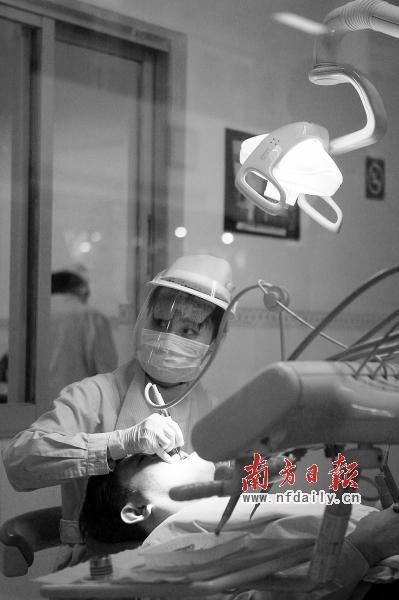
  As the first city in the province to pilot doctors to practice freely, Shenzhen has recently made a lot of moves. The newly issued Detailed Rules for the Implementation of Multi-point Free Practice of Doctors in Shenzhen (hereinafter referred to as the "new rules") clearly points out that doctors only need to file online for multi-point practice without the approval of their affiliated hospitals, and it has been reported to the Provincial Health Department for approval.

  Over the years, every step of doctors’ income, promotion and pension in public hospitals in China is inseparable from the system, and the voice of "liberating doctors" has been rising. In December 2009, the Health Department issued the Trial Management Measures for Doctors’ Multi-point Practice. From January 1, 2010, doctors’ Multi-point Practice was tried out. Any practicing doctor who has the title of associate senior and has worked in this technical position for more than two years can apply for multiple practice places, but he must go through the procedures of reporting and approval at the original unit.

  Due to the application, although many doctors are eager to try, not many of them finally managed to leave. According to the data, as of December last year, there were only 36 doctors who applied for multi-point practice from Shenzhen Wei Ren Wei Committee, of which 60% were doctors from private medical institutions. Most of the "going out" from public hospitals were old doctors who were about to retire or postpone their retirement.

  Today, the new Shenzhen rules skip the approval process of the original unit. And this "shock wave" also radiated to Guangzhou-two days ago, a plastic surgeon in a large 3A hospital in Guangzhou put forward an application for "acupuncturing".

  Once the new rules are implemented, can doctors really be set free? How many doors do doctors need to break through to "liberate"?

  Yizhong door

  How can doctors have the energy to "walk the hole" when they are overworked?

  Every day, I spend almost all the available time in rounds, operations and outpatient clinics, and I have to teach and research, and I don’t even have time to spend with my family. Even if you don’t need to apply to the hospital for acupuncture, you are willing but unable to do so.

  Two days ago, in the conference room of a large 3A hospital in the old city of Guangzhou, members of the hospital team held a special meeting on the application of a plastic surgeon for "acupuncturing".

  "In the end, we tend to let him concentrate on his work in the hospital. With so many things, how can I have more energy to practice? " The person in charge of the hospital admits that the hospital is overcrowded every day. "This person can’t be released. After all, it can’t affect the hospital’s diagnosis and treatment order and medical level."

  There are many patients in big hospitals, and it is no longer news that doctors are overwhelmed. Take the First Affiliated Hospital of Sun Yat-sen University as an example. Last year, the number of outpatients received exceeded 4.6 million, and the average number of outpatients per day exceeded 10,000. Experts had to see more than 40 patients every day, and the time was full.

  The same is true of Shenzhen. According to media reports, the designed outpatient service of Shenzhen Children’s Hospital is 2,000 person-times per day, and the actual daily consultation often reaches 5,000 to 6,000 person-times, and the medical staff are overloaded. Liao Qingwei, director of the Medical Affairs Department of the Shenzhen Municipal People’s Health Commission, bluntly said in an interview with the media that although there are many changes in the new policy, it is not expected that there will be a blowout in the number of doctors applying for multi-point practice. After all, the old system will affect the implementation of the new policy, especially in public hospitals, where staff work overtime every day, and doctors will carefully consider going out to practice more.

  When it comes to multi-point practice, many doctors in public hospitals first nodded and said "looking forward to liberation", then shook their heads and said, "If you want to leave, you have to overcome all difficulties."

  "Every day, I spend almost all my time on rounds, operations and outpatient clinics. In addition, I need teaching and research, and I don’t even have time to spend with my family." Dr. Zeng is the deputy chief physician of a large 3A hospital in Guangzhou. She admits that even if there is no need to apply to the hospital for "going to the acupuncture point", the doctor is willing but unable to do so, and it is better to be content with the status quo.

  Double gate

  Who should be responsible in case of medical accident?

  A hospital in Haizhu District of Guangzhou staged a "farce" in which patients and their families collectively jumped off the building. The hospital was "shot while lying down" because this operation was done by doctors in other hospitals, and the "mother’s family" lost money to avoid trouble.

  In recent years, the doctor-patient relationship has almost fallen to the "freezing point". If a doctor goes out to go to the acupuncture point and there is a medical accident or medical dispute, who should be held accountable?

  The reporter learned that a hospital in Haizhu District of Guangzhou staged a "farce" in which patients and their families collectively jumped off the building. However, the hospital was shot while lying down, because the failed operation was done by doctors in other hospitals, and the "mother’s family" hospital was inexplicably taken as a "big head" and finally lost money to avoid trouble.

  "In today’s environment, once patients and doctors have conflicts, it is easy to go to the hospital." Zeng Qiyi, Dean of zhujiang hospital, Southern Medical University, said that one of the advantages of freelance practice is to return this complicated relationship linked to the organization to a simple relationship between doctors and patients. "The ideal situation is that once a medical dispute arises between the two parties, it can be resolved through lawyers or insurance companies. If it proves to be the responsibility of the doctor, his qualification for practice can be revoked. "

  The reporter learned that this is the way to operate in the United States. If a doctor has a medical accident in the course of treatment, the patient can seek help from an insurance company or a lawyer instead of solving the problem through medical trouble. Once the doctor’s improper operation is verified, his file will have bad records.

  "Therefore, if we really want to realize multi-point practice, not only should the patient’s concept be changed, but doctors and medicine need to understand that they are not omnipotent, and doctors should also respond well and take relevant legal issues seriously." Zeng Qiyi said.

  At present, in view of the medical disputes that may occur during doctors’ free practice, Shenzhen has given a new solution, or launched a compulsory insurance system for medical practice liability ("medical insurance") within this year to provide a protective barrier for doctors’ practice risks. Insurance companies will bear a certain amount of compensation for medical damage caused by doctors’ improper diagnosis and treatment, which is the first time that individual medical practitioners have been included in the insured in China.

  In addition, Shenzhen will learn from Hong Kong’s experience, and the doctors’ association will be responsible for online filing, so that professional doctors’ associations can judge and supervise doctors and realize real industry autonomy and professional autonomy.

  Triple Door

  Who will pay for the benefits of working in multiple hospitals?

  Under the current system, public hospitals, as institutions, have concentrated high-quality resources for teaching and scientific research, and doctors are responsible for all kinds of insurance and welfare benefits. If they choose to practice freely, it is equivalent to giving up their identity as institutions.

  In a private hospital in Guangzhou, which focuses on obstetrics and gynecology, there are more than 20 experts with the title of deputy high school or above. The reporter learned that six or seven of them are multi-point doctors. However, they don’t want the "mother’s family" hospital to know that they are "part-time" outside, because they are afraid that welfare, security and promotion will be affected.

  The 2011 China Health Statistics Yearbook shows that there are about 2.41 million medical practitioners (including assistant doctors) in medical institutions nationwide, of which 1.73 million are affiliated to public hospitals, accounting for 71.8%. While enjoying the stable welfare of public institutions, more than 70% of these doctors are also bound by their own choices.

  Under the current system, public hospitals, as institutions, concentrate high-quality resources for teaching and scientific research, and hospitals are responsible for all kinds of insurance and welfare benefits for doctors. "To some extent, if you choose to practice freely, it is equivalent to giving up the identity of a public institution." In the opinion of many doctors, the reason for taking this step is to think carefully, because we can’t help but care about this identity. "Stay in the hospital for one day and enjoy the corresponding protection and welfare of the hospital. If you go out, once the hospital does not provide complete insurance and welfare benefits, the relevant promotion evaluation will be difficult to achieve. "

  Therefore, many doctors who have "left" still believe that the current multi-point practice has not made doctors truly free, and doctors have always been attached to the identity management and corresponding benefits of the public medical system and cannot get rid of the constraints of "units".

  However, from the standpoint of the hospital, there are also views that if the hospital allows experts to practice more, the salary bonus can be reduced accordingly. At the same time, in order to ensure that the welfare of doctors is not weakened, we only need to negotiate with third-party practice institutions to form a win-win situation.

  Zeng Qiyi provided a specific idea: if a unit is responsible for various benefits of doctors, such as social insurance and housing accumulation fund, the bonus can be deducted accordingly; Another unit is responsible for the rest of the salary bonus. Through this tripartite bond, healthy competition between hospitals is formed.

  ■ Expert advice

  Doctors’ multi-point practice should be managed by doctors’ association

  Facing the possible problems caused by doctors practicing more, Liao Xinbo, deputy director of the Provincial Health Department, thinks that this reform in Shenzhen has certain significance, at least it has taken a step, but the step is not big enough. He believes that the operation steps are still too complicated. Whether a doctor has the ability to practice more should be managed by the medical association, and professional autonomy will be better.

  "I think that a more meaningful approach is contractual management and contractual management. I work here according to the service contract I signed with the hospital, and I don’t need to report to the hospital where the rest of the time is. This is market-oriented, which can force the society to respect the value of doctors. As long as doctors flow, the market value of doctors will naturally form. " Liao Xinbo said.

  Zeng Qiyi believes that doctors should practice regionally and establish a regional qualification system certification. Regional, that is, doctors have obtained the qualification of practicing in the whole country, but they need to be registered in the local area to facilitate management.

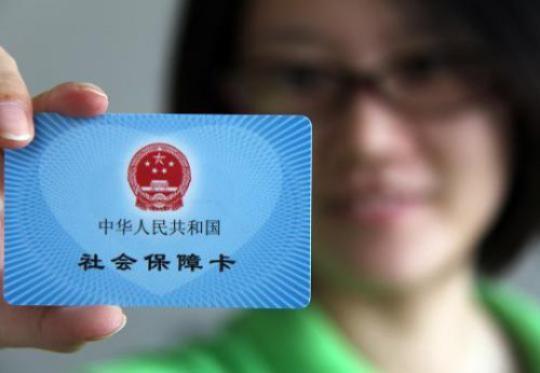
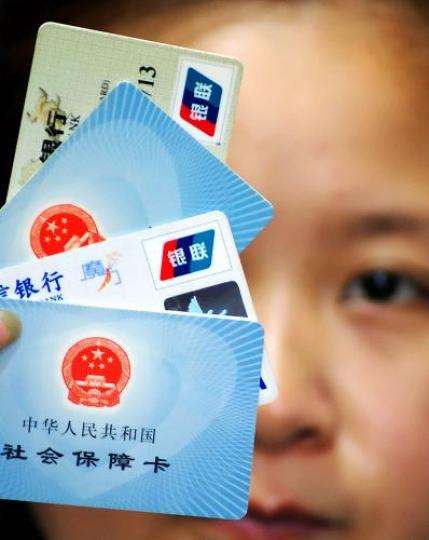
Reduce the social security rate by five insurances and one gold or change to "four insurances and one gold"

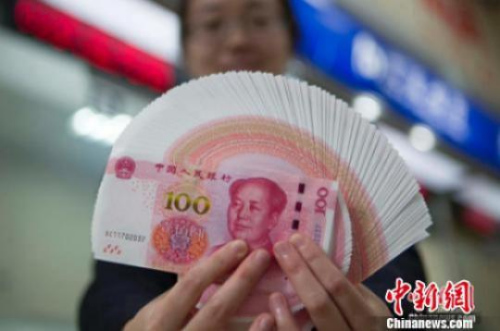
Reduce the social security rate more often. Did you get more salary?

  Data map. Xinhua News Agency issued Zhang Chunlei photo

  BEIJING, Beijing, March 23 (Reporter Li Jinlei) "Let enterprises lighten their burdens a little more, and let employees get more cash", which was Li Keqiang, Premier of the State Council of the People’s Republic of China’s statement when answering questions related to "five insurances and one gold" at a Chinese and foreign press conference on March 16. The reporter of Zhongxin. com (WeChat WeChat official account: cns2012) noticed that recently, Shanghai, Guangdong, Tianjin and other places announced the reduction of social security rates.

  In addition, streamlining the "five insurances and one gold" has also set the direction. The recently announced "Thirteenth Five-Year Plan" outlines that maternity insurance and basic medical insurance should be implemented together. This means that with the merger of maternity insurance and basic medical insurance in the future, the familiar "five insurances and one gold" will become "four insurances and one gold".

  Help enterprises reduce costs

  — — Reduce social security rates in many places

  Reducing costs is one of the main tasks of China’s economic work in 2016. Under the background of high social security burden, reducing social security burden has become a practical measure for local governments to reduce costs for enterprises.

  The reporter from Zhongxin. com found that recently, Shanghai, Guangdong, Tianjin, Yunnan, Gansu, Hangzhou, Zhejiang, Xiamen, Fujian and other regions have successively introduced new policies to reduce social security rates to varying degrees.

  Shanghai announced on March 21 that from January 1, 2016, the unit contribution rates of employee basic endowment insurance and employee basic medical insurance will be lowered by 1 percentage point, and the unemployment insurance unit contribution rate will be lowered by 0.5 percentage point.

  Guangdong reduced the unemployment insurance premium rate from 2% to 1% from March 1st this year, and demanded that the urban-rural integration of basic medical insurance should be promoted from the second half of 2016, and the unit premium rate should be gradually lowered to about 5.5%.

  In early February this year, Tianjin launched the first batch of 20 policy measures to reduce the cost of enterprises in the real economy, and proposed to reduce the payment rates of unemployment, maternity and work-related injury insurance. Among them, the rate of unemployment insurance paid by enterprises has dropped from 2% to 1%; The rate of paying maternity insurance was reduced from 0.8% to 0.5%; The minimum standard for payment of work-related injury insurance is reduced from 0.5% to 0.2%, and the maximum standard is reduced from 2% to 1.9%. After adjustment, the comprehensive rate level is lowered from 0.67% to 0.54%.

  In addition, Yunnan and Gansu have also lowered unemployment, work injury and maternity insurance rates; Hangzhou, Zhejiang Province, decided to reduce the basic medical insurance premium paid by enterprises by one month every year, the maternity insurance premium rate dropped by 0.2 percentage points, and the benchmark industrial injury insurance premium paid by enterprises dropped by 0.2 percentage points on average; Xiamen, Fujian Province also issued a notice to reduce the employer’s contribution rate of basic medical insurance for enterprise employees by 1 percentage point.

  Data map. Photo by Zhang Yun

  In some areas, the individual payment rate will be lowered.

  — — The salary you get may increase.

  It can be seen from observation that according to the local actual situation, the types of social security insurance, the rate decline and the implementation period are not consistent, and most of the downward adjustments are unit payment rates.

  Take Shanghai as an example. This adjustment in Shanghai involves three types of insurance: pension, medical care and unemployment insurance. The overall rate has dropped by 2.5 percentage points, but only the rate of unit contributions has been reduced. According to estimates, after this rate reduction, it is estimated that the burden on enterprises will be reduced by about 13.5 billion yuan in 2016.

  However, the reporter of Zhongxin. com noticed that Guangdong, Yunnan and other regions not only reduced the unit contribution rate, but also took into account the reduction of individual contribution rate.

  For example, the unemployment insurance rate in Guangdong has been reduced from 2% to 1%, of which the unit rate has been reduced from 1.5% to 0.8% and the individual rate has been reduced from 0.5% to 0.2%. According to estimates, in 2016, it is estimated that the insured enterprises in the province can pay less 5.3 billion yuan, and individuals will pay less premiums of 2.4 billion yuan.

  The payment rate of unemployment insurance in Yunnan was reduced from 3% to 2%, of which the employer’s payment rate was reduced from 2% to 1.4% and the individual’s payment rate was reduced from 1% to 0.6%.

  This means that employees in Guangdong, Yunnan and other places may get more wages. Take Yunnan as an example. Employees of enterprises with a monthly salary of 5,000 yuan were required to pay unemployment insurance premium at 1% and 50 yuan every month. After the personal rate is lowered to 0.6%, they only need to pay 30 yuan every month, so they can get more salary 240 yuan every year.

  On the other hand, people are generally worried about lowering the social security rate. After the social security rate is lowered, will the treatment level of the future insured also decline?

  In this regard, Shanghai said in the policy interpretation that at present, the income and expenditure of the social insurance fund for employees in this city is good, with a certain accumulation and an annual balance. The downward adjustment of the basic old-age insurance, medical insurance and unemployment insurance rates will not affect the overall treatment level of the insured.

  Data map. Xinhua News Agency, Fa Jing Wei, photo

  Maternity and medical insurance will be merged.

  — — "Five insurances and one gold" or "Four insurances and one gold"

  In addition to lowering the social security rate, some regions also proposed to merge maternity insurance and basic medical insurance.

  The Overall Plan for Supply-side Structural Reform in Guangdong Province (2016— In 2018), it is proposed to optimize the structure of social security insurance and promote the combined implementation of maternity insurance and basic medical insurance in accordance with the unified national deployment.

  "Several Opinions of Hangzhou Municipal People’s Government on Reducing Costs, Reducing Burden and Removing Capacity to Promote the Healthy Development of the Real Economy in an All-round Way" also requires that maternity insurance should be incorporated into the scope of medical insurance management in a timely manner according to the unified arrangements of the state.

  The reporter of Zhongxin. com noted that the recently announced "Thirteenth Five-Year Plan" clearly stated that maternity insurance and basic medical insurance should be combined.

  This means that with the merger of maternity insurance and basic medical insurance in the future, the familiar "five insurances and one gold" may become "four insurances and one gold". (End)

Promoting School-enterprise Cooperation Many joint R&D projects appeared at China Higher Education Expo.

CCTV News:Spring 2023 China Higher Education Expo was held in Chongqing International Expo Center from April 8 to 10. The theme of this year’s High-Tech Fair is "Campus-Land Convergence, Production-Education Integration: High-quality Development", with three sections: high-tech equipment exhibition, high-level conference forum, informationization and high-end achievement release. The joint research and development of scientific and technological products by many schools and enterprises has become a highlight of this exhibition.

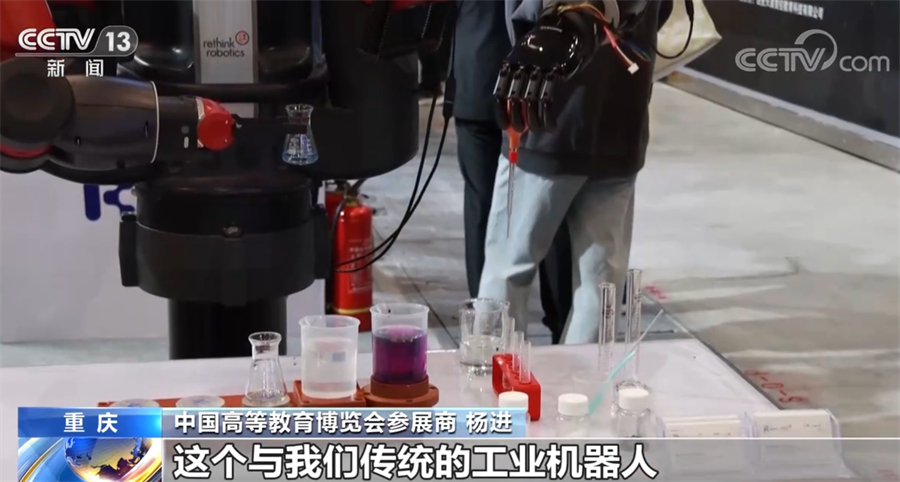
In the high-tech equipment exhibition area, a new type of dual-arm cooperative robot attracted the attention of many exhibitors.

Yangjin, exhibitor of China Higher Education Expo:We adopt the configuration of flexible joints, which can drag the robot’s arm very flexibly, which is essentially different from our traditional robots. We cooperate with universities to introduce some of our industry applications and resources into the curriculum system, such as specialty construction and laboratory construction.

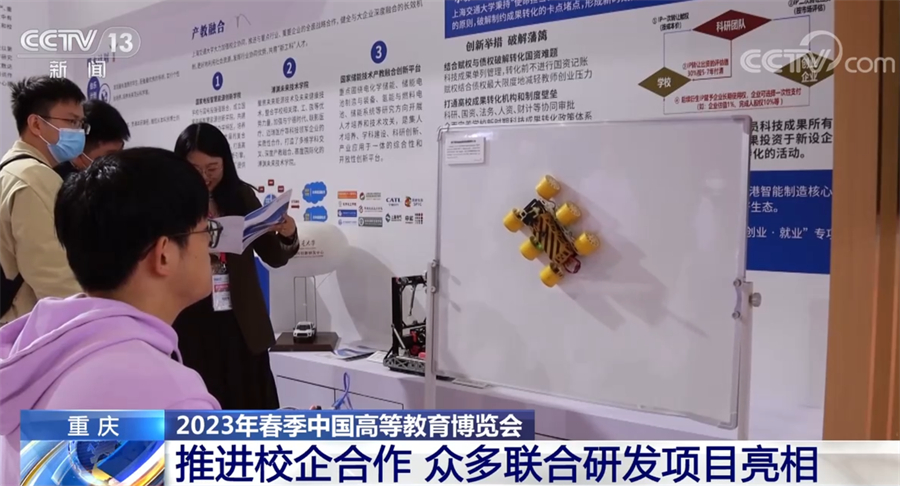
The "black technology" independently developed by many college students is also favored by exhibitors. In the booth of Shanghai Jiao Tong University, this robot for inspecting the inner wall of large containers can adsorb and move on the inner wall of steel lining through magnetic adsorption, and transmit the image back to the staff of the control station in real time through wireless transmission, thus replacing the previous manual scaffolding for inspection.

Li Tongjia, Graduate Student, School of Mechanical and Power Engineering, Shanghai Jiaotong University:In the process of developing it, I have been trained by both school tutors and enterprise tutors. On the one hand, I can apply what I have learned in school to actual production and life, on the other hand, I can understand the needs of enterprises.

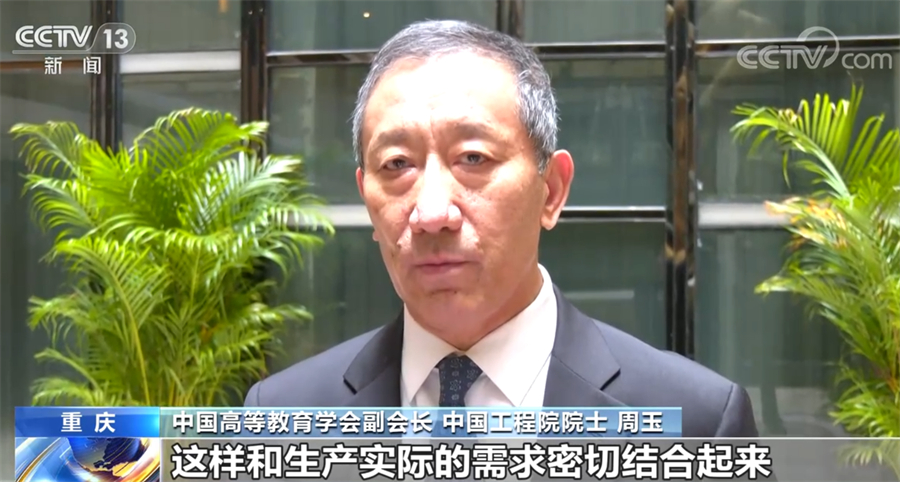
Zhou Yu, Vice President of China Higher Education Society and Academician of China Academy of Engineering:Take the road of school-enterprise cooperation and integration of production and education, closely combine with the actual needs of production, extract the scientific and technological problems that enterprises need, and we will work together with schools to solve this problem.

In the newly-added college area of this high-tech fair, the achievements of 110 colleges and universities in 28 provinces (municipalities and autonomous regions) are displayed in a concentrated way. In the booth of Harbin Institute of Technology, 549 patriotic education bases and 50 national heavy equipment enterprise bases were drawn to form three maps of red resources, national heavy equipment and industry model, which effectively integrated ideological and political theory courses with practical teaching.

Yin Shengjun, Director of the Teaching and Research Section of the Ideological and Political Practice Course of Harbin Institute of Technology:On this platform, we pay special attention to the development of students’ subjectivity, that is, students participate in ideological and political courses as the main body, and more actively speak and present what they have learned through his perspective.

On the Times Value of Revolutionary Culture

  Author: Pan Hong (researcher, Institute of Military Political Work, Academy of Military Sciences)

  "Revolutionary culture" is a special cultural phenomenon, and people from all walks of life in China interpret, publicize and practice it with their own understanding of its connotation. In many parts of China, revolutionary culture is more often called "red culture". As a result, "revolutionary culture" and "red culture" are confused, the original intention of revolutionary culture is diluted, and the explanation of red culture is more "different". After careful analysis, it is found that the concept of "red culture" appeared at the beginning of the 21st century. After more than 20 years of reform and opening up, China faces many difficulties in its development. It is inevitable that people will recall the faith and spiritual strength that led the party and people to victory from the past history and experience. Facts have proved that this phenomenon is very consistent with the cultural records of academic circles at that time. The full-text database of China journals shows that in 2003— In the academic papers in 2004, "red culture" has become the key word. At the same time, some scholars have noticed that before the concept of red culture appeared, the academic circles in China had already put forward such terms as "red classics", "red resources" and "red tourism". Are these formulations accurate?Should the inheritance of revolutionary tradition return to its original intention? In the new era of Socialism with Chinese characteristics, it has become an important concern for people to find a correct position for revolutionary culture and reflect its contemporary value.
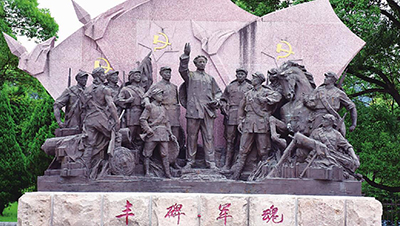
  The fundamental difference between revolutionary culture and other cultures lies in the red background color paved by the China Revolution.

  The report of the 19th National Congress of the Communist Party of China pointed out that culture is the soul of a country and a nation. "Socialism with Chinese characteristics culture, which originated from the excellent traditional Chinese culture nurtured by the 5,000-year civilization history of the Chinese nation, was cast in the revolutionary culture and advanced socialist culture created by the party leading the people in revolution, construction and reform, and was rooted in the great practice of Socialism with Chinese characteristics". It can be seen from this document that condenses the latest theoretical achievements of the Party that "red culture" should be called "revolutionary culture" in a standardized way, and its historical origin can be traced back to the magnificent new-democratic revolutionary practice in China in the early 20th century.

  China’s "revolutionary culture" can be traced back to the founding of the Communist Party of China (CPC), and it is closely related to the establishment of proletarian political parties in the world and Marxist theory. In the mid-19th century, after the birth of Marxism in Europe, after half a century, it changed from a ghost to a proletarian revolutionary theory, which guided the success of the October Revolution in the Soviet Union and showed the future direction of the China Revolution with the light of truth. As a result, in the 20th century, China in the East kept switching revolutionary themes in the democratic revolution, national salvation and people’s liberation movements. In the mutual agitation and choice of various ideologies and plans to save China, the Communist Party of China (CPC) wrote Marxist theory on his banner, led the people in unremitting struggle and made great sacrifices to realize the lofty ideal of communism. According to the statistics of the Information Center of the Academy of Military Sciences, during the 22 years from 1927 to 1949, there were 3,203 major battles and battles that were able to find out the basic elements such as battle names, combat areas, our troops participating in the war, enemy troops participating in the war, and combat results. "I dare to teach the sun and the moon to change the sky for the sake of sacrifice and ambition." Under the leadership of the Communist Party of China, the people’s army finally seized power and established People’s Republic of China (PRC) after arduous struggle. Deng Xiaoping once said that the founding of New China was dyed red with the blood of hundreds of millions of martyrs. Indeed, the blood of the revolutionary martyrs paved the background of the China revolution, and only then did the red China in the eyes of foreigners have the red regime in Chinese’s heart, and today ".红色文化”称谓的流传。

  中国共产党及其领导下的人民军队是革命文化的主创者。1927年第一次国共合作破裂后,面对国民党的屠杀政策,中国共产党为挽救革命,实行武装抵抗。在著名的三大起义中,南昌起义部队沿用了国民革命军的番号;秋收起义非常接地气地打出了“工农革命军”的人民武装旗号,广州起义因有苏联顾问的参与指导,宣布组织“工农红军”,并打出了“工农红军”旗帜。当时中国共产党作为共产国际远东支部,无条件接受其领导,中共中央遂于1928年5月25日发布《军事工作大纲》,明确规定武装“割据区所建立之军队,可正式定名为红军,取消以前工农革命军的名义”。井冈山上的毛泽东、朱德根据中央指示,将工农革命军第四军正式改称“中国工农红军第四军”,各革命根据地武装力量先后奉命改称“红军”。1931年后,全国各地革命军队统一改称“中国工农红军。”1936年,红军长征的胜利,使中国工农红军的红色传奇故事走向世界。

  Under the leadership of the Communist Party of China (CPC), this red powerhouse developed from a single spark to a prairie fire during the Agrarian Revolution. During the War of Resistance against Japanese Aggression period, he resolutely went to the battlefield behind enemy lines to carry out independent guerrilla warfare and joined hands with the Kuomintang to resist aggression and win national liberation; In the war of liberation, we fought a strategic decisive battle with the Kuomintang for the two futures and destinies of the people of China; Finally, after 28 years of bloody fighting, he completed the task of the new democratic revolution, established the proletarian regime, and became a strong pillar of the new socialist China.

  Thus, the background color of China Revolution is red, and the banner of China Revolution is also dyed red with the blood of millions of martyrs. Needless to say, the dictatorship of the proletariat and its theory of violent revolution have transformed semi-colonial and semi-feudal China in China, and the people have become masters of their own affairs. The essence of all this is the practice of China’s new-democratic revolution. Therefore, any "colored" cultural term can reflect this practice process more accurately than "revolutionary culture".

  After the 18th National Congress of the Communist Party of China, General Secretary of the Supreme Leader attached great importance to the inheritance and construction of revolutionary culture. During his inspection of the former Lanzhou Military Region, he stressed that it is necessary to carry forward the advantages of red resources, carry out in-depth education on the military history of party history and fine traditions, and pass on the red gene from generation to generation. Since then, he has visited Xibaipo, Jinggangshan, Yimeng Mountain, Gutian, Yan ‘an, Zunyi and other revolutionary holy places. After the 19th National Congress of the Communist Party of China, General Secretary of the Supreme Leader led The Politburo Standing Committee (PSC), paid a visit to the site of the First Congress of the Communist Party of China in Shanghai and the Red Boat in Nanhu, Jiaxing, Zhejiang, reviewed the history of party building and revisited the pledge of joining the Party, in which the "revolutionary main line" was clearly visible. To be exact, red is only a symbolic meaning, but revolutionary culture is the "root" and "soul" of the Communist Party of China (CPC)’s national rejuvenation in the new era, so that we can deeply understand the original intention of "keeping in mind the original heart" and never forget "knowing where to go from where to go".

  Following the main line of the Supreme Leader’s visit to the revolutionary holy land, the rich connotation of revolutionary culture has been gradually revealed. The Jinggangshan struggle made us understand the inevitability of ideological vacillation at the beginning of the revolution and the importance of strengthening the confidence in the victory of the revolution. At Gutian Conference, the Party stipulated the nature, purpose and task of the Red Army in the form of resolutions, and made clear the basic problem of "who carries guns and fights for whom". Established the principle of the party’s absolute leadership over the army and solved the fundamental problem of how the party leads the army; Straightened out the relationship between military work and political work in the army, and the basic way to correct all kinds of non-proletarian thoughts. The Zunyi Meeting marked that the China Revolution got rid of dogmatism, the Communist Party of China (CPC) began to explore the China Revolution independently, and the China style and China style at the beginning of the formation of Mao Zedong Thought. Yan’ an years make people feel the hardships during the anti-Japanese national salvation period and the richness in the spiritual world of the revolutionary holy land; Xibaipo — — The Central Committee of the Communist Party of China, the last rural headquarters of China Revolution, issued an earnest warning to all party member before going to the ruling stage. In this way, the connotation of revolutionary culture should include: rich contents of material and intangible culture as revolutionary cultural resources; All the old things and relics, former sites and sites related to the revolutionary struggle and other revolutionary historical remains and memorial sites,And the corresponding revolutionary spirits formed in the revolutionary years, including Red Boat Spirit, Jinggangshan Spirit, Long March Spirit, Yan ‘an Spirit, Xibaipo Spirit and so on.

  Revolutionary culture was formed in the great practice of China revolution and has distinct spiritual characteristics.

  Revolutionary culture was conceived in the Communist Party of China (CPC)’s initial intention of seeking happiness for the people of China and rejuvenation for the Chinese nation, and formed in the great practice of the China Revolution. It is a precious spiritual wealth of the Chinese nation’s history and culture, and has become a powerful spiritual driving force and cultural support for national rejuvenation. The strong vitality of revolutionary culture is embodied in its distinctive spiritual characteristics.

  Revolutionary. It mainly includes the revolutionary theory and the revolutionary practice. Nearly 70 years after the publication of the communist party Declaration, Marxist theory has finally changed from revolutionary prophecy to reality. In China’s new-democratic revolution, the Communist Party of China (CPC) people, represented by Mao Zedong, made Marxism take root in China with outstanding theoretical consciousness, practical consciousness and historical consciousness. As the first theoretical achievement of China Marxism, the formation and development of Mao Zedong Thought greatly enriched and developed the treasure house of Marxist theory. Revolutionary culture is the reflection of China’s new-democratic revolutionary struggle, so revolutionary is the proper meaning in the practice of China’s new-democratic struggle.

  Nationality. The direct motive of Mao Zedong’s systematic study of Marxism in Yan ‘an caves is to avoid the "Left" and Right-leaning erroneous thoughts in the Communist Party of China (CPC) from harming the Party’s cause again. At the Sixth Plenary Session of the Sixth Central Committee of the Communist Party of China, he stressed: "To make Marx concrete in China and make him have the characteristics of China in every performance, that is, to apply it according to the characteristics of China has become an urgent problem for the whole party to understand and solve." Mao Zedong, who came out of Chongli, Shaoshan, Hunan Province, was a peasant all his life, and became attached to the land, farmers and countryside. He has always been proud of the Chinese nation, eclectically absorbed outstanding achievements of foreign civilization, and achieved the revolutionary cause in China. Mao Zedong’s theoretical innovation has always been based on the Marxist way of thinking, but it has never been a ready-made word in the "book" of Marxism, and it has always reflected the national style that is closest to the reality of China, and China’s revolutionary culture has been marked with a distinctive national brand.

  Popular. In the communist party Declaration, Marx solemnly declared: "All the movements in the past were for or for the benefit of a few people. The proletarian movement belongs to the vast majority of people and works for the interests of the vast majority of people. " The people of the Communist Party of China (CPC), represented by Mao Zedong, know the essence of historical materialism, creatively put forward the Party’s mass line, that is, the ideological line of "all for the masses, all relying on the masses, coming from the masses and going to the masses", and reached the conclusion that "the people, only the people, are the driving force for creating world history", which became an important magic weapon for China’s revolutionary victory. The laboring masses in China saw the power of example and the hope of China’s revolution when the advanced revolutionary elements in China put aside their superior lives and devoted themselves to the proletarian movement for the benefit of the vast majority of people, thus making the revolutionary culture a popular feature of the revolutionary movement "for the people".

  Times. Every era has its own cultural requirements and characteristics, that is, the so-called "fashion". All cultures are created in specific times, so the necessity of any group culture, its creativity and its inheritance and elimination have a distinct brand of the times. Take the Long March as an example, which is a microcosm of the China Revolution. The "fashion" of the China Revolution in the 1930s was: advocating firm faith. The number of people who arrived in northern Shaanxi on the Red Army’s Long March only accounted for 30% of the number at the time of departure. This is undoubtedly a collective "martyr’s ambition" for "ism"! Advocate loyalty to the party. After the Red Army and the Red Fourth Front Army joined forces, Zhang Guotao split the Central Committee, which almost ruined the China Revolution. It was the backbone of the party’s loyalty to safeguard the party’s unity and avoid division; The response and support of the 15th Red Army Corps to the Central Committee of the Communist Party of China and the Central Red Army under the leadership of Mao Zedong in northern Shaanxi made it possible for the Party to lay a political and military foundation in the Shaanxi-Gansu base area. On the Long March, Mao Zedong turned the stretcher into a political stage, showing the mind of revolutionaries in adversity, reflecting a high degree of historical responsibility, regaining leadership, and avoiding the collapse of the Party and the Red Army.

  Innovation. Revolutionary culture includes theoretical innovation, institutional innovation and practical innovation. In order to counter the argument that China’s ravines can’t produce Marxism, Mao Zedong wrote On Practice and On Contradiction, which laid the philosophical foundation of Mao Zedong’s dialectical materialism and historical materialism. In 1938 alone, Mao Zedong’s theoretical achievements included Strategic Issues of Anti-Japanese Guerrilla War, On Protracted War, Independence in the United Front and so on. These programmatic documents are full of thoughts on the key issues of China’s revolutionary war. Mao Zedong explained the Marxist view of war and methodology with his unique "dialectics of war". In 1939, Mao Zedong wrote "China Revolution and the Communist Party of China (CPC)", put forward the scientific concept of "new democratic revolution" for the first time, and defined the basic content of the general line of new democracy. In 1940, Mao Zedong wrote "On New Democracy", which planned the new China after military victory and expounded the politics, economy and culture of new democracy. In 1945, Mao Zedong wrote "On the Coalition Government", which designed the revolution after the victory of the Anti-Japanese War, further linked the politics, economy and culture of the new democratic society with the Party’s program, and completed the blueprint for the new China.

  The reason why revolutionary culture has vitality stems from its agreement with contemporary spiritual pursuit and values.

  The ancients said, "Look at humanity and turn it into the world." The power of culture is the meridian that runs through the historical evolution of human society, and it is the progressive soul of a country and a nation. Revolutionary culture was formed in the period of China’s new-democratic revolution, and it is the product of that era. Besides its own spiritual characteristics, revolutionary culture partially overlaps with contemporary spiritual pursuits and values. Because of this, whenever we walk into any remains of China’s revolutionary culture, we will feel the shock of our hearts, which is one aspect of the contemporary value of revolutionary culture.

  In the report of the 19th National Congress of the Communist Party of China, General Secretary of the Supreme Leader pointed out that we should promote the creative transformation and innovative development of Chinese excellent traditional culture, inherit revolutionary culture, develop advanced socialist culture, keep in mind the original, absorb foreign countries and face the future, better build China spirit, China values and Chinese strength, and provide spiritual guidance for the people. In the new era when the Communist Party of China (CPC) leads the people of China to great rejuvenation, revolutionary culture has special times value.

  The first is to help the leadership of ideological work. Revolutionary culture continues to promote the China, modernization and popularization of Marxism, laying an important foundation for building a socialist ideology with strong cohesion and leading force, and closely uniting all the people in ideals, beliefs, values and moral concepts, and providing a strong support for strengthening theoretical arms and promoting the supreme leader’s Socialism with Chinese characteristics Thought in the new era to be deeply rooted in the hearts of the people. The relationship between revolutionary culture and Socialism with Chinese characteristics culture in the new era is inseparable: the revolutionary culture is formed in the initial stage of Marxism in China, and it has made great theoretical contributions to Marxism in China. As the latest theoretical achievement of Marxism in China, the Supreme Leader’s New Era Socialism with Chinese characteristics Thought is an important part of Socialism with Chinese characteristics’s theoretical system and a guide for the struggle of the whole party and the people of the whole country to practice the great rejuvenation of the Chinese nation. Theoretically, the two are in the same strain. The essence of Socialism with Chinese characteristics is that it must adhere to the leadership of the Communist Party of China (CPC), and the greatest advantage of the Socialism with Chinese characteristics system is that it has always adhered to the leadership of the Communist Party of China (CPC), which is basically consistent and unshakable. Guided by the latest theoretical achievements of contemporary Marxism in China, leading the country, the nation and the people to achieve the Party’s goals is also the homogeneous requirement of revolutionary culture and Socialism with Chinese characteristics culture in the new era.

  The second is to help cultivate and practice socialist core values. The influence of culture is first of all the influence of values. The struggle for various cultures in the world is essentially a struggle for values, as well as a struggle for people’s hearts and ideology. As the saying goes, "the strength of a moment lies in strength, and the victory or defeat of the ages lies in reason." Core values are the spiritual bond that a nation depends on and the common ideological and moral foundation of a country. The important reason why the Chinese nation’s thousands of years of history is endless, handed down from generation to generation and tenacious development is that the Chinese nation has a common spiritual pursuit, spiritual characteristics and spiritual context. What kind of values should China and the Chinese nation adhere to? This is both a theoretical issue and a practical one. The General Secretary of the Supreme Leader pointed out that our socialist core values of prosperity, democracy, civilization, harmony, freedom, equality, justice, rule of law, patriotism, professionalism, honesty and friendliness embody the thoughts of ancient sages, the long-cherished aspirations of people with lofty ideals, the ideals of revolutionary martyrs and the yearning for a better life of people of all ethnic groups. From this, we can understand the common ideological foundation of socialist core values and revolutionary culture.

  The third is to help strengthen ideological and moral construction. In the report of the 19th National Congress of the Communist Party of China, General Secretary of the Supreme Leader pointed out that it is necessary to improve people’s ideological consciousness, moral standards and civilized accomplishment, raise the level of civilization of the whole society, extensively carry out education on ideals and beliefs, deepen publicity and education on Socialism with Chinese characteristics and the Chinese dream, carry forward the national spirit and the spirit of the times, strengthen education on patriotism, collectivism and socialism, and guide people to establish a correct view of history, nationality, country and culture. At the Seventh Plenary Session of the 18th Central Commission for Discipline Inspection, the General Secretary of the Supreme Leader emphasized: "If leading cadres want to forget their initial intentions and stick to the right path, they must strengthen their cultural self-confidence. Without the foundation and nourishment of China’s excellent traditional culture, revolutionary culture and advanced socialist culture, it is difficult to be deep and persistent. " Revolutionary spirits cultivated by revolutionary culture in different historical periods, such as Red Boat Spirit, Jinggangshan Spirit, Long March Spirit, Yan ‘an Spirit, Xibaipo Spirit, etc., show patriotic feelings of loyalty and sincere dedication to the country; Not afraid of strong enemies, dare to fight and win; Heroic spirit of overwhelming decisive battle; The spirit of sacrifice that takes death as death and dares to struggle; Loyal and unyielding revolutionary integrity; The psychological strength of being calm and resolute; Military orders, such as mountains, military discipline, such as iron, are all inherent manifestations of revolutionary culture. Revolutionary culture and the national spirit with patriotism as the core emphasized by Socialism with Chinese characteristics culture in the new era have the same value pursuit.

  The fourth is to help the prosperity and development of socialist literature and art. Socialist literary and artistic creation comes from the people and takes the people as the center. To prosper literary and artistic creation, we must be rooted in historical themes and realistic themes, and constantly tap and launch masterpieces that eulogize the party, the motherland, the people and the heroes of the era. Advocate stressing taste, style and responsibility, and resist vulgarity, vulgarity and kitsch. Revolutionary culture is the product of the war years, so the spirit of high-spirited struggle is its distinctive feature. At the same time, the simple and colorful literary form of revolutionary culture is popular with the public, so it is also the easiest to take root among the broad masses. This is particularly worth learning and thinking in the new era today, in order to avoid borrowing the name of revolutionary culture and practice vulgar vulgar kitsch culture.

  The fifth is to help the development of cultural undertakings and cultural industries. In order to meet people’s new expectation of a better life, we must provide rich spiritual food for the people. Therefore, strengthening the protection and utilization of revolutionary cultural resources must be regarded as an important content to improve the public cultural service system, implement the cultural benefit project and enrich mass cultural activities. We will continue to build international communication capacity and tell the story of China well. We should not only make full use of the brilliant achievements of ancient Chinese civilization, but also deeply explore the spiritual connotation of revolutionary culture, show the world a true, three-dimensional and comprehensive China, and improve the cultural soft power of the country. Protecting and managing Chinese traditional culture and revolutionary culture well, at the same time, strengthening research and utilization, allowing history to speak and cultural relics to speak, while inheriting the achievements and glory of Chinese culture and revolutionary culture, enhancing national pride and self-confidence will surely become the best way to understand history and learn from future development.

  Guangming Daily (October 9, 2018, 05 edition)
Make up for the "efficiency deficit" and solve the "contradiction between supply and demand", and China and Pakistan will work together to promote the reform of the global governance system.

  Introduction: The current global governance system is affected by political polarization, and the "efficiency deficit" is prominent. On the one hand, developed countries do not have enough ability and willingness to provide global public goods, on the other hand, they are unwilling to transfer more power to developing countries, resulting in two "supply and demand contradictions" in international governance. It is difficult for developing countries to deeply participate in global governance and promote the democratic reform of global governance. China and Brazil, as the largest developing countries and important representatives of emerging powers in the eastern and western hemispheres, will continue to carry out efficient and sustainable bilateral cooperation, twist into a rope with the vast number of developing countries, and work together to promote the reform of the global governance system.

  China and Brazil are the main representatives of emerging powers. They are in an important period of national modernization and rising international influence, and their international identities are facing a key transformation from "peripheral powers" to "central countries". Since the beginning of the new century, with the strong impetus of economic and trade relations and the promotion of South-South cooperation, China-Pakistan relations have made a leap-forward breakthrough with richer international connotations. Promoting the reform of the global governance system has become an important topic in the strategic dialogue between China and Pakistan, which is also the key reason why the international community is paying more and more attention to the development trend of China-Pakistan relations.

  Both China and Pakistan advocate the reform of the current global governance system, and hold similar positions on major international issues such as the reform of the international financial system, food security, energy security, climate change, the UN Millennium Development Goals, and global security governance. They both adhere to the principle of multilateralism, advocate the democratization of international relations and the multipolarization of the world, emphasize the concept of a new international political and economic order, and defend the development and security rights of developing countries. China and Pakistan hold common reform demands and similar reform positions, laying an important foundation for the two countries to expand bilateral cooperation in major international affairs.

  Since the beginning of the new millennium, the two countries have cooperated closely in international multilateral mechanisms such as the United Nations, the International Monetary Fund, the World Trade Organization, the World Bank, and the G-20. Especially through the platform of BRICS, China and Pakistan have achieved more extensive cooperation with other developing countries (especially large developing countries), which has enhanced the overall voice of developing countries in global governance and promoted the gradual establishment of a new world political and economic order and an international multipolar pattern.

  Image source: vision china

  From the overall context of the development of China-Pakistan bilateral relations, global governance cooperation has become a significant growth point of China-Pakistan cooperation since the new century, and South-South cooperation, including China-Pakistan cooperation, has actually promoted the redistribution of global power resources. Although the developing countries are far from achieving an international status that matches their overall strength, their global governance concept has attracted higher international attention, which fully shows that multilateral cooperation has become an effective way for developing countries to enhance their participation in global governance.

  At present, the theme of "peace and development" is facing unprecedented challenges, and the "efficiency deficit" of global governance is prominent. Generally speaking, the current predicament of global governance mainly stems from two groups of contradictions between supply and demand. The first group of contradictions is the contradiction between the arduous task of global governance and the decline of the ability and willingness of the leaders of the governance system to provide public goods. At this stage, influenced by political polarization, the narrow nationalism, protectionism and populism of developed countries in the United States and Europe are on the rise. In the process of participating in globalization, they emphasize the maximization of their own interests, and their willingness and ability to participate in global governance and provide public goods are greatly reduced, and even the phenomenon of withdrawing from international multilateral cooperation mechanisms at will appears, which is in great contrast to the situation in which developed countries led the promotion of global governance in the rapid development stage of economic globalization in the past. Moreover, the problems of "democracy deficit", "responsibility deficit" and "trust deficit" existing in global governance are more prominent, and the reform of global governance system is very necessary and urgent.

  Another set of contradictions is the contradiction between the great demand of developing countries to participate in international governance and the small transfer of power in developed countries. In the process of the transformation of the international system, the vast number of emerging markets and developing countries have put forward reasonable demands for participating in global governance, demanding the reform of the global rule system dominated by western developed countries, changing the global governance rules oriented to the interests of developed countries, and paying more attention to the interests of developing countries (even all mankind). However, with the comparative change of global strength and the relative weakness of its own strength, the West hopes to continue to master the leading role of global governance at a lower cost. In other words, the leading party of the global governance system does not agree with or accept the new participants. This makes it more difficult for global effective governance, global governance reform and international system transformation to fit together, which leads to the lag of global governance mechanism that is not commensurate with the global power structure.

  Image source: vision china

  Obviously, the above two groups of contradictions between supply and demand form a two-way constraint on multilateralism, which is bound to create obstacles for developing countries to expand their participation in global governance and promote the democratic reform of global governance. Although multilateralism is in crisis, it is still the priority path for developing countries to carry out international cooperation. First, multilateralism can effectively reduce the cost of emerging powers participating in global governance; Second, multilateralism helps to alleviate the asymmetry of decision-making influence between emerging powers and established powers.

  China-Pakistan relations have a solid foundation for cooperation. At present, the world outlook, security outlook and development outlook of the two governments are highly consistent, and they have similar positions on the reform of the global governance system, which provides a favorable environment of mutual trust for deepening cooperation. In the next stage, the development focus of China-Pakistan relations is mainly reflected in the following two levels.

  First, maintain the efficiency and sustainability of bilateral cooperation. The development of relations between countries should be based on the integration of interests of both sides, and the degree of interest consistency is the key factor to determine the efficiency of bilateral relations. The trade structure between China and China is highly complementary. Brazil is an important partner of to ensure energy, resources and food security, and also a major supplier of soybeans, corn, iron ore and oil. At present, China and Pakistan still have a large space to "make a big economic and trade cake", especially the agricultural products trade has great potential. At the investment level, we should pay more attention to Brazil’s energy, infrastructure, mining, agriculture and other fields, especially focusing on the two major fields of energy and infrastructure, which have a large investment gap in Brazil. Considering Brazil’s "re-industrialization" demand, achieving higher quality integration of industrial chain will be the development direction of bilateral investment relations in the future.

  Second, firmly defend multilateralism and work together to promote global governance reform. As the largest developing countries in the eastern and western hemispheres, China and Brazil shoulder the mission of safeguarding the legitimate rights and interests of developing countries, and should also be the core forces to promote the reform of the global governance system. Especially in the situation that globalization is going against the current, multilateralism is facing difficulties and the efficiency of global governance is shrinking, on the one hand, China and Brazil should strengthen the coordination of their positions on major global issues. We should make good use of multilateral mechanisms such as G20, BRICS and Basic Four countries (Brazil, South Africa, India and China) and strive to form a unified voice. On the other hand, we should strengthen interaction and cooperation with other developing countries to stimulate new vitality of South-South cooperation. Only when developing countries form a strong reform force can the reform of global governance system make a fundamental breakthrough.

  Image source: China Daily

In his speech at the conference on the integration of science and technology and capital development, Wang Qingxian pointed out that we should work together to build a virtuous circle of science and t

  On the morning of November 21st, a conference on the integration of technology and capital was held in Hefei, which was jointly organized by China Academy of Sciences Holding Co., Ltd. and CITIC Securities Co., Ltd.. Wang Qingxian, Governor of Anhui Province, attended and delivered a speech.

  In his speech, Wang Qingxian pointed out that it is necessary to thoroughly study and implement the spirit of the important speech delivered by the Supreme Leader General Secretary at the Central Financial Work Conference, better combine the promotion of high-quality financial development with the realization of high-level scientific and technological self-reliance and the construction of a modern industrial system, continuously deepen the cooperation among science and technology, industry and capital, promote the deep integration of innovation chain’s industrial chain, capital chain and talent chain, and continuously improve the transformation and industrialization level of scientific and technological achievements.

  Wang Qingxian emphasized that vigorous innovation is Anhui’s most beautiful business card, and distinctive manufacturing features are the most solid support for Anhui’s high-quality development. In the process of building an influential source of scientific and technological innovation and a gathering place of emerging industries, Anhui has given full play to the important role of capital in driving the concentration and allocation of various production factors, vigorously promoted the construction of multi-level capital markets, and effectively empowered scientific and technological innovation and industrial innovation by implementing the "Welcome to Pine" plan and building a "fund jungle" system. Anhui will persistently use platform thinking and ecological concepts to promote the integration, agglomeration and interactive coupling of factor resources, vigorously promote the construction of Silicon Valley of HKUST, Science and Technology Business School of China HKUST and Antelope Industry Internet platform, and promote scientific research institutions, colleges and universities, scientific apparatus to carry out collaborative innovation with enterprises and capital, so as to create an ecosystem of integrated development of science and technology, industry and capital.

  Wang Qingxian said that Anhui is willing to become a "testing ground" for the integration and docking of national science and technology, industry and capital, and hopes that more investors and entrepreneurs will fully grasp the broad opportunities of Anhui in building a new development pattern, and carry out in-depth cooperation in the transformation of scientific and technological achievements, the development of emerging industries, industrial venture capital funds, and the construction of innovation platforms, and form more promotion of "science and technology — Industry — Innovative practice of virtuous circle of finance.

  At the meeting, the main responsible comrades of China Academy of Sciences Holdings Co., Ltd. and CITIC Jiantou Securities Co., Ltd. delivered speeches successively. Nearly 500 well-known academicians and experts, representatives of listed companies, science and technology enterprises and financial investment institutions from the fields of information optoelectronics, computing chips and general artificial intelligence attended the meeting. (Reporter Wu Liangliang)