Deepwater Horizon: Is the dirtiest movie a clean stream in a disaster movie?

Special feature of 1905 film network The English title of "Deepwater Horizon" still haunts many Americans, because this term has long been closely linked to the worst marine ecological catastrophe in the history of the United States and even the world six years ago.
On April 20, 2010, the Deepwater Horizon offshore drilling platform leased by BP exploded and sank in the waters of the Gulf of Mexico, and 3.19 million barrels of crude oil continued to leak for 87 days. The oil slick on the sea covers an area of over 9,900 square kilometers. The accident caused the ecological circle composed of more than 8,300 species along the coast of the Gulf of Mexico to be devastated, and the local fishery and tourism industry also suffered greatly.
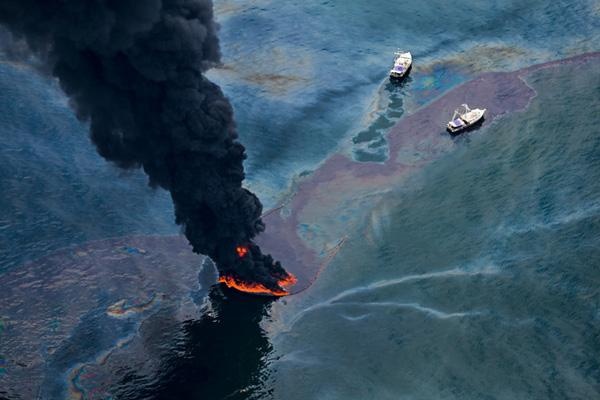
News photos of "Gulf of Mexico oil spill"
In the face of this "worst oil spill" in American history, the media and public opinion focused on the slow response of the Obama administration, the "quick success and instant benefit" BP company and even the seagulls and marine life that were poisoned, but only the 11 people who died unfortunately and the 126 oil workers who experienced the disaster were rarely interested.
Peter Berg, the director, admits that this is the original intention of his filming of Deepwater Horizon, which truly reproduces the catastrophe of life and death faced by 126 oil workers on April 20th, 2010, and makes 11 unfortunate lives get due attention and respect.
Special effects in the environment are a double-edged sword.
When it comes to the style of Peter Berg’s works, it can be said that there are two poles, one is such a popcorn visual blockbuster, and the other is such a heavy masterpiece with no lack of temperature. This time, Deepwater Horizon seems to find a delicate balance between the two.
Realistic visual effects are a highlight of Deepwater Horizon. According to reports, Borg "restored" the Deepwater Horizon drilling platform according to the proportion of 85% for the authenticity of the scene restoration, and put the whole platform in a giant water tank with a water storage capacity of 10,000 tons. The scale of the studio is among the highest in film history. In addition, almost all the scenes in which the actors appear are shot with real scenes, including a lot of flames and smoke shots.
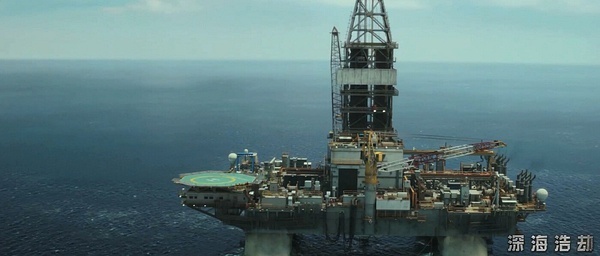
This makes the disaster scenes in the film (especially the IMAX version) have a strong impact and a sense of presence. The audience seems to be in a sea of fire with the drilling workers, and may be swallowed up by the flames spewing out at any time. However, the use of special effects is a double-edged sword. The second half of the film is almost filled with blowouts and explosions again and again, which seems to be progressive but there is no essential difference. The audience can easily become numb under the stacking of special effects and repeated bombing, ignoring the really important characterization and emotional expression behind them.
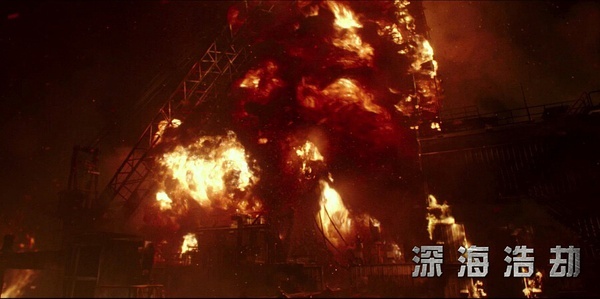
Deepwater Horizon, which is not sensational, can be called a clean stream.
When it comes to the characterization in the film, authenticity and credibility are a great advantage. There is no "facebook" hero in the film, even mark wahlberg’s "engineer" Mike, who saves the team, strictly corresponds to the real people, without dazzling savior aura and over-rendering.
In the film, the workers who took the lead in boarding the lifeboat chose to abandon Mike and Mr. Jimmy to escape by boat. This detail is the same as many movie scenes, but in this film, the director did not sublimate it to the interpretation of the dark side of human nature, but tried to explain the rationality of this decision with details.

Although there are a few emotional climaxes in the film, such as the "leap of faith" of Mike and Andrea crossing the fire, the collective kneeling prayer of the survivors and the emotional embrace of the protagonist’s family of three, etc. However, compared with the consistent mode of Hollywood disaster films, Deepwater Horizon is extremely restrained, not sensational or sublime, but tries to restore the stories and scenes in detail for the audience to taste, which can be called "a clean stream" in Hollywood, which is "afraid of chaos in the world".
Of course, the director’s demand for authenticity sacrifices the drama conflict and entertainment that many blockbusters deserve. After all, the reason why the audience loves disaster movies is that their inner defense can still be shattered by the extreme nature of disaster and the flash of human nature on the premise of knowing the result.
Cas lineup is remarkable. mark wahlberg returns to "ordinary people"
The lineup of this film is also remarkable, which can be described as a gathering of strength. Kurt Russell and john malkovich, two "old players", put the two roles of "one right and one wrong" into a vivid interpretation. Under the collision with director Peter Berg, mark wahlberg always seems to show a completely different sense of plainness from other commercial films. As Borg said, Wahlberg has a rare "ordinary" quality.

In contrast, the role of kate hudson, the propaganda focus of this film, is relatively mediocre, and there is no more bright spot except for his loving wife and anxious family members. The affectionate embrace of his stepfather Kurt Russell in real life at the end of the film has won a lot of applause outside the film.
The audience needs more than shock and tribute.
At the end of the film, the names and photos of eleven victims emerged one by one, the real trial footage was broadcast, and the subtitles were printed. Two senior executives of BP Company were held accountable, but the film came to an abrupt end. The director’s explanation is that he only wants to restore the scene of the incident and pay tribute to the lost life, and does not want to enlarge it into a thorough study of the cause and effect of the whole incident.
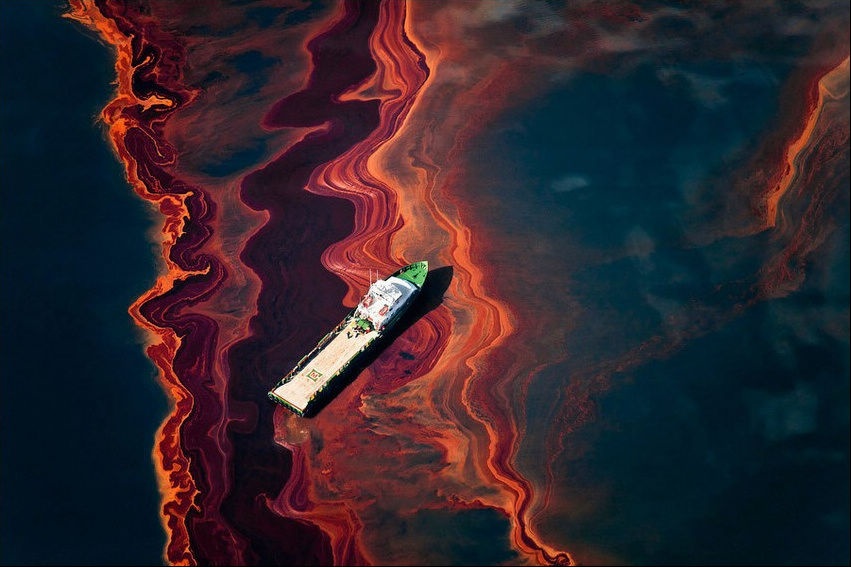
Site map of oil spill in Gulf of Mexico
However, the oil spill in the Gulf of Mexico is different from ordinary accidents. Its position and influence in the history of the United States and the world make any film related to it have an innate sense of mission. After all, he is not a "natural disaster" but a "man-made disaster". The audience should be given room for rational thinking while marveling at the visual effects and being in awe of the deceased. How did all this happen, who should be responsible for it and how to avoid the recurrence of the disaster? If we want to talk about shortcomings, Deepwater Horizon is far from enough at this level.