This year, over 30 cities have adjusted the property market purchase restriction policy: "high-frequency small-step optimization" will become a feature.
"Cancel the recognition of housing and loan" and "encourage the elderly to buy houses with relatives" …… On March 1 this year, after Zhengzhou became the first city in China to relax the purchase restriction policy, many cities followed up and adjusted the purchase restriction policy.
Over 30 cities adjust the purchase restriction policy
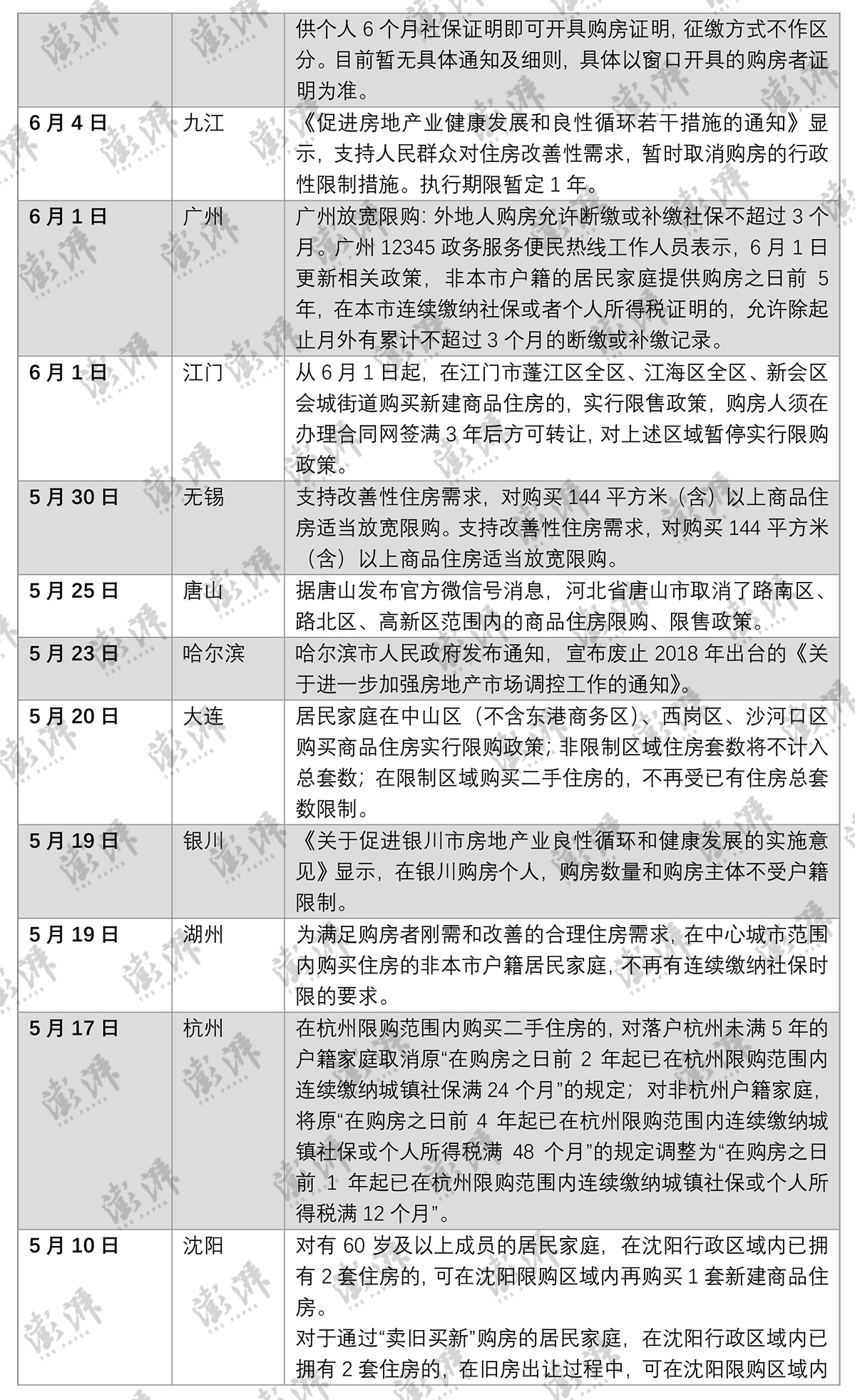
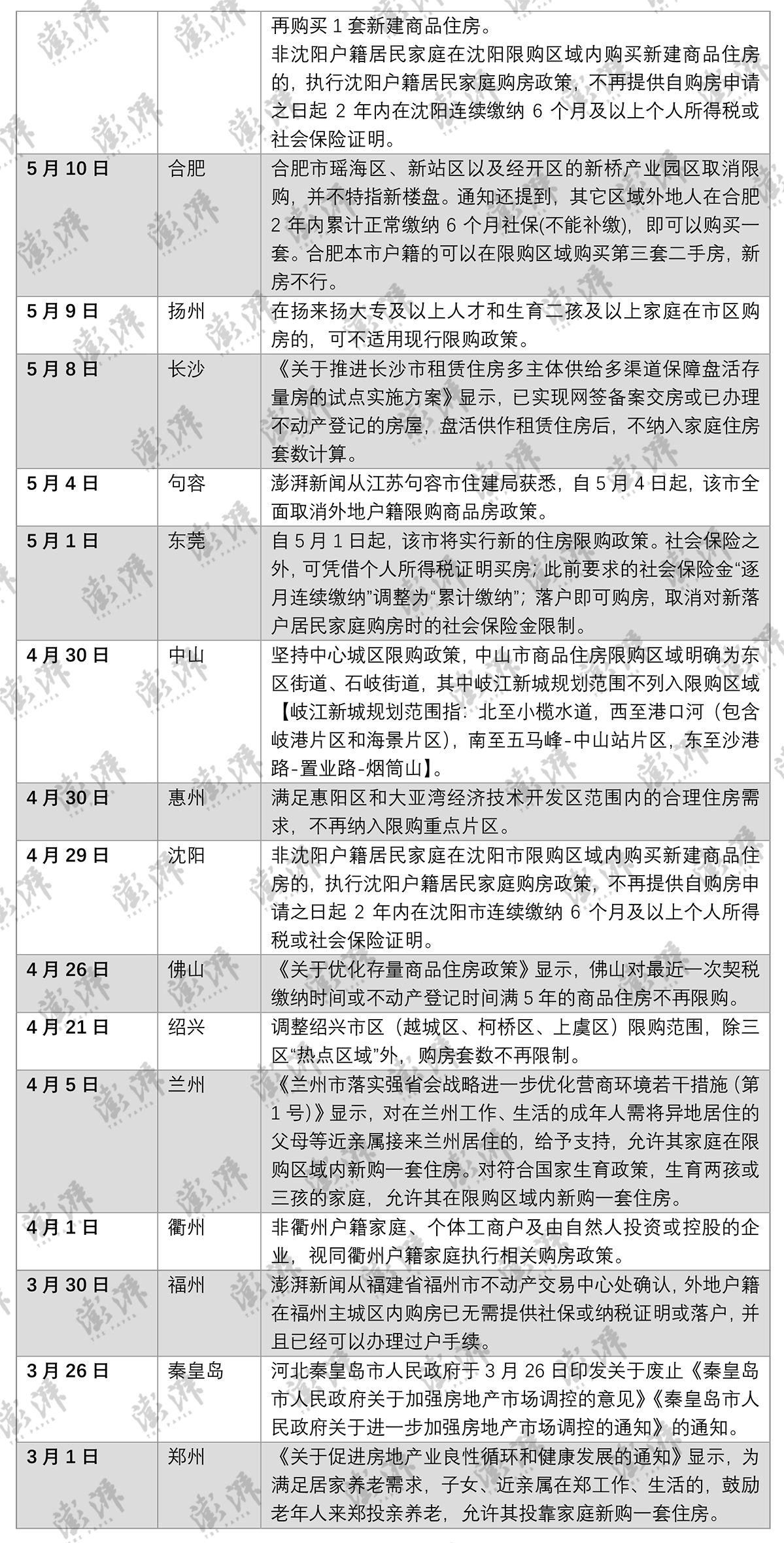
According to the incomplete statistics of The Paper, this year, it includes Zhengzhou, Qinhuangdao, Fuzhou, Quzhou, Lanzhou, Shaoxing, Foshan, Shenyang, Huizhou, Zhongshan, Dongguan, Jurong, Changsha, Yangzhou, Hefei, Shenyang, Hangzhou, Huzhou, Yinchuan, Dalian, Harbin, Tangshan, Wuxi, Jiangmen, Guangzhou, Jiujiang, Nanjing, Wuhan.
In these cities, some announced the abolition of the original restrictive measures, some announced the narrowing of the scope of purchase restrictions, some lowered the threshold of purchase restrictions, and some cities made it clear that families with many children and relatives could increase the number of places to buy houses.
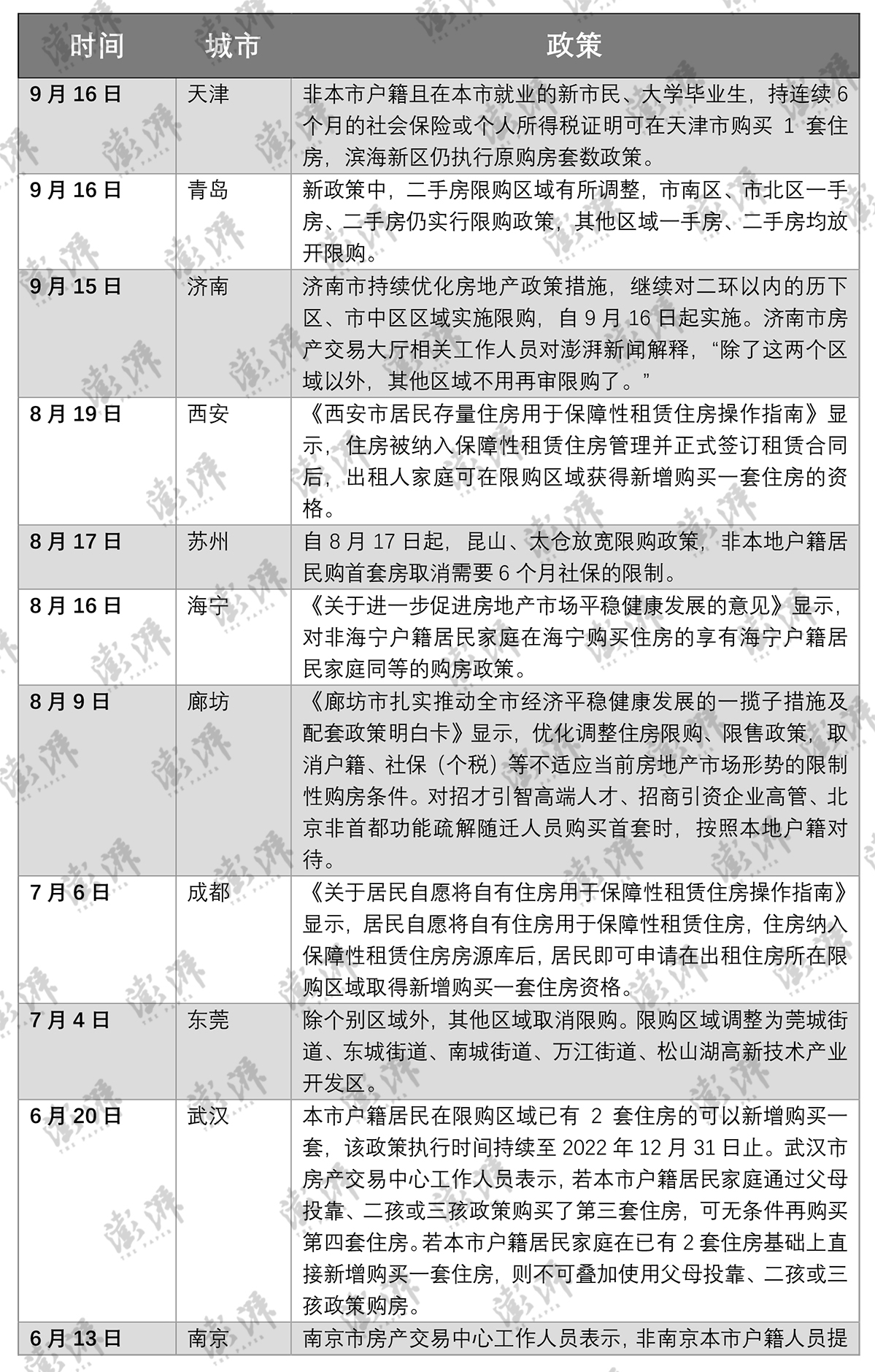
Take Tianjin as an example. On September 16th, according to "Tianjin Housing and Urban-Rural Development", the Tianjin Municipal Housing and Urban-Rural Development Committee and other seven departments jointly issued the Notice on Further Improving the Real Estate Regulation Policy to Promote the Healthy Development of the Real Estate Industry (hereinafter referred to as the Notice). The Notice mentioned that new citizens and college graduates who are not registered in this city and are employed in this city can buy in Tianjin with social insurance or personal income tax certificates for six consecutive months.
According to the "Implementation Opinions on Deepening the Regulation of the Real Estate Market in Tianjin" issued by Tianjin on March 31, 2017, families with non-Tianjin household registration who purchase houses in this city need to provide proof of continuous payment of social insurance or personal income tax for more than 2 years in Tianjin within 3 years.
In terms of supporting the demand for improved housing, the Notice proposes that families with members aged 60 and above and families with many children who have two or more children can purchase another set of housing on the basis of the original housing purchase restriction policy in Tianjin with the household registration book.
Guan Rongxue, an analyst at Zhuge Housing Data Research Center, pointed out that in the original policy, it was clear that non-Tianjin registered residents were required to provide proof of continuous payment of social insurance or personal income tax for more than two years within three years in this city, and now it is adjusted to only provide social insurance or individual income tax for six consecutive months, which lowered the threshold for buying a house; Secondly, for families with members aged 60 and above and families with many children who have two or more children, one set can be purchased, which fully considers the housing needs of different age groups and reasonably relieves the contradiction between supply and demand.
The policy of Suzhou and Qingdao is now "one-day tour"
However, in the above-mentioned cities that announced the adjustment of the purchase restriction policy, there have also been cases in which policies have been introduced and adjusted.
Taking Qingdao as an example, on September 15th, WeChat official account, the official WeChat of Qingdao Urban and Rural Construction Bureau, released "Dynamic Improvement of Real Estate Policy in Qingdao". The New Deal is clear, and the purchase restriction policy will continue to be implemented in Shinan District and Shibei District (except the original Sifang District).
At the same time, continue to clarify the purchase of housing. For new commercial housing in the restricted area, local residents are restricted to purchase 2 sets, families with two children and three children can purchase 1 set, and foreign residents can purchase 1 set after living for half a year; Second-hand housing is no longer restricted.
However, on the same day, Qingdao Housing and Urban-Rural Development Bureau deleted the statement that "second-hand housing is no longer restricted".
On the afternoon of September 16th, the relevant staff of Qingdao Housing and Urban-Rural Development Bureau told The Paper that in the new policy, the restricted purchase area of second-hand houses has been adjusted, and the restricted purchase policy is still implemented for first-hand houses and second-hand houses in Shinan District and Shibei District, while the restricted purchase is released for first-hand houses and second-hand houses in other areas.
On September 14th, market news came out that Suzhou City, Jiangsu Province has made adjustments to the purchase restriction policy, and non-Suzhou local residents can directly purchase the first suite without providing proof of social security payment.
According to the New Deal, the six districts in Suzhou (including Xiangcheng District, gusu district District, Wuzhong District, Wujiang District, Industrial Park and High-tech Zone) have adjusted the policies for foreigners to buy the first suite, and it is no longer necessary to show social security certificates or tax certificates.
Subsequently, The Paper confirmed from the real estate departments in various districts that the above policies were indeed adjusted. However, on September 16th, The Paper learned from the real estate departments of gusu district, Xiangcheng District, Wuzhong District, High-tech Zone and Industrial Park in Suzhou City, Jiangsu Province that the purchase restriction policies of gusu district, Xiangcheng District, Wuzhong District, High-tech Zone and Industrial Park for non-registered households have been restored to the original policy, that is, the conditions for non-registered households to purchase houses are to pay social security for six consecutive months in Suzhou within three years.
Chen Wenjing, director of market research in the Index Division of the Central Finger Research Institute, believes that under the guidance of the central government’s orientation of "housing and not speculating", the efforts of policy optimization in first-and second-tier cities are generally weak, and high-frequency small-step optimization in various places has become a major feature of real estate policy adjustment this year.
Chen Wenjing pointed out that the recent cancellation of the purchase restriction policies in Suzhou and Qingdao has been withdrawn, which further shows that "no speculation in housing" is still the bottom line of the policies. Among all kinds of restrictive policies, the restriction on the purchase of foreign household registration is an important firewall for core cities to achieve "housing and not speculation". In the short term, it is unlikely that hot second-tier cities will completely cancel the restriction on purchases. It is expected that more cities will gradually advance by giving priority to relaxing the restrictions on purchases in suburbs. At the same time, combined with the National Standing Committee at the end of August, "Allow local ‘ One city, one policy ’ From the expression of "flexible use of credit and other policies", it is more likely that second-tier cities will reduce the down payment ratio and optimize the "recognition of housing and loans" in the future.
From a national perspective, Chen Xiao, a senior analyst at Zhuge Housing Search Data Research Center, pointed out that from the perspective of policy trends, policy loosening has gradually shifted from the initial stage of mild relaxation such as initial housing subsidies and relaxation of provident fund loans to a more in-depth stage, that is, the policy loosening is stronger, the coverage is deeper, and the influence is more profound. At present, many cities have released policies to loosen restrictions on purchases, including some hot second-tier cities, and the degree of loosening has gradually expanded, which will play a substantial role in boosting the property market.
According to the monitoring data of Zhuge Housing Search Data Research Center, the sales area of new houses in 40 cities monitored in August was 14,882,000 square meters, down 10.08% from the previous month and 24.53% from the same period last year. 59,721 sets of second-hand houses were sold in 10 key cities, down 9.23% from the previous month and up 21.27% year-on-year.